19 min read

A Wretched Hive of Scum and Villainy: Meet The Rothschilds

A Wretched Hive of Scum and Villainy: Meet The Rothschilds
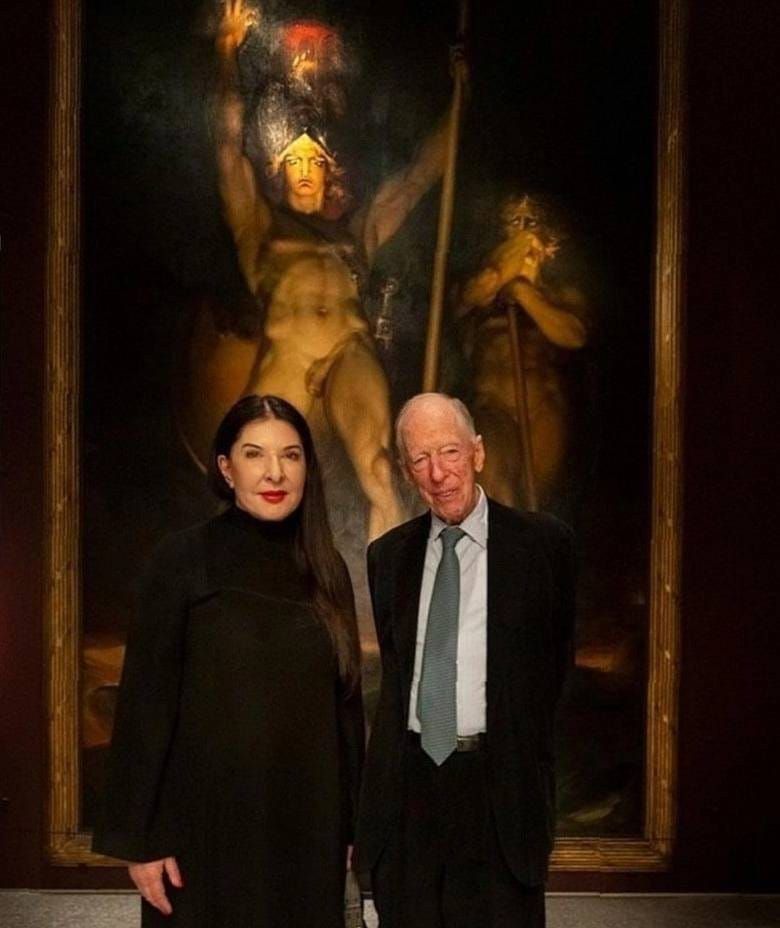
Marina Abramović and Sir Jacob Rothschild  standing in front of a painting titled "Satan Summoning his Legions" by Sir Thomas Lawrence, painted 1796 to 1797.
You've probably never met one. You've almost certainly never seen one on a Forbes list. That's entirely by design.

By Matt Stone

Every year, Forbes publishes its list of the world's wealthiest people. Elon Musk. Jeff Bezos. Mark Zuckerberg. The names are familiar. The numbers are staggering. And the list is, by any serious measure, wholly incomplete.

Two of the most consequential concentrations of wealth on earth do not appear on it. The Saudi royal family and the Rothschild dynasty are both absent, and they are absent for reasons that say more about the nature of real power than any number on any list ever could.

The House of Saud controls an estimated $1.4 trillion in wealth when state-directed assets are included. Crown Prince Mohammed bin Salman exercises de facto authority over the Public Investment Fund, which surpassed $1.15 trillion in assets by late 2025, and directs Saudi Aramco with a market cap of $1.6 trillion. None of that appears under his name in any major wealth ranking. Forbes and other publications explicitly exclude sovereign dynasties and heads of state by methodology. The Saudi royals are not on the list because Forbes decided they do not belong in the same category as private citizens. That exclusion means the people directing the flow of more capital than most national economies are effectively invisible to the ranking system most people use to understand global wealth.

The Rothschilds are absent for a different but equally revealing reason. A former Forbes researcher confirmed it on record: "We did research them years ago. We stopped when we decided to track individual billionaires, not families. And we couldn't pin one of the members down as an individual billionaire." That is the mechanism in plain language. The Rothschild family has dispersed its wealth across hundreds of descendants, distributed through private trusts, foundations, and offshore structures specifically designed so that no single member of the family clears the individual threshold Forbes requires. The fortune is not gone. It is structured to be invisible.

Two different mechanisms with the same result. Neither shows up. Both shape the world anyway, insulated by obscurity.

The Rothschild family is, by most measures, the longest-running financial dynasty in modern history. Over 250 years of accumulated power, starting from a Jewish ghetto in Frankfurt, Germany, and ending up with reach into the banking systems, governments, and backroom deals of virtually every major nation on earth. During the 19th century, the Rothschild family possessed the largest private fortune in the world, larger than any royal family, any government treasury, any competitor. Their visible wealth today runs into the billions. The full picture is something else entirely.

Their wealth is split across many descendants and branches, held privately in trusts, foundations, vineyards, hotels, art collections, and real estate, with businesses independently managed through complex ownership structures deliberately designed to frustrate outside scrutiny. Estimates on their combined net worth range from $1 billion in publicly confirmed holdings to over $400 billion across all branches, depending on who is counting and how much they can actually see. The gap between those two numbers is not an accident.

As author Paul Johnson wrote: "The Rothschilds are elusive. There is no book about them that is both revealing and accurate. Libraries of nonsense have been written about them. A woman who planned to write a book entitled Lies about the Rothschilds abandoned it, saying: 'It was relatively easy to spot the lies, but it proved impossible to find out the truth.'"

That elusiveness is the first thing to understand about them. The second is how they built it, and how they maintained it across two and a half centuries.

FROM A GHETTO TO GOVERNING EUROPE

Mayer Amschel Rothschild was born in 1744 in the Judengasse, the walled Jewish quarter of Frankfurt. He started as a coin and antique dealer, gained the attention of the local German prince as a financial manager, and used that royal relationship to build credibility with other European courts. By the time he died in 1812, he had dispatched each of his five sons to a different European financial capital: Amschel to Frankfurt, Salomon to Vienna, Nathan to London, Karl to Naples, and James to Paris.

This was the masterstroke. Not the money, the architecture.

Five sons, five cities, five banking houses, operating as a single coordinated entity under family control. They could move capital, intelligence, and political leverage across national borders faster than any government or competitor could react, because they had no borders. When a government in Vienna needed a loan to fund a military campaign, Salomon was already in the room. When the British treasury needed to transfer gold to pay Wellington's troops in Portugal and Spain, Nathan in London arranged it. When France needed to borrow after a military defeat, James in Paris handled the terms. The family did not compete in the market. For most of the 19th century, they were the market.

The British Chancellor of the Exchequer David Lloyd George claimed, in 1909, that Nathan, Lord Rothschild was the most powerful man in Britain. An 1836 American publication described the family as "the wonders of modern banking... peering above kings, rising higher than emperors, and holding a whole continent in the hollow of their hands." From 1895 through 1907 they loaned nearly $450 million to European governments, equivalent to $15.5 billion today. And that is just the portion they documented.

THE INFORMATION ADVANTAGE

Before they controlled money, they controlled something more valuable: information.

In an era before telegraphs, telephones, or organized postal infrastructure, news traveled at the speed of horses. A battle result could take days to reach a capital city. In that gap between an event and its public knowledge lay enormous financial opportunity.

The Rothschilds closed that gap for themselves and no one else.

They built a private pan-European courier network: trusted riders on fast horses, chartered boats, and, by the 1840s, trained carrier pigeons carrying coded messages between their five houses. The Rothschild family's own archive confirms they relied on a network of trusted couriers and certainly by the 1840s had taken to using pigeons to carry short and important messages between branches. Niall Ferguson, drawing on the family archive, documents that success in their bond trading operations "hinged on rapid communication." Governments came to rely on Rothschild intelligence. Metternich in Vienna and Wellington in London both regularly received political updates from Rothschild sources before their own diplomats could report.

This was not a side benefit. It was a foundational mechanism of power. If you know the outcome of a war before the stock exchange does, you know which government bonds to buy and which to sell. If you know a treaty is coming before it is announced, you know which currencies will strengthen. If you know a king is about to default before his creditors do, you can restructure your position in advance. The Rothschilds institutionalized this information edge across five cities simultaneously for decades.

In the 19th century, their pigeons were the Bloomberg Terminal of their time. The fucking pigeons had more power than most human beings on earth. They possessed the information to defeat armies and topple governments.

THE WAR BUSINESS: BOTH SIDES

If there was any question of the morals possessed by the Rothschilds, or lack thereof, it was put to bed long ago. During the Napoleonic Wars, the Rothschilds provided loans to the British government to fund the war effort, and also made loans to Napoleonic France and other European powers who were fighting the British. Nathan Mayer Rothschild in London coordinated massive subsidy transfers and provided the bullion to pay the Duke of Wellington's troops as they fought across Portugal and Spain, moving millions of pounds in gold and credit through hostile territories. At the same time, the Paris and Frankfurt houses maintained business relationships with governments on the other side of that conflict.

The Crimean War is where the pattern becomes documented and undeniable. During the Crimean War of 1853 to 1856, the Rothschilds lent £26 million to Britain while simultaneously lending to France and Turkey. Not two sides. Three. Historian Niall Ferguson, the first scholar given access to the family's own archive, found that between 1859 and 1870 they "found themselves repeatedly on both sides of decisive conflicts." His conclusion from the family's own papers: "Far from weakening the Rothschilds' position, the Crimean War had precisely the opposite effect in that it emphatically reasserted the Rothschild houses' primacy in the field of public finance." Millions of men died while billions found their way into the pockets of Rothschild family members.

The logic is simple and ruthless. The winner repays from strength. The loser repays from desperation. Either way, the house collects. The family did not need to pick the winning side. They just needed both sides to need them and their wealth.

The Boer War at the turn of the 20th century marked a watershed. It was the first major British conflict in which the government did not turn primarily to the Rothschilds, instead using direct market sales and the banks of J.P. Morgan and Barings. It was a major blow to what had been a virtual Rothschild monopoly on state finance. Their grip on war financing did not end because they chose to stop. It ended because the capital markets finally grew large enough to route around them.

If it Rhymes with War Crimes

The Rothschilds did not personally commit war crimes or crimes against humanity. That distinction is important and deserves to be stated clearly, but not with much conviction. They did not run concentration camps, command armies, or order massacres. What the documented record shows is something more structural and in some ways more sinister and troubling: a family that consistently enriched itself from the financial scaffolding surrounding events that, by modern international legal standards, constitute crimes against humanity. Again and again, the money trail runs directly to the edge of the atrocity, and the family walked away wealthier each time.

The Napoleonic Wars (1803 to 1815). The wars killed an estimated 3.5 million soldiers and an unknown number of civilians across Europe. The family emerged from the conflict with vastly expanded power and capital. The dead had no equivalent exit.

The Crimean War (1853 to 1856). The war killed approximately 95,000 French soldiers, over 21,000 British soldiers, and an estimated 450,000 Russians, the majority from disease and exposure in conditions that the financial machinery of the war sustained and prolonged. Ferguson's conclusion from the family archive: the war "emphatically reasserted the Rothschild houses' primacy in the field of public finance." Three sides. One banker. Half a million dead.

South Africa and the Rhodes operation (1880 to 1902). With funding from N.M. Rothschild and Sons, Cecil Rhodes systematically bought out and consolidated diamond mines. De Beers Consolidated Mines was launched in March 1888 financed by N.M. Rothschild and Sons, which became its largest shareholder. Nathaniel Rothschild was one of the main financiers of the Maxim gun company.

In the battle of Shangani River in 1893, 1,500 Matabele warriors were slaughtered while only four British troopers died. Rothschild money financed both the monopoly and the weapons used to clear the people standing between that monopoly and the ground it needed. The documented history connects the twenty-year financial partnership between Natty Rothschild and Cecil Rhodes, the Jameson Raid conspiracy, the engineered diplomatic crisis, and the concentration camps in which 27,000 Boer women and children died.

Cecil Rhodes put in place the necessary mechanisms to make apartheid possible. The Rothschild bank was one of the main recipients of the wealth extracted from conquered black Africans kept in deliberate underdevelopment and inequality. Leopold de Rothschild administered Rhodes's estate after his death in 1902 and helped set up the Rhodes Scholarship scheme at Oxford University.

King Leopold II and the Congo (1885 to 1908). No direct financial link between the Rothschilds and Leopold's Congo Free State has been documented. Leopold financed his operation primarily through Belgian government loans. The Rothschilds were not his bankers. But Cecil Rhodes was Leopold's direct competitor in southern and central Africa, operating the same colonial extraction model in adjacent territory with Rothschild capital behind him.

While Leopold was running a regime that included forced labour, torture, murder, kidnapping, and the amputation of the hands and feet of men, women, and children when rubber quotas were not met, with population decline estimates ranging from 1 million to 15 million people, the Rothschilds were financing the parallel operation next door, holding equity in the outcomes, and one of them was preparing to administer the estate. They were not Leopold's bankers but they were financing the same system, with the same logic, in the same region, at the same time.

The Rothschilds did not need to be present at the atrocity. They needed to be present at the financing. They needed to hold equity in the operation that the atrocity made possible. They needed to be available to lend to whichever side survived. And when the shooting stopped, they needed to be positioned to collect. That is not a theory. That is the documented structure of how the family operated across more than a century of conflict. The body count was someone else's problem. The balance sheet was always theirs.

CONTROLLING THE PRICE OF EVERYTHING

War financing was only one instrument. The Rothschilds built infrastructure-level control over the global economy across multiple parallel domains simultaneously.

Sovereign debt. By the 1820s the family had shifted from wartime operations to issuing foreign government bonds denominated in sterling on the London market, pioneering what became the modern sovereign debt market. A 19th-century state that wanted to wage war, build railways, or stabilize its currency had to access the Rothschild network. They were not a bank governments could choose. For decades, they were the only bank capable of operating at that scale across borders.

Railways. As the age of sovereign war finance gave way to the Industrial Revolution, the Rothschilds pivoted into what would become the defining infrastructure of the century. James de Rothschild in Paris secured the concession for the Chemin de Fer du Nord, the railway linking Paris to the Belgian border and the Channel ports, in 1845. The family financed major rail networks across France, Austria, and beyond, giving them influence over the physical arteries of European commerce and troop movement.

Mining and commodities. The family invested in mercury mines in Spain, gold, copper, diamond, and ruby extraction globally, and the bullion trade that flowed from them. They became one of the leading investors in mineral exploration and extraction worldwide.

The Suez Canal. In 1875, when Egypt's ruler needed to sell his shares in the Suez Canal Company urgently, British Prime Minister Disraeli wanted to buy them for Britain. Parliament was not in session. There was no mechanism to raise the funds quickly. Disraeli sent a message to Nathan Rothschild's son: "We have it. You have the power." The Rothschilds lent the British government four million pounds within 24 hours. Britain became the Canal's controlling shareholder. The Rothschilds earned 2.5 million pounds in interest and commission on a deal that reshaped global trade routes.

Gold. Until May 5, 2004, the price of gold was fixed twice a day at N.M. Rothschild and Sons in London by the world's main Bullion Houses: Deutsche Bank, HSBC, ScotiaMocatta, and Societe Generale. A Rothschild sat at the table that set the global price of the world's primary store of value for nearly two centuries. They stepped away from that seat in 2004, quietly, without explanation, without fanfare. Nobody asked why.

The Vatican. The Rothschilds managed assets for the Catholic Church. The family that started in a Frankfurt ghetto became the personal bankers of the Pope.

THE MECHANICS OF CONTROL

Wealth alone does not survive 250 years. The Rothschilds maintained their position through a set of deliberate structural mechanisms that most dynasties never figured out.

Coordinated family governance. Mayer Amschel Rothschild's will prohibited his daughters and their husbands from participating in the family business, keeping control within a tight male line. The five houses operated as a single entity under family coordination, sharing intelligence, splitting risk, and presenting unified positions to outside parties. When one house faced a crisis, the others supported it. No outside investor or creditor could pick them apart.

Diplomatic cultivation. The Rothschilds befriended writers, composers, politicians, and royalty across Europe, using cultural patronage as a tool of political access. Benjamin Disraeli was a close ally. Their children took piano lessons from Frederic Chopin. Queen Victoria's personal financial advisor was Sir Evelyn Robert de Rothschild, who she knighted in 1989 for his services to banking. The family held seats in Parliament and the House of Lords. They were not lobbying power from the outside. They were inside it.

Privatization of their own firm. In 2023, Alexandre de Rothschild took Rothschild and Co fully private in a 3.7 billion euro deal. The family's holding company, Rothschild and Co Concordia, now holds nearly all voting power. The 2023 buyout neutralized hedge fund campaigns and removed public proxy battles permanently. There are no more outside shareholders to demand transparency. The family-led board directs global advisory operations spanning over 400 major deals per year, with complete internal control and no public accountability.

CONTROLLING THE PRICE OF GOVERNMENTS: MODERN SOVEREIGN ADVISORY

The Rothschilds' modern form of control is less visible than war financing and more durable. They advise governments on how to restructure their economies. And when governments are in crisis, those governments have very little choice about who they call.

Rothschild and Co pioneered government privatization programs in the 1980s under Margaret Thatcher, spreading that model to more than 30 countries worldwide. When a government wants to sell a state asset, break up a national industry, or restructure sovereign debt, Rothschild is typically in the room advising on the terms.

In recent years their sovereign advisory business guided debt restructurings in Ukraine, Ghana, Sri Lanka, and the Bahamas. In Ghana, they helped secure a $13.1 billion sovereign bond restructuring aligned with IMF frameworks. In Sri Lanka, they introduced a novel financial structure that broke a two-year impasse. They advised Cyprus, Greece, Ireland, and Portugal during the eurozone crisis. They advised on the $8.7 billion restructuring of Americanas in Brazil. Euromoney named them the world's best bank for independent advisory in 2025.

The word "independent" in that sentence is doing a lot of work. When a country in financial crisis hires a Rothschild to advise on its debt restructuring, Rothschild is negotiating with the same class of bondholders and financial institutions it has cultivated relationships with for two centuries. They are not a neutral party. They are a central node in the system. The country in crisis is not hiring an outside consultant. It is entering the Rothschild network.

In recent years Rothschild and Co has advised on nearly a thousand completed mergers and acquisitions with a combined value exceeding one trillion dollars. Their financial advisory division serves the British royal family. They operate in 50 countries with 4,800 staff.

THE SHIELD: HIDING BEHIND LEGITIMATE PAIN

This section requires precision, because it cuts both ways.

The Rothschild family was subjected to genuine antisemitic attacks throughout their history. In the mid-19th century, a French pamphleteer published fabricated claims that Nathan Rothschild had profited from advance knowledge of the Battle of Waterloo, a story entirely invented and published 30 years after the battle and 10 years after Nathan's death. The story went viral across Europe. Institutions as respectable as Encyclopaedia Britannica repeated it as fact. That was real antisemitism, built on fiction, and it caused genuine damage.

But here is what else happened. After that pamphlet went viral, a massive industry of Rothschild criticism emerged, some of it fabricated, some of it not. The effect of bundling the invented material with the documented record was that any scrutiny of the family's actual financial operations became easy to dismiss under the same umbrella. Critics who raised legitimate questions about documented war financing, sovereign debt operations, and gold price control found themselves having to defend their motives before they could present the evidence.

The genuine antisemitism was real. It was also extraordinarily convenient. The documented financial record deserved scrutiny it largely did not get, not because the questions were bigoted, but because the framing made asking them costly. The family benefited from that dynamic for over 150 years. Whether they engineered it or simply inherited it, the result was the same: the most powerful banking dynasty in modern history operated with less public accountability than a mid-sized corporation.

EPSTEIN: RUNNING THE BANK; PAYING THE DEVELOPERS

The CEO of the Edmond de Rothschild Group, one of Switzerland's ten largest private banks managing $250 billion in assets, was receiving numbered strategic directives from Jeffrey Epstein on how to run her institution. Not suggestions. Numbered action items.

This section does not require speculation. It requires reading the documents the U.S. Department of Justice released in early 2026.

Ariane de Rothschild, head of the family-owned Edmond de Rothschild Swiss private bank, oversees 184 billion Swiss francs in assets. She corresponded dozens of times with Jeffrey Epstein and agreed to multiple meetings over about five years before his 2019 arrest, according to DOJ files.

The DOJ files show that Ariane de Rothschild visited Epstein's private island in the Caribbean. In November 2014, she brought three of her teenage daughters with her. Epstein's island where he systematically abused underage girls.

A 2015 document shows Epstein's firm received a $25 million payment from the Rothschild Group, covering risk analysis and algorithm-related services, tied to a Rothschild settlement with the U.S. Department of Justice.

In March 2014, Epstein wrote to de Rothschild about the situation unfolding in Ukraine: "Ukraine upheaval should provide many opportunities, many." It reads like a man who has seen this movie before. A family that spent two centuries turning military and political crises into profit was receiving that note and continuing the conversation.

In a 2016 exchange, de Rothschild told Epstein she was sick with the flu. Epstein invited her to stay at his apartment, writing: "it would be private. no one the wiser."

The DOJ documents do not contain confirmed evidence of criminal wrongdoing. What they do contain is a sustained, personal, financially entangled relationship between a Rothschild bank CEO and a convicted sex trafficker, along with the documented fact that she brought her own daughters to his island.

The family's response to the fallout was characteristically dynastic. When the Epstein emails became public, Alexandre de Rothschild, owner of the rival Rothschild and Co. branch, instructed his relationship managers to tell concerned clients: "Not us. The other ones."

Two centuries of building the most powerful banking dynasty in history, and when the walls close in, the move is to point at your own family.

A December 2015 email shows Epstein sending Ariane de Rothschild a seven-point directive covering DOJ settlement strategy, personnel decisions, regulatory pressure tactics, and board succession planning. She responded: "deep thks for your amazing help."

A separate July 2015 email from Epstein outlines a comprehensive restructuring plan covering IT, HR, asset management, and board composition. He was advising on whether she should move from CEO to chairman while an interim group CEO was installed. He was managing the bank's relationship with Swiss financial regulators.

The bank's board did not know this was happening. Epstein held no formal position, no disclosed role, no contractual relationship beyond the $25 million consulting fee, and no public accountability. A convicted sex trafficker was the shadow strategist of a quarter-trillion-dollar Rothschild bank.

At the same time, that same man's money was flowing through MIT's Digital Currency Initiative directly into the salaries of the three people who controlled Bitcoin's core code.

When the Bitcoin Foundation collapsed and filed for bankruptcy in 2015, it left Bitcoin's most critical developers without funding. MIT's Media Lab director Joi Ito moved quickly to fill the vacuum, launching the Digital Currency Initiative and recruiting those developers to MIT. He confirmed the operation to Epstein in writing: "Used gift funds to underwrite this which allowed us to move quickly and win this round. Thanks." Those gift funds came from Epstein. The donations were deliberately marked anonymous to conceal their origin from MIT's own administration and from the developers themselves.

The three developers whose salaries were paid through this arrangement were not peripheral contributors. Gavin Andresen was the man Satoshi Nakamoto personally handed the Bitcoin source code to when he disappeared. He was Bitcoin's lead maintainer, its Chief Scientist, the closest thing the protocol had to a guardian.

Wladimir van der Laan was Bitcoin Core's Lead Maintainer, the person with final authority over what changes were accepted into the code.

Cory Fields controlled Bitcoin's build systems and deployment infrastructure, the machinery that determined how the code reached the world. Epstein had attempted to contact Andresen directly as early as 2011, within months of Andresen taking over from Satoshi. He also invested $3 million in Coinbase at a $400 million valuation, $500,000 in Blockstream through a fund he co-owned with Ito, and invited Blockstream's co-founder Adam Back to his private island.

It doesn’t require Sherlock Holmes to see that there’s an oddity about the situation.

The man directing strategy at a $250 billion Rothschild bank, the same family that has controlled the world's finances for centuries, was simultaneously paying the salaries of the three people who controlled the code of the currency specifically designed to make Rothschild-style central banking obsolete. Bitcoin was built on the ideological premise that money could exist outside the control of institutions like the Rothschilds. Stateless. Trustless. No gatekeepers or bankers. And the man who was essentially running a Rothschild bank was paying the people who decided what Bitcoin was and what it would become.

The developers allegedly did not know where the money came from. There is no known evidence of code manipulation or backdoors. Those facts belong on the record and they are important to state clearly.

What also belongs on the record is this: the supposedly ungovernable alternative to the old financial order had its most critical developmental window funded by a man who was, at that same moment, sending seven-point action plans to the CEO of a Rothschild bank and signing a $25 million consulting contract with her institution.

That is not my theory. That is what the documents say. Conflict-of-interest is somehow too small of a term to describe this scheme. This is a conflict of interest on a cosmic scale.

AI: THE NEXT TABLE

There is no documented evidence that the Rothschild family owns or controls any major AI company. No stake in OpenAI. No stake in Anthropic, Google DeepMind, or xAI. The major investors in frontier AI are Microsoft, Amazon, Google, Nvidia, and SoftBank.

But control has never been the Rothschild’s modus operandi. Proximity has. Advisory has. Being the family that governments and institutions call when they need to understand what to do next.

Rothschild and Co already actively track and advise on every major AI venture capital deal globally. Their published Deals Monitor covers US venture capital raises of $100 million or more, and AI has dominated that landscape for two years running, accounting for 57% of total US growth equity proceeds in 2025 alone. They are in the room as advisors and analysts on the deals that are building the infrastructure of the next century.

The family also holds a 26% stake in The Economist Group, one of the most influential publications shaping how global elites think about AI policy, regulation, and power.

In the 19th century, the Rothschilds did not need to own the railroads to profit from them. They financed them, advised on them, and sat between the governments granting concessions and the investors providing capital.

In the 20th century they did not need to own national industries. They advised governments on how to privatize them and structured the deals that transferred those assets.

In the 21st century they do not need to own AI companies. They are positioned as the advisory layer between governments trying to understand and regulate AI, and the financial markets pouring capital into it.

The family that spent 200 years controlling the price of gold, financing the winning and losing sides of European wars, and sitting at every major financial table is now positioned around the most consequential technology in human history. Not owning it. Not controlling it. Just very, very close. They have always preferred it that way.

VERDICT

The Rothschild dynasty did not get to where it is through myth. It got there through competence, coordination, secrecy, and a consistent willingness to be on every side of every table simultaneously, while ensuring that scrutiny of that fact came pre-labeled as prejudice.

The wars were real. The lending to multiple sides is documented in the family's own archive. The information network was real and confirmed by the Rothschild Archive itself. The sovereign debt monopoly was real. The gold fixing happened for nearly two centuries in plain sight. The privatization advisory reach spans 30 countries. The Epstein connection is in the federal record. The AI adjacency is in their own published materials.

The picture at the top of the article is real. The painting of Satan calling his legions is real. The fact that they decided to take that photo in front of that painting could just be an aesthetic choice. But if it is, it's a fucking weird one.

The most remarkable thing about the Rothschilds is not the mythology written about them or the difficulty in finding factual information. It is that the documented reality is already this extraordinary, and most people have never heard of them at all.

Sources: Niall Ferguson, The House of Rothschild, Vol. 1 and 2 (1998, 1999); The Rothschild Archive (rothschildarchive.org); U.S. Department of Justice Epstein file release (February 2026); Reuters, U.S. News, IBTimes UK coverage of DOJ files; Rothschild and Co Growth Equity Updates (2025, 2026); Euromoney Awards for Excellence 2025; Rothschild and Co Sovereign Advisory page; House of Saud wealth analysis (houseofsaud.com, 2026); Wikipedia; Britannica; Market Histories; Springer Nature academic review; Quora (former Forbes researcher on record).