6 min read

Antarctica Ate a Submarine

Antarctica Ate a Submarine
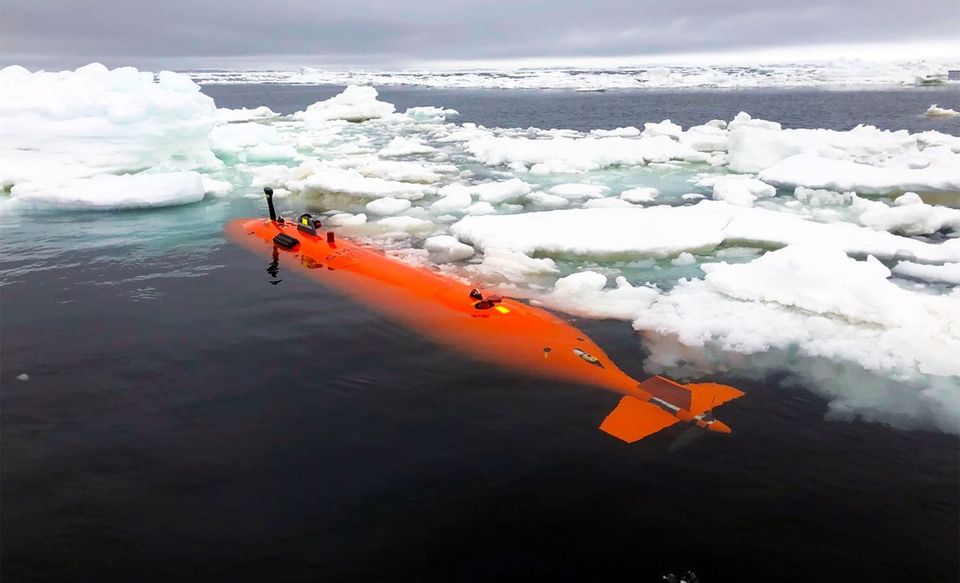
Sweden’s Hugin AUV ‘Ran’. Image credit Filip Sted (Gothenburg University). RAN specialises in high-quality bathymetric mapping.
An unmanned submarine mapping West Antarctica’s Dotson Ice Shelf reported strange under-ice structures, then went silent after traveling underwater roughly ten miles towards the ice shelf’s center.

By Matt Stone

We sent a robot submarine under the Dotson Ice Shelf in Antarctica to poke around in the dark and see what the planet has been hiding. The submarine was called Ran, which already sounds like it never planned on coming back. It spent 27 days under the ice, traveled over 1,000 kilometers, and made it about 17 kilometers into the cavity beneath the shelf, mapping terrain no human being had ever seen directly.

Then, on a later expedition in January 2024, after a string of successful voyages under Antarctic ice, including earlier work beneath Thwaites Glacier, Ran vanished without a trace.[1] No debris. No signal. No dramatic final message. Antarctica just took the thing and said "Finders Keepers."

Anna Wåhlin, the professor leading the project, described it as searching for a needle in a haystack without even knowing where the haystack is. By that point, Ran’s batteries were dead. The team could only conclude that something unexpected happened under the ice, the vehicle ran into trouble, and that whatever happened prevented it from getting back out. She also made clear that this was not the fault of the ship or crew. In fact, quite the opposite, she said the Araon was the best icebreaker Ran had ever worked from.[2]

Before it disappeared, though, Ran did something extraordinary. It returned the first detailed maps of the underside of the Dotson Ice Shelf. What it found was not some smooth, frozen ceiling quietly minding its own business. It found a wrecked and sculpted underworld of plateaus, valleys, channels, dune-like formations, terraces, and giant teardrop-shaped pits. The bottom of the ice shelf looks less like a clean slab of ice and more like nature has been experimenting with heat and current in a very strange way, for longer than we can imagine.

Climate change is not just about hotter summers, sweaty politicians pretending there's nothing to see here, or every third idiot online pretending snow in April disproves physics. In West Antarctica, one of the big stories is ocean-driven melt. Warm, salty Circumpolar Deep Water pushes onto the continental shelf and gets under floating ice shelves like Dotson.

The ice melts from below, which is a serious problem because ice shelves are not just decorative frozen overhangs. They help brace the glaciers behind them. If the shelf thins and weakens, then cracks, the land ice upstream can move faster into the ocean. Sea levels would likely rise enough to make even the hardest climate skeptics pay attention.

Ran’s maps showed that this melting is not happening in one neat, evenly distributed way that makes modelers feel warm and fuzzy. The western side of Dotson is melting faster because strong underwater currents are chewing at its base more aggressively. The eastern side is subject to different forces.[3]

The underside shows stranger, more layered structures that suggest a more complex history of melt and water flow. Researchers were blunt about the implication: many earlier assumptions about how glacier undersides melt are too simple, and current models cannot fully explain the patterns they found.

The lost submarine is the sexy headline. The real story is that one of the most important ice systems on Earth appears to be more complicated and less predictable than the simplified version we were working with. The science was not weak, but it did get better by entering the actual murder scene instead of playing guessing games from the porch.

The team also found evidence of very high melt at vertical fractures running through the glacier. Cracks are not just signs of weakness. They can become pathways that focus water and heat into exactly the places you do not want either. It is not just broad melting from below. It is targeted damage along structural vulnerabilities, which is the sort of detail that tends to make future sea-level projections less fun, at least for the ones actually conducting the research.

There will still be those who scoff at the idea of climate change and refuse to change their mind in the presence of new information. Those people will always exist. But so will the ones who do the work.

People hear “global warming” and picture air temperature like the whole crisis is one giant thermostat on the wall. But in parts of Antarctica, the real danger is heat moving through water into places most people will never see. The atmosphere starts the argument. The ocean takes it outside and handles business.

NASA says Antarctica is already losing roughly 135 to 150 billion tons per year, depending on dataset and summary period, which is a polite scientific way of saying the continent is bleeding out in slow motion.[4]

Dotson sits in the Amundsen Sea, where ocean-driven melting of floating ice shelves is the main process controlling Antarctica’s contribution to sea-level rise. The danger is real. It is already doing the work.[5]

One 2023 study found the region is likely locked into ocean warming at roughly triple the historical rate this century, which is the kind of sentence that would have been too ridiculous for science fiction twenty years ago.[6]

Together, Greenland and Antarctica hold more than 99% of Earth’s freshwater ice. If they fully melted, sea level would rise about 67.4 meters, or 223 feet.[7]  While 223 feet would be a very long-term, worst case scenario, a sea level rise of only 6 inches is enough to cause problems around the world.

It makes high-tide flooding more common, worsens storm surge, pushes saltwater into drains and groundwater, and turns what used to be a bad coastal storm into a much nastier one. NOAA has repeatedly shown that small increases in baseline sea level sharply increase nuisance flooding frequency.[8]

Around 1 to 2 feet is where the damage becomes impossible to treat as occasional inconvenience. Roads, septic systems, coastal property, drinking water sources, wetlands, and low infrastructure begin failing. FEMA and other climate assessments treat this range as enough to seriously raise flood risk for many U.S. coastal communities.[9]

Around 3 feet is where many coastal cities and military bases begin to really suffer. You are looking at chronic flooding, retreat from some areas, expensive seawalls, insurance collapse in vulnerable zones, and repeated disruption to ports and transport.[10] This still counts as everyone’s problem.

The big climate lesson is that Antarctica is not just melting from warm air above. In places like this, the ocean gets underneath the ice and starts eating the foundation first. That framing is supported by current research on ocean-driven melt in the Amundsen Sea.

This is not really a story about a submarine disappearing under Antarctic ice, though that absolutely did happen and it obviously had to be a headline. It is a story about a robot going under one of the planet’s most fragile ice shelves, finding evidence that the melt is more violent, uneven, and structurally dangerous than we thought, and then being devoured by the same environment it was trying to explain.

We sent a machine into the dark to learn how fast the world is breaking. It came back with proof that the problem is worse and stranger than our clean diagrams and spreadsheets suggested. To top it off, the ice kept the machine and told us to go fuck ourselves.

Antarctica is not subtle. She is dark, cold, and frankly, fucking terrifying. And she likely holds many secrets that humans will never know. Or that we may never even want to know.

Sources

[1] University of Gothenburg, “Underwater Vehicle Gone Missing Under a Glacier,” Jan. 31, 2024.

[2] Anna Wåhlin et al., “Swirls and Scoops: Ice-Base Melt Revealed by Multibeam Imagery of an Antarctic Ice Shelf,” Science Advances (2024).

[3] British Antarctic Survey, “Mysterious Patterns Revealed on Ice Shelf Bottom,” Aug. 2, 2024.

[4] NASA, “Ice Sheets – Earth Indicator,” and NASA/US interagency Global Sea Level Change: Antarctic Ice Sheet.

[5] Kaitlin A. Naughten, Paul R. Holland, and Jan De Rydt, “Unavoidable Future Increase in West Antarctic Ice-Shelf Melting Over the Twenty-First Century,” Nature Climate Change 13 (2023): 1222–1228.

[6] National Snow and Ice Data Center, “Ice Sheets Today.” April 14, 2026

[7] NOAA, “Annual High Tide Flooding Outlook,” April 14, 2026

[8] NOAA Digital Coast, “Sea Level Rise and Coastal Flooding Impacts.” April 14, 2026

[9] Congressional Research Service, Military Installations and Sea-Level Rise (July 26, 2019).

[10] NOAA, “High Tide Flooding,” and NOAA Digital Coast, “Sea Level Rise and Coastal Flooding Impacts.” April 14, 2026