
The Inheritance of War
How Satellites, AI, and Invisible Infrastructure Bring War Home.
By Matt Stone
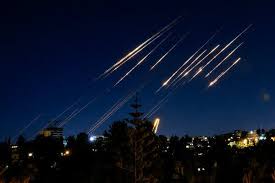
It did not begin with a slow march or some old-fashioned ground invasion. It began the way modern war begins now, at the speed of systems. Reuters reported that U.S. Cyber Command and U.S. Space Command were effectively out front, hitting Iranian communications and military visibility before the broader strike package fully unfolded. That matters because the first blow was not just about destruction. It was about perception. It was about blinding Iran’s ability to see, talk, coordinate, and respond before the rest of the violence arrived.
That is where the Space Force layer stops sounding like a bad pitch from a defense contractor with a Marvel addiction and starts sounding deadly serious. Its core functions are missile warning, satellite communications, and positioning, navigation, and timing. In plain English, that means detecting launches fast, keeping forces connected under pressure, and letting American operations move with terrifying precision and tempo. Reuters described more than 1,000 targets hit in the first twenty-four hours. That is not a slow buildup. That is paralysis by speed. Command networks, launch infrastructure, and military responsiveness were hammered almost immediately, and that kind of tempo only makes sense when satellites are feeding warning, navigation, and communications into a tightly integrated strike system.
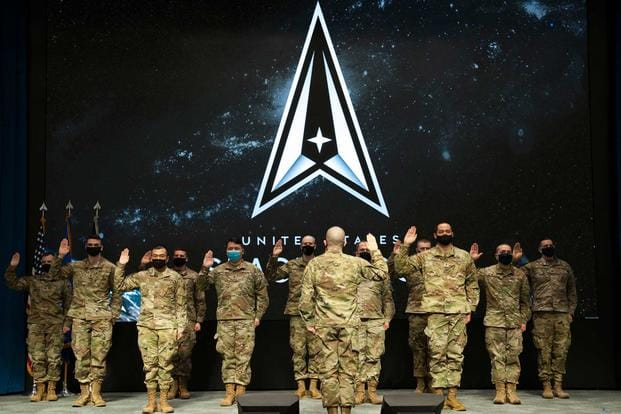
The United States Space Force is not really about fighting in space. It is about controlling the conditions of war on Earth. It provides the sensing, timing, and connectivity that let modern military power move faster than older ideas of war can even describe. In a conflict like this, missile launches can be detected within seconds, forces across the region can stay linked even when disruption starts, and precision targeting can still function inside chaos. Space-based navigation keeps aircraft, drones, and naval forces synced up. Satellite communications keep command from fragmenting. Overhead surveillance compresses the time between movement and detection, and once AI-assisted analysis gets layered on top, observation turns into prioritization at a speed human beings alone struggle to match.
That is the deeper shift. The United States does not have to drag massive forces across borders first to create overwhelming pressure. The architecture itself moves. The system sees, sorts, flags, prioritizes, and feeds targets into action faster than an adversary can recover. That is what modern dominance looks like now. Not just more firepower, but faster perception.
Then the campaign widened. Less than three weeks in, South Pars was hit. That is not some random facility. It is the backbone of Iran’s gas supply, which means the war moved from disrupting military coordination to hitting the infrastructure that keeps the state alive. First the system was blinded. Then the foundation got kicked.
The strike was reportedly carried out by Israel rather than the United States, though the broader campaign logic remained aligned. What matters is what the target represented. Up to that point, the focus had been on command structures, missile systems, and military coordination. South Pars marked a shift from limiting Iran’s ability to fight to weakening its ability to function. That is a different kind of message.
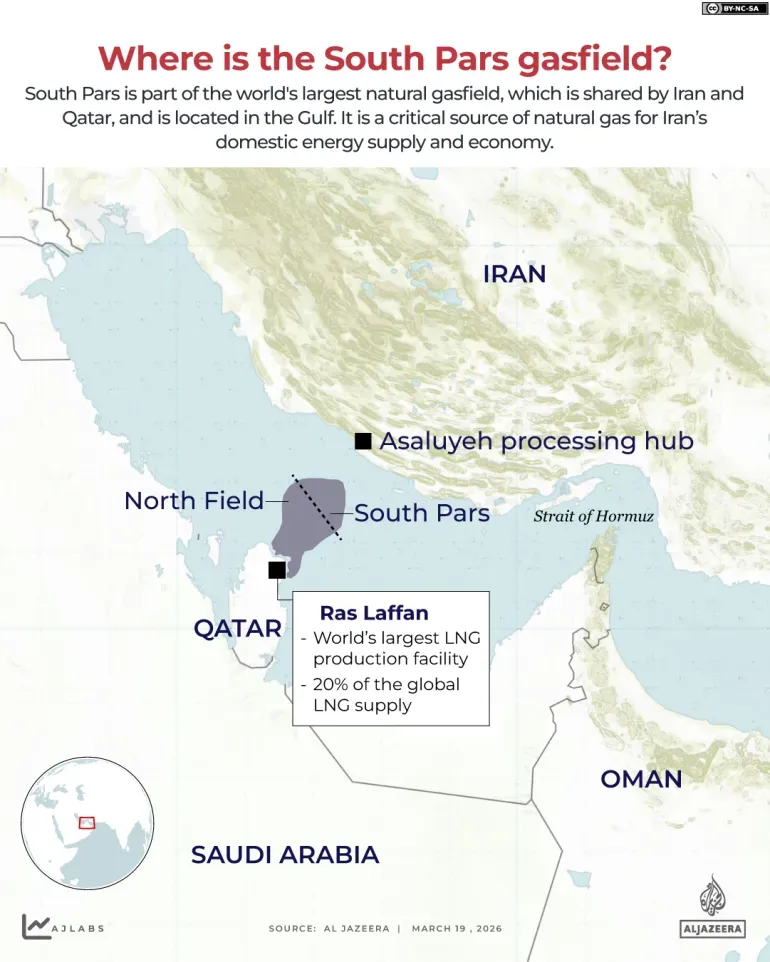
And that is the part people should sit with. Within weeks, the campaign had already moved from disorienting the system to striking the system’s foundation and central nervous system. That does not happen by accident. It happens in a battlespace shaped by constant surveillance, rapid data processing, and shrinking decision timelines. Satellites identify infrastructure. AI helps decide what matters most. Once priorities are set, the jump from military targets to economic lifelines can happen very fast.
Most Americans still picture a war with Iran using old imagery. Fighter jets over the Gulf. Warships cutting through dark water. Missile batteries lighting up the night. Oil fields burning in the distance. Steel, fire, and men in command rooms making grim decisions. What they do not picture is the invisible architecture above it all, quietly deciding what can be seen, what can be tracked, what can be targeted, and how fast consequence arrives. They do not picture the satellites. They do not picture the data. And they definitely do not picture artificial intelligence turning all that raw information into recommendations, priorities, and pressure before a human being has had much time to think.
That is the real transformation. The battlefield over Iran is no longer just physical terrain. It is orbital, digital, and increasingly algorithmic. This is not some cartoon fantasy about lasers in space. It is more serious than that because it is real, it is already here, and most people still do not understand that it has become part of the operating system of modern conflict.
American satellites are not decorations floating overhead. They are the nervous system of U.S. military power. They detect missile launches, carry communications, provide the navigation that guides ships, aircraft, drones, and precision weapons, and help commanders track movement across vast distances. They help establish what is happening before the public knows there is even a crisis. Modern force depends on this layer so completely that most people only notice it when they imagine the chaos that would follow without it.
Without satellites, the American war machine becomes slower, clumsier, and a lot more vulnerable. Navigation degrades. Communications get shakier. Missile warning worsens. Precision starts to slip. The most technologically advanced military on Earth starts feeling less omniscient and a lot more human, which is a polite way of saying it starts looking like the rest of us when the Wi-Fi dies. That is why Iran does not need to defeat the United States in some neat conventional sense to create real danger. It only needs to disrupt enough of the hidden systems America relies on to preserve its edge.
Iran has spent years learning how to fight inside that gap. It cannot match American reach head-on, so it tries to make the battlefield dirtier, noisier, and harder to interpret. GPS jamming, spoofed signals, dispersed launchers, decoys, buried infrastructure, movement timed to exploit surveillance gaps, all of that is part of the logic. Iran does not need to erase every American advantage. It only needs to interfere with enough of the invisible machinery to create uncertainty, hesitation, and partial blindness. That is where things get especially dangerous, because modern war is no longer just about who has the most firepower. It is about who can still trust their perception of reality when the system starts shaking.
And now AI is entering that picture, not as some distant possibility but as a practical response to overload. The United States collects more surveillance, sensor, and signal data than human analysts can comfortably absorb at the speed conflict now demands. Satellites generate oceans of information. Human beings still matter, but more and more they are being placed at the far end of a pipeline that has already been filtered, sorted, and prioritized by machines.
That is where AI changes the character of conflict. It does not need to become some rogue superintelligence to make the battlefield more dangerous. It only needs to accelerate classification and shrink the interval between detection and action. It can scan imagery faster than teams of analysts. It can flag unusual movement, identify recurring signatures, compare patterns across time, and elevate certain threats for immediate attention. What used to take longer takes less time. What once passed through more human interpretation now passes through less. The pace tightens. The window narrows. The pressure builds.
That should bother people. AI is not just making war smarter. It is making war faster. That sounds efficient right up until you ask what gets squeezed out when judgment and consequence start collapsing into each other. In slower systems, there is at least some room for doubt, disagreement, reinterpretation, hesitation. In faster systems, ambiguity starts to feel intolerable. The machine flags something. The system classifies it. The alert moves up the chain. The clock starts ticking. Action begins to feel less like a choice and more like an obligation imposed by tempo.
In a conflict with Iran, that compression matters a lot. This is already a region saturated with proxies, historical trauma, mistrust, and escalation ladders that are much easier to climb than descend. Add AI-assisted surveillance and targeting to that environment and you get a situation where signals are processed faster, anomalies are elevated faster, and retaliatory logic hardens before diplomacy has time to breathe. Nobody has to intend catastrophe for the structure itself to become more dangerous. Speed does that. It is one of the few growth industries in America that never seems to hit a recession.
Iran understands this too, which is why deception becomes even more valuable in an AI-mediated battlespace. If American systems are using machine learning to detect patterns, Iran has every incentive to poison those patterns. Decoys matter more. Erratic movement matters more. Spoofed signals matter more. Hidden infrastructure matters more. Ambiguity itself becomes a weapon. One side tries to see clearly. The other side tries to make clarity impossible. One side builds systems to accelerate certainty. The other side learns how to break the conditions certainty depends on.
That is why the war above Iran matters. It is not some exotic sideshow detached from the missiles, ships, and headlines. It is the layer shaping how all those things are perceived and acted on. Space systems provide the eyes, the timing, the links, and the warning. AI increasingly helps interpret what those eyes are seeing and what deserves attention first. Together they create a battlespace where information becomes a weapon and speed becomes a form of pressure.
But there is another lie sitting underneath all this. The old lie is that war, ugly as it is, drags civilization forward. That without catastrophe we would stagnate. That the blood, the debt, the rubble, and the dead children somehow arrive packaged with innovation, national purpose, and technological advance. It is one of the slickest propaganda lines ever sold to the public because it launders profit through sacrifice. It takes political favoritism, emergency contracting, captured institutions, and limitless public spending and recasts them as destiny. A nation can apparently set itself on fire as long as a consultant somewhere calls it innovation.
What people call the progress of war is usually something darker and more pathetic. It is not proof that destruction is necessary. It is proof that in peacetime the powerful refuse to mobilize money and coordination unless they are cornered, and that once they are cornered, the people best positioned to benefit are usually the ones already closest to the state. The miracle is not war. The miracle is how often organized theft gets rebranded as national strength.
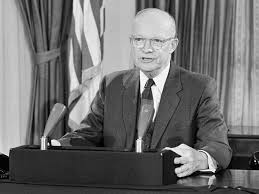
Eisenhower warned the country about this more than sixty years ago. He did not do it as a pacifist or an outsider. He did it as a five-star general who understood exactly what war required and exactly what it could become. What he warned was simple. The United States had created a permanent military-industrial complex, an alliance of armed force, private industry, and political power that would not simply dissolve when war ended. Once the machinery existed, it would grow constituencies. Factories would employ voters. Contracts would enrich corporations. Bases would anchor local economies. Politicians would learn to depend on defense spending. War would stop being an emergency. It would become an industry.
That warning matters here because the machinery did not disappear. It evolved. It got sleeker, more digitized, more polite, and somehow even more ravenous. The old version gave us tanks, missiles, and aircraft. The new version gives us cloud infrastructure, data systems, semiconductors, energy-hungry computing, and artificial intelligence. What we are watching now is not merely an expanded military-industrial complex. It is the emergence of an AI-military-corporate complex.
If you want to understand the modern version, stop looking only at missiles and maps. Look at the commercial architecture that blooms around crisis. Fighting involving Iran drives up tanker rates, pushes shipowners to take extraordinary risks through the Strait of Hormuz, triggers emergency insurance mechanisms, and produces new surcharges in maritime freight. The choke point is military, but the system feeding off it is financial, logistical, and corporate. When an artery like Hormuz is threatened, the scramble is not just strategic. It is commercial. Somebody is always standing nearby with a spreadsheet and a patriotic expression.
The same pattern is spreading well beyond one conflict. Critical infrastructure, resilience, artificial intelligence, autonomous systems, and technological innovation are all now being openly framed as central to future military capability. Pentagon priorities reflect the same logic. This is not just rearmament. It is the merger of war finance, industrial policy, and technological acceleration under the banner of emergency.
The comforting myth is that this machinery exists because the world is dangerous. The more uncomfortable possibility is that the machinery itself develops a hunger. Not in the cartoon sense where a few men in cigar smoke script every conflict by hand, but in the more ordinary and believable sense that institutions built around war budgets, emergency authority, strategic scarcity, and permanent threat inflation begin to need crisis the way a furnace needs fuel. Contractors need contracts. Insurers need volatility. Politicians need fear. Tech firms need state demand. Bureaucracies need missions. Once enough careers and balance sheets depend on permanent tension, peace stops being the natural goal. It becomes an interruption.
During the Cold War, the defense industry built machines. Today the most important strategic resource is not steel. It is computation. Artificial intelligence systems require advanced semiconductors, data centers, water, electricity, specialized chips, and cloud infrastructure. Those are not side details. They are the backbone of the new order. They are becoming as geopolitically important as oil fields once were.
That is why companies that once looked like ordinary tech firms are now increasingly intertwined with national security systems. AI is being integrated into intelligence analysis, targeting, logistics, drone warfare, cyber operations, and automated decision-making. Governments pour billions into these technologies not only for military advantage, but because whoever controls AI infrastructure will shape the next phase of economic and political power. The incentives line up accordingly. Tech companies get contracts and privileged access to state resources. Governments get new tools for surveillance, prediction, and war. Defense institutions get the ability to operate faster and with less friction than ever before.
The old system built weapons. The new one is building the operating system of power itself.
One of the clearest ways to see who benefits from war is to look at who actually fights it. Throughout modern history, the pattern has been almost embarrassingly consistent. The political and economic class that authorizes war almost never bears its physical risk. During Vietnam, elite students found deferments while working-class Americans were drafted and sent overseas. Sacrifice was never distributed evenly. It was distributed downward.
That pattern never disappeared. It just learned how to dress better.
In the United States, war is still wrapped in the language of shared duty, but in practice it functions like a class arrangement. Policy is made at the top. Money moves upward. Dying is pushed downward into the same military families, working-class towns, and economically cornered communities that have been feeding the machine for generations. That distance makes war easier to sell, easier to sustain, and easier to mythologize. When the sons of power are insulated from the consequences, sacrifice becomes something to praise in public and avoid in private. Everybody loves valor when it belongs to somebody else’s kid.
The myth is that war forces civilization forward. The uglier truth is that war creates conditions where enormous amounts of public money move quickly through systems with very little oversight. In those moments, politically connected industries flourish. What gets called wartime innovation is often just the byproduct of unlimited budgets and suspended restraint.
The deeper question is not whether war accelerates technology. Of course it does. The deeper question is why our societies seem unable to mobilize intelligence, capital, and collective effort on that scale unless the justification involves destruction. Fear remains the great accelerant because it reaches into the oldest survival machinery we have. If the only time civilization can move this quickly is when the engines are fueled by secrecy, profit, and manipulated fear, then war is not the engine of progress. It is the smoke rising from the engine.
And the engine itself is a form of capitalism so entangled with the state, so insulated from consequence, and so addicted to emergency that it can turn fear into procurement, procurement into policy, and policy into profit before the public has even figured out what story it is being sold.
That is the truth Americans need to understand. If conflict with Iran expands, it will not just be fought in deserts, seas, and skies. It will be fought in orbital infrastructure, navigation systems, sensor networks, commercial shipping corridors, insurance markets, cyber systems, and the algorithmic architectures that sort threat from noise. The old image of war as men and machines colliding in physical space is no longer enough.
The new version lands closer to home. Gas prices lurch. Banking networks slow. Infrastructure gets probed through digital weak points built for efficiency instead of resilience. Power outages show up rude and uninvited. Shipping gets disrupted. Insurance spikes. Social media fills with panic before facts have even put their pants on. That is what modern escalation looks like. Not one cinematic moment, but a cascade across systems people were dumb enough to think were stable.
The battlefield now stretches through supply chains, data centers, financial rails, cloud infrastructure, and the electrical grid. Satellites help determine what is seen. AI helps determine what matters. Cyber operations probe for leverage. Markets smell opportunity before bodies are even counted. The consequences do not stay overseas. They show up in ordinary civilian life.
The quiet war above Iran is not quiet because it is small. It is quiet because most people still do not know where to look. Above the headlines, above the spectacle, above the official language, there is an invisible contest underway over who controls perception, who controls timing, and who gets to define reality first. Wrapped around that contest is an economic order ready to profit from every spike in fear, every emergency contract, every insurance panic, every fresh excuse for faster systems and bigger budgets.
Satellites built that world. Artificial intelligence is making it move faster. Money is circling above it all like a vulture told to call itself innovation. Once a system like that becomes normal, war stops feeling like a series of decisions and starts feeling like a sequence human beings are scrambling to keep up with while somebody, somewhere, is already sending the invoice.
The lie is that war moves civilization forward. The reality is that it moves money upward. The bombs fall downward. The contracts float upward. And somewhere in between, the public is told this is the price of progress.
If war really were the engine of human advancement, the richest and safest people in society would be the ones fighting it.
They never are.
Member discussion