Cutting Trees to “Create Water”: When Political Folklore Masquerades as Hydrology
By Matt Stone
There is a recurring confidence in American politics that treats ecosystems like plumbing diagrams. It assumes nature can be optimized with a chainsaw and a talking point.
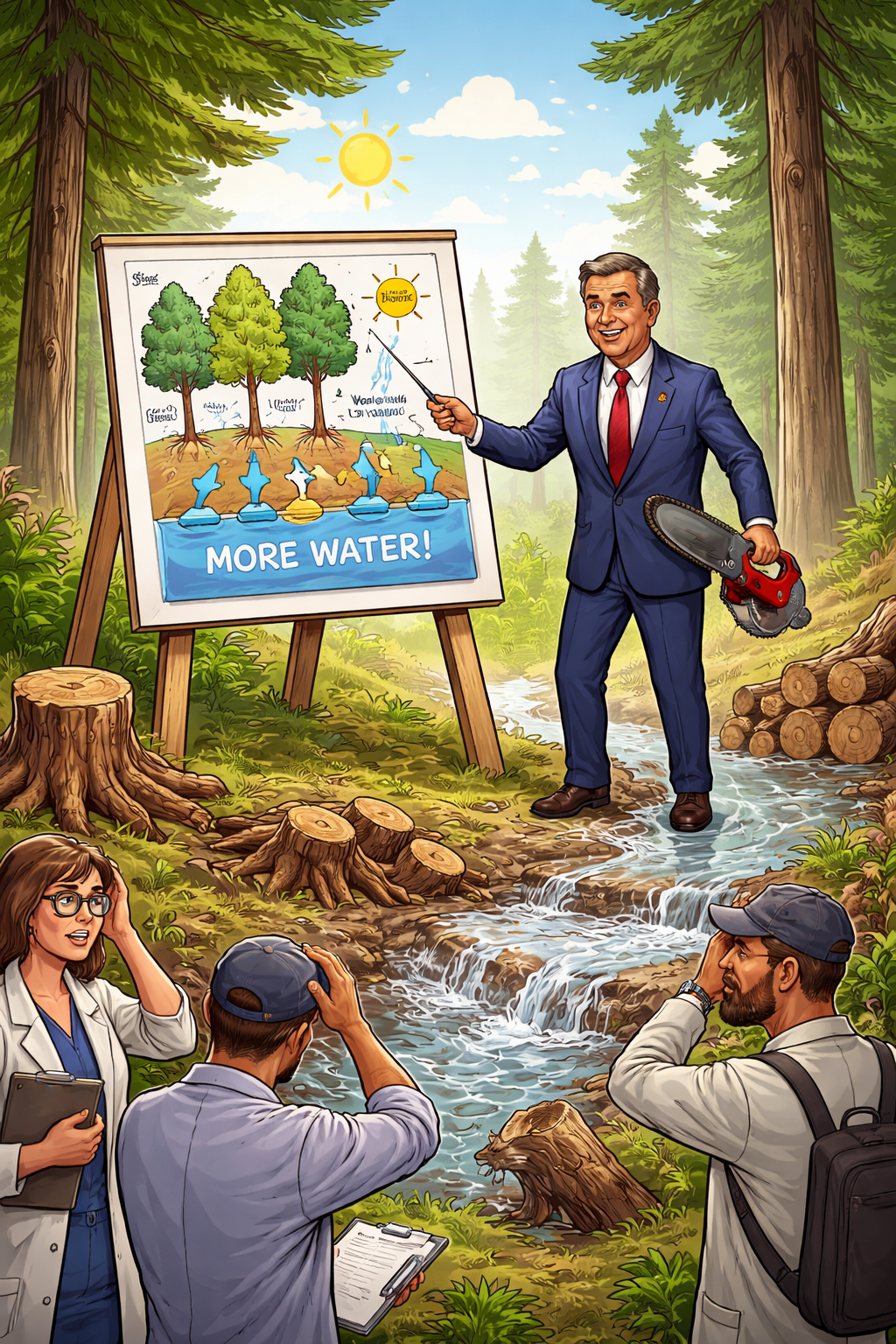
Recently, a nominee for leadership over federal public lands, Steve Pearce, suggested that removing trees would increase water supply in the American West. The logic sounds clean. Trees use water. Remove trees. More water remains.
That reasoning works on a napkin. It collapses in a watershed.
Let’s slow this down.
Forests Are Not Straws in a Reservoir
Yes, trees transpire water. They draw moisture from soil and release it into the atmosphere. That part is true. But what disappears in the sound bite is everything else forests do.
Forests regulate snowpack retention.
They shade soil, reducing surface evaporation.
They stabilize slopes, preventing sediment from clogging rivers and reservoirs.
They slow runoff, allowing water to infiltrate into groundwater systems instead of flash flooding downstream.
In much of the American West, snowpack functions as the primary reservoir. Forest canopy influences how snow accumulates, melts, and enters streams. Remove canopy indiscriminately and you do not get a neat increase in usable water. You often get earlier melt, hotter soil, more rapid runoff, and lower late season stream flows. Those late flows are exactly when communities and agriculture need water most.
Hydrology is not subtraction. It is systems behavior.
The Mirage of “More Yield”
There is a long history in Western land management of what is called the water yield argument. The idea is that reducing forest cover increases streamflow. In small, highly controlled experimental watersheds, temporary increases in runoff have been observed after clearcutting.
Temporary is the key word.
What follows in many cases is increased sedimentation, higher peak flows and lower base flows, degraded water quality, warmer stream temperatures, and long term shifts in vegetation that reduce ecosystem resilience.
A brief pulse of extra runoff does not equal sustainable water supply. Applying simplistic thinning logic across millions of acres that vary in elevation, soil composition, precipitation pattern, and watershed structure is not management. It is gambling.
Policy built on a slogan does not survive contact with terrain.
Public Lands Are Not an Abstraction
The Bureau of Land Management oversees roughly 245 million acres. That is not a thought experiment. It is sagebrush steppe, alpine forest, high desert, river corridors, tribal adjacency, grazing allotments, recreation economies, wildlife habitat, and carbon storage.
These lands operate under statutory frameworks like the Federal Land Policy and Management Act. They are bound by multiple use mandates and environmental review requirements. They are legally obligated to balance conservation, extraction, recreation, grazing, energy development, and habitat protection.
When leadership reduces watershed science to a sentence fragment, it signals something deeper. It suggests a worldview in which complexity is an inconvenience.
Water scarcity in the West is real. Climate volatility is real. Population growth is real. Agricultural demand is real. But solving those pressures requires basin level modeling, climate projections, groundwater accounting, infrastructure planning, and negotiated water rights reform.
It does not require folklore.
Why This Matters
Western water systems are already strained. Aquifers are being depleted. Reservoir levels fluctuate dramatically. Snowpack is less predictable. Forests are experiencing wildfire regimes intensified by drought, fuel accumulation, and warming temperatures.
In that context, land management decisions must be precise. They must be informed by hydrology, forestry science, and regional variability. Large scale removal of trees framed as a water creation strategy ignores the interdependence of canopy, soil, snowpack, and stream dynamics.
Once sediment fills a reservoir, it does not politely leave.
Once groundwater recharge patterns shift, they do not quickly reset.
Once ecosystems destabilize, restoration costs multiply.
Public lands are long horizon assets. They do not respond well to short horizon thinking.
The Real Question
The issue is not whether selective thinning has a place in wildfire mitigation. It does. The issue is whether complex watershed systems should be reduced to bumper sticker logic.
When leaders speak casually about manipulating forests to manufacture water, they reveal either a misunderstanding of ecological systems or a willingness to oversimplify them for political convenience.
Neither inspires confidence.
If we are serious about the future of the West, we should demand literacy in systems science from anyone entrusted with 245 million acres.
Water does not come from cutting trees.
It comes from understanding how everything is connected.
The Case Against Steve Pearce Leading the Bureau of Land Management
Steve Pearce has built a career rooted in energy development, private enterprise, and skepticism toward expansive federal land control. Those positions are not minor background details. They go directly to the heart of whether he is a fit to lead the Bureau of Land Management, the agency responsible for overseeing roughly 245 million acres of public land across the United States.
The central concern is philosophical. Pearce has historically supported transferring or selling federal public lands to state or private control. Even if current federal law limits large-scale land disposal, his past advocacy raises serious questions about long-term stewardship. Public lands are not just acreage. They are wildlife corridors, grazing lands, recreation economies, watersheds, and carbon sinks. Once transferred or sold, that character changes permanently.
Compounding this concern is Pearce’s background in the oilfield services industry. The BLM oversees vast oil and gas leasing operations. When someone with deep financial and ideological ties to extraction industries takes the helm, critics reasonably ask whether development will be prioritized over conservation. This is not about demonizing energy. It is about institutional bias and structural incentives. Leadership philosophy shapes agency culture.
There are also climate implications. Federal lands in the Mountain West play a significant role in carbon storage and ecological stability. Accelerated leasing, expanded drilling, or weakened mitigation standards could exacerbate emissions and contribute to desertification in already stressed ecosystems. At a time when land management decisions directly intersect with climate resilience and water security, critics argue that leadership must demonstrate an unequivocal commitment to long-term ecological sustainability.
Finally, transparency matters. During confirmation questioning, Pearce reportedly avoided clear yes-or-no commitments about opposing future land sales. Ambiguity in this role is not trivial. The BLM manages land owned collectively by the American public. That responsibility demands clarity about whether the mission is stewardship or liquidation.
Taken together, the critique is not that Pearce is personally corrupt. It is that his record, industry alignment, and policy history suggest a vision of land management that could fundamentally shift the balance away from conservation and public access and toward development and privatization.
That is the real controversy.