
How One Pirate Forced an Empire to Negotiate
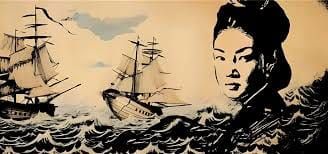
Zheng Yi Sao was, at one point, the most feared pirate on the seas.
At the turn of the nineteenth century, the South China Sea was not a frontier but a system. It was the economic backbone of East Asia and its surrounding empires, a dense lattice of trade routes shaped by monsoon winds, port schedules, and imperial demand. Tea, silk, porcelain, spices, and silver moved through these waters in steady, predictable rhythms. Ships sailed when the winds allowed. Ports expected arrivals with seasonal certainty. Entire coastal populations depended on maritime trade not merely for wealth, but for survival.
Predictability created vulnerability.
Every ship represented profit in motion.
Every harbor represented leverage over markets and states.
Imperial authority along the coast was thin and corruptible. Naval patrols were underfunded. Officials accepted bribes as a routine extension of governance. Merchants paid protection as a cost of business. Fishermen smuggled when it suited them and informed when it paid. Violence, in this environment, was not disorder. It was regulation. Piracy functioned less as criminal disruption and more as an alternate system of enforcement layered atop failing state control. From this environment emerged figures who did not reject the system, but exploited it.
Zheng Yi was one such figure. A fisherman turned pirate, he rose through brutality, timing, and an understanding of how fear could substitute for law. His authority was built through terror rather than loyalty. Villages were burned not because it was profitable, but because it was instructive. Ships were destroyed to send messages rather than to maximize loot. Captives were mutilated and released so they could carry fear back to their ports faster than any rumor.
Under Zheng Yi, violence was spectacle. Reputation became a weapon. Compliance followed inevitability. Merchants rerouted preemptively. Cities paid without resistance. The threat of destruction mattered more than destruction itself.
This strategy worked.
By the early 1800s, Zheng Yi commanded hundreds of ships and thousands of pirates drawn from coastal communities across southern China. His confederation was large, feared, and profitable. But it was also fragile. Authority rested on personal dominance. Discipline depended on proximity to the leader. Alliances shifted. Loyalty followed strength rather than structure. The fleet functioned as long as Zheng Yi lived.
In 1807, he died in a typhoon.
The sea erased him without ceremony. No battle. No betrayal. No succession plan announced in advance. Under ordinary circumstances, this would have ended everything. Pirate coalitions built around personal terror rarely survive leadership transitions. Lieutenants seize assets. Crews defect. Rival factions splinter the remains. States exploit fragmentation and restore control through attrition.
How One Pirate Forced an Empire to Negotiate Matt Stone
This was the expected outcome.
It did not happen.
Instead of collapse, command consolidated.
The figure who stepped forward did not inherit Zheng Yi’s fleet so much as dismantle it and rebuild it into something else entirely. Long before Zheng Yi’s death, this individual had already been managing the internal life of the confederation. Logistics, finances, discipline, and negotiations flowed through this quiet center of gravity. Loot distribution was tracked. Disputes were mediated. Punishments were enforced. Deals were negotiated with merchants and intermediaries.
Long before authority was formalized, control had already been quietly centralized. While Zheng Yi ruled through spectacle and terror, the daily machinery of the confederation moved elsewhere. Ships required provisioning. Crews required payment. Disputes required arbitration. Merchants required negotiation. Someone tracked numbers, weighed risks, enforced discipline, and decided when violence served purpose and when it merely created enemies.
That work did not announce itself. It did not fly banners or burn villages. It operated below the threshold of legend, where survival depends not on fear alone but on consistency. Commanders learned where to bring disputes. Crews learned which rules were enforced and which were not. Merchants learned whom to bargain with if they wanted predictability instead of ruin.
Sao controlled the internal economy of the fleet, and with it, the fleet’s true center of gravity.
Loot distribution passed through this office. Punishments were approved or denied. Negotiations with coastal intermediaries and corrupt officials were conducted with an understanding that violence was most effective when restrained. Authority flowed through ledgers, decisions, and enforcement rather than shouted orders on a deck. By the time Zheng Yi died, loyalty had already begun to reorganize itself around competence rather than terror.
This mattered more than bloodline or title.
When the typhoon came, it removed the visible head of the confederation but left its internal organs intact. Crews did not panic because the system that fed them, paid them, and disciplined them still functioned. Commanders did not splinter because there was already a recognized arbiter of disputes. Merchants did not revolt because negotiations continued uninterrupted.
What appeared, from the outside, to be an impossible succession was in fact a revelation: the fleet had already been governed this way. The formal transfer of power merely made visible what had been operating quietly all along.
Power had already shifted inward before it shifted upward.
How One Pirate Forced an Empire to Negotiate Matt Stone
Following Zheng Yi’s death, authority was asserted quickly. Speed mattered. Delay would have invited fragmentation. The fleet was reorganized into six color-coded squadrons—Red, Black, White, Blue, Yellow, and Green—each with defined command, territory, and responsibility. The Red Flag Fleet held primary authority, coordinating strategy and enforcement across the confederation.
This was not symbolic rebranding. It was structural transformation.
Loot distribution was centralized. All captured goods were registered. A fixed portion was allocated to a collective treasury used for provisioning, ship repair, and long-term operations. Theft from the common fund carried the death penalty. Desertion was punishable by execution. Independent raiding was prohibited. Violence ceased to be impulsive and became regulated.
Authority shifted from personality to system.
A formal legal code governed conduct across the fleet. Rules applied across rank. Senior officers were not exempt. Commanders who violated the code were executed publicly, not quietly removed. Punishment was instructional rather than arbitrary. Crews learned exactly which behaviors produced reward and which produced death. Internal conflict declined. Discipline hardened. The confederation began to function not as a loose criminal enterprise, but as an institution.
Prisoners were categorized upon capture. Ransomable captives were protected. Others were released, absorbed into the fleet, or executed according to established rules. Sexual violence was explicitly prohibited. Rape carried the death penalty. Consensual relationships required approval. Abuse of civilians invited severe punishment. This was not mercy. It was control through predictability.
The fleet stabilized.
One potential threat to this consolidation remained: Cheung Po Tsai. Zheng Yi’s adopted son and a powerful commander, Cheung controlled significant forces and loyalty within the fleet. Under normal circumstances, he would have been a rival. Instead, an alliance was formed. This partnership neutralized internal opposition, preserved symbolic continuity, and ensured military cohesion.
It was a political move, not a romantic one.
With rivals absorbed rather than crushed, the confederation expanded rapidly. Captured sailors joined voluntarily. Defectors brought intelligence. Fishermen supplied information in exchange for protection. Corruption weakened imperial suppression efforts before ships ever left harbor. Pirate patrols controlled major trade arteries. Signal networks coordinated movement across wide distances. Logistics supported sustained operations rather than isolated raids.
At its height, the confederation controlled between 400 and 1,800 ships and as many as 70,000 to 80,000 personnel. Even conservative estimates rivaled national navies operating in the region.
How One Pirate Forced an Empire to Negotiate Matt Stone
Entire stretches of sea fell under pirate oversight. Merchant insurance rates spiked. Trade routes shifted. Coastal cities paid protection not for immunity, but for predictability.
Piracy ceased to function as disruption. It became parallel governance.
The Qing court launched repeated suppression campaigns and failed. Imperial fleets were defeated or evaded. Blockades collapsed. Portuguese and British warships sustained losses. Each failure strengthened pirate legitimacy and eroded imperial authority. Corruption hollowed out enforcement from within. Informants lied. Captured sailors defected. The state began to look abstract. The fleet looked real.
By 1810, continued escalation produced diminishing returns. Military suppression drained resources without restoring control. Trade disruption threatened broader economic stability. Coastal governance frayed. The empire faced a calculation it could no longer avoid. Negotiation followed.
The resulting settlement granted full amnesty. Pirate wealth was retained. Officers entered imperial service with rank preserved. No mass executions followed. No imprisonment. No confiscation. The fleet disbanded voluntarily. Ships were surrendered peacefully. There was no final battle, no martyrdom, no spectacle.
The most powerful pirate confederation in recorded history ended not through defeat, but through acknowledgment of its supremacy.
Zheng Yi Sao retired wealthy and legally protected. No trial followed. No retribution arrived. Power exited quietly, which is the rarest ending of all.
While it is rare for such a powerful figure to retire and live peacefully, especially in the world of pirating, Zheng Yi Sao had accomplished something even more rare. Perhaps the most remarkable thing about Zheng Yi Sao is not the scale of the empire, the discipline it imposed, or the empires it bent—but that all of it was accomplished by a woman.
Sources
- Dian H. Murray, Pirates of the South China Coast, 1790–1810 (Stanford University Press, 1987)
- C.R. Pennell (ed.), Bandits at Sea: A Pirates Reader (NYU Press, 2001)
- Sabrina Jarema, The Dragon Lady: The Life and Legend of the Pirate Queen Zheng Yi Sao (2012)
- David Cordingly, Under the Black Flag (Random House, 1995)
- Philip Gosse, The History of Piracy (1932)
- Stephen Turnbull, Pirate of the Far East 811–1639 (Osprey, contextual East Asian piracy)
- Angus Konstam, Piracy: The Complete History (2008)





Member discussion