Karma's Most Wanted #4: Stephen Miller
By Matt Stone
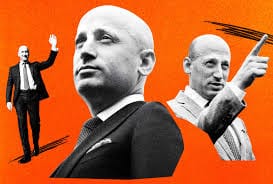
Stephen Miller looks like Nosferatu in a suit, which would almost be funny if he were not so good at turning human misery into policy. That is the first thing people get wrong about him. They treat him like an irritation, a side character, a snarling little goblin who drifted into the frame because Donald Trump needed one more fanatic with dead eyes and a microphone.
That is lazy thinking. Stephen Miller is not an accident. He is not background noise. He is not one more freak in the traveling carnival.
He is what happens when resentment finds discipline.
Trump is appetite. Trump is impulse. Trump is spectacle, ego, volume, instinct. He points, shouts, improvises, lies, threatens, and sniffs out where the crowd is weakest. Miller is something colder. He is the administrative afterlife of that energy. He is the one who takes the fever dream and writes it into directives, quotas, procedures, legal theories, and bureaucratic muscle memory.
That is how a man like him gets where he is.
Not by charm. Not by broad appeal. Not because normal people find him persuasive in any old democratic sense. He gets there because the modern American right has spent years rewarding a very specific kind of operator: the true believer willing to be more ruthless than everyone around him, more obsessive than everyone around him, and more comfortable translating hatred into process than everyone around him.
Stephen Miller is not the beast. He is the tapeworm.
Trump is the bloated host, roaring and flailing and gorging himself on grievance, spectacle, and attention. Miller is the thinner thing inside him, colder and more disciplined, feeding off the larger body while quietly shaping its appetite. A tapeworm does not need charm. It does not need beauty, stature, or independent force. It survives by attaching itself to something bigger, siphoning nutrients, weakening the host while depending on it completely, and growing stronger as the body swells.
That is Stephen Miller.
He attached himself to Trump early, found a nervous system already twitching with fear, vanity, and appetite, and learned how to feed on all three. Then he did what parasites do best. He reproduced. Not biologically, but bureaucratically. He laid ideological eggs in executive orders, detention systems, court fights, travel bans, enforcement quotas, and the daily language of public fear, until the infection was no longer confined to one man’s gut. It had entered the bloodstream of the state.
That is what makes him more dangerous than a mere crank or propagandist. He is not just loud. He is operational. He does not merely express ugliness. He organizes it. He does not simply flatter prejudice. He teaches institutions how to speak it fluently.
Miller learned that game early.
He grew up in Santa Monica, which makes his eventual public role feel even more revealing. He was not forged in some isolated bunker in a forgotten county where everyone thought exactly like him. He emerged in a place full of multicultural life, liberal assumptions, and people he could define himself against. That matters. A lot of ambitious people enter politics. Miller’s rise appears to have been built on something narrower and meaner: oppositional identity. He did not merely disagree with the environment around him. He seems to have needed it as a theater. He sharpened himself against it. He found power in permanent siege.
That is a very American pathology. In this country, grievance is not just an emotion. It is often a career track. Then came the mentors and pipelines.
Older ideological operators saw what he was and put fuel in the tank. He found the usual right-wing infrastructure waiting for him: provocateurs, publications, handlers, and networks that know exactly how to turn a young man’s bitterness into usefulness. This is how resentment becomes a profession. This is how a person stops being merely abrasive and starts becoming a mechanism.
At Duke, he kept practicing. Public conflict. Culture war. Media combat. Constant performance. He did not stumble into notoriety. He trained for it.
Then he found Jeff Sessions, and that is where the little ghoul starts becoming a machine.
That period matters because it is where Miller moved from provocation into policy war. He found the issue that would define him, the apparatus that could carry him, and the language in which cruelty could present itself as seriousness. Immigration became the perfect vehicle because it allowed him to fuse fear, race, nationalism, punishment, bureaucracy, and legal theater into one coherent project.
That is the key to understanding him.
Stephen Miller is not some generic conservative hardliner who happens to favor stricter borders. He is a career specialist in translating nativist panic into durable instruments of state power. He does not just want immigration law enforced. He wants immigration law weaponized, expanded, dramatized, and bent until the targeted population feels hunted by the existence of the state itself.
That is why family separation matters so much in understanding his role. It is not just one scandal among many. It is a moral X-ray. It shows you the inner design. It reveals what the machine is for.
They talk endlessly about saving the family while actively breaking up real families and stripping women of control over their own bodies. But that hypocrisy only looks accidental if you still believe they mean family in the human sense. They do not. They mean a state-approved hierarchy: the right kind of parents, the right kind of children, the right kind of nation, the right kind of obedience.
The family-values language is just perfume sprayed over rotten domination. Children were turned into leverage. Suffering was converted into strategy. Bureaucracy became camouflage for deliberate harm.
That is Miller’s world in one awful frame: the cold administrative conversion of pain into policy.
And he did not fade after the backlash. He got stronger.
That tells you almost everything you need to know about the movement that made him. In a healthier political culture, a figure so closely associated with organized cruelty might become radioactive. In this one, he became indispensable. He remained useful because he is exactly what modern authoritarian politics requires: not just a frontman, but a clerk of the dark arts. A fanatic who can take appetite and make it procedural. A functionary who does not get squeamish when the human cost becomes visible. A man who can stand at the inferno with a gas can and still call himself a serious policy thinker.
That is why Trump-ism needs him. Movements like this cannot survive on charisma alone. They need clerics. They need legalists. They need people who can turn instinct into paperwork and rage into implementation.
Trump supplies the heat. Miller supplies the method. And there is something especially American about the whole rotten enterprise.
European monsters traditionally liked uniforms and grand gestures. American monsters love process. They love plausible deniability. They love directives, compliance language, agencies, forms, budgets, and implementation schedules. They love making barbarism sound managerial. Miller fits that tradition perfectly. He is not the jackboot on the throat in the cartoon version. He is the email explaining why the boot is now standard procedure.
That is what makes the Nosferatu image almost too gentle.
Because Nosferatu at least had the decency to look like evil from the start.
Miller learned something more useful. He learned how to wear legitimacy. He learned how to move through the bloodstream of the state without ever needing affection. He learned that in modern America, you do not have to be loved if you can make yourself indispensable to the people holding the pen.
That is Stephen Miller: Donald Trump’s tapeworm, a parasitic little ideologue that learned to read, write, and translate racism into state power.
Not just a ghoul. Not just a zealot. A converter.
A converter of private venom into public machinery.
A man who found the institutional circuitry capable of multiplying his worldview and then helped wire it into the body of the state. Before long, the machinery was breeding at scale, wriggling into people’s heads and nesting in their thoughts by speaking in voices that sounded suspiciously like their own. Those voices taught them to fear anything that did not talk like them, walk like them, worship like them, or look like them.
That is how he got where he is.
He got there because every stage of the system selected for him.
The teenage provocateur found mentors. The mentors found him placements. The placements found him a cause. The cause found him a patron. The patron found him a champion in Trump. And Trump found in him what every authoritarian movement eventually needs: a man willing to make cruelty procedural.
That is why Stephen Miller feels darker than an ordinary partisan hack. A partisan hack wants wins. Miller wants transformation. He wants the state to speak his worldview fluently. He wants its forms, notices, databases, raids, detention systems, and exclusion rules to express his theory of who belongs and who does not.
He’s got all the charm of a school shooter and the bureaucratic instincts to make the damage permanent. He is not merely creepy. He is operational.
And now he sits near the center of American power doing exactly what he was always built to do. Not moderating. Not learning. Not broadening. Not softening.
Escalating.
So yes, call him Nosferatu in a suit. But do not stop there. The point is not just that he looks eerie. The point is that he learned how to attach himself to a larger beast, feed on its rage, refine its instincts, and use the body of the state to spread the infection. That is a different kind of danger. Quieter at first. More procedural. More durable.
Trump may be the mouth of the project.
Stephen Miller is one of the things living inside it, feeding on it, sharpening it, and making sure the sickness survives after the performance ends to find a new host.
That is why he belongs on the list.
Not as a sidekick.
Not as a footnote.
Not as background noise in somebody else’s scandal.
He belongs here as one of the clearest examples in modern America of a man who took private hatred, found public machinery capable of multiplying it, and taught that machinery to reproduce at scale, just in time for artificial intelligence to inherit the trick and learn how to manipulate us in voices that sound like our own.
That is Stephen Miller.
And that is why he is on Karma’s Most Wanted.
Member discussion