
Techno-Nationalism and the new Shape of War
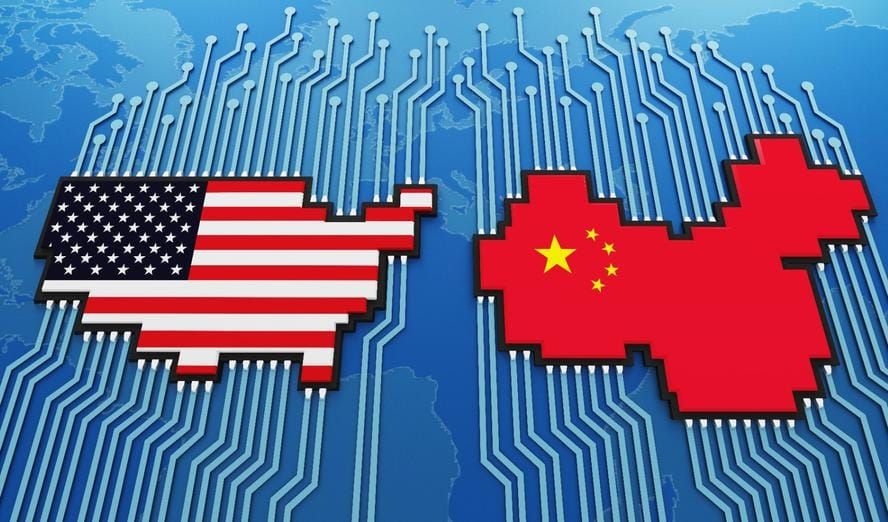
Part I of a series on techno-nationalism and the changing structure of power.
Introduction
The intersection of politics and technology is becoming increasingly pronounced in the 21st century, with artificial intelligence acting as the catalyst for a geopolitical paradigm shift that is causing the world to split into separate competing technological blocs. The vast potential of AI has kicked off a global race for technological supremacy that has jeopardized the partnerships that enabled such breakthroughs in the first place. What was once a collaborative effort to improve the human condition on a global scale through technological advancements, has now become a battleground of national interests. Nationalist sentiments have been surging worldwide since 2016, with countries increasingly prioritizing their own agendas and strategic advantages in lieu of global collaboration with other countries. With major countries like the US and China developing their own technological ecosystems, not only is shared progress on AI at stake, but trade relationships, alliances, and the entire global dynamic of international relations could be fundamentally changed.
Problem Statement
The possibility of a technologically fractured world becomes greater with each innovative discovery in AI, with the US and China both developing their own technological ecosystems that threaten to split the rest of the world up like children in the wake of a messy divorce. Intense competition across the fields of AI and other emerging technologies have contributed to some scholars suggesting the dawn of a new era in great power competition[1]. The next era of great power competition will be unlike any the United States or the rest of the world have seen. Problems--and solutions--will become increasingly difficult to comprehend, especially if states continue acting in the same self-interested way characteristic of the anarchic international system.
With the rise of Chat-GPT, AI has already shown how it can dramatically change the world and potentially shift the geopolitical landscape. Much of the progress in AI has been due to a collaboration between countries encouraged by the open-source software movement- referring to source code that is available for anyone to use or modify. Collaboration will remain vital for innovation in the future, but a global surge in nationalism threatens to obstruct progress. Nationalism involves the identification with one’s nation and its interests often to the exclusionary detriment of other countries. Since 2016, nationalism has been rising across the world with many movements putting a focus on national interests while decrying “globalist” liberal institutions. How is a rising tide of nationalism affecting the development and regulation of AI technologies? This paper will seek to answer this question, and to explore the geopolitical implications of countries valuing state sovereignty and autonomy more than global partnerships and collaboration. Finally, I will conclude with ways in which the United States can be proactive in addressing the challenges of engaging with multilateralism in the age of AI.
Literature Review
Coined in the 1950s, artificial intelligence was the result of the realization that software and robotics could possess a human-level intelligence. Where civil and chemical engineering built upon physics and chemistry, artificial intelligence has been summed up as a new engineering discipline built on ideas, algorithms, computing, inference, and optimization.[2] The dangers posed by technology have been theorized and written about since as far back as 1950 when Norbert Wiener wrote The Human Use of Human Beings. Despite not specifically referring to AI, Wiener displays a careful apprehension of technology automation. Weiner wrote that the reflections of a society were based on thought processes made evident by techniques used: “If the seventeenth and early eighteenth centuries are the age of clocks, and the later eighteenth and nineteenth centuries constitute the age of steam engines, the present time is the age of communication and control.”[3] Wiener also addressed the societal implications of taking “Manichean” attitudes on technology, or rather taking an over-simplistic view of technological innovation and its impact without nuance or responsibility.[4]
In his 2018 paper "Artificial Intelligence -The Revolution Hasn’t Happened Yet", Michael Jordan was already highlighting the dangers of AI becoming too narrowly focused on industry and academia while blinding us to the novel challenges arising as a result. The founders of the AI Now Institute, Kate Crawford and Meredith Whittaker also cited the lack of an international body focused on the social, ethical, and political implications of AI technology as the catalyst for the creation of their organization.[5] Automating processes for societal procedures will require more than just tech executives in a Silicon Valley boardroom. The founders of AI Now set out with the mission of creating guardrails for implementing the automation of processes deemed vital to society, especially since many AI algorithms are inherently taking on the biases of tech developers- a primarily white, male profession. Crawford and Whitaker have been pioneers in the field of AI ethics and have put forth the terrifying possibility of a bleak dystopian future where automated decision processes are underscored by biases that reinforce the status quo- leaving little to no recourse for those affected unfairly or even illegally.[6]
In the last few years there has been a tidal wave of AI guidelines and codes of ethics introduced by groups in both the public and private sectors as countries wrestle with the newly created challenges of a world permeated with artificially intelligent technology.
Not all scholars believe in the usefulness of attempting to create an AI Code of Ethics. Luke Munn’s 2022 paper “The Uselessness of AI Ethics” argues that these principles are largely toothless and meaningless, with most being contested and lacking operational mechanisms for accountability.[7] Munn claims these principles are not just failing to address the social, racial, and environmental consequences of AI, but are dangerously distracting from other more effective alternatives.[8]
In her 2019 book, The Age of Surveillance Capitalism: The Fight for a Human Future at the New Frontier of Power, Shoshana Zuboff claims a new type of capitalism, called surveillance capitalism, manifested in the early twenty-first century. This new style of capitalism revolves around businesses making money by spying on and surveilling their customers. Google and Facebook are two of the biggest culprits, with their advertising models being based on monetizing user behavior data through a litany of opaque services and user permissions designed to keep users ignorant and unaware of the processes by which their data becomes monetized.[9]
One of Zuboff’s main points lies in the dangers of an asymmetry of knowledge, in which the surveillance capitalists (tech giants) possess all the knowledge and by extension, all the power. Data as a resource is a novel idea created by this new style of capitalism, and AI technology heavily relies on huge amounts of data and input. Most democracies around the world have built-in constitutional protections against state surveillance, yet none have protections against or any oversight of its privatized counterpart in the surveillance capitalists. The companies using this model today not only monitor user behavior, but they actively manipulate and modify it with patented tools and technology that the public is often unaware exists.[10] The utilization of user data has become a focal point in the future of artificial intelligence and global governance, with democratic nations beginning to form an alliance based on a human rights-oriented approach to socio-technical governance.[11] Zuboff highlights the dangers of this model to democracy and to the democratic ideals of inclusive and informed governance, but other scholars have posited that this new manifestation of user data as a resource is becoming the newest manifestation of great power competition instead of controlling land and territories.
Countries in the age of AI strive to manipulate this data to reinforce their own internal authority and their position within the global system.[12] Sebastian Spence argues that the ideas underlying state sovereignty have transformed from a focus on territorial control to the control of a population and state’s data. A state that controls their population data and can manipulate it, can frame that data within a national context based on state institutions and boundaries.[13] This has huge implications for the possibility of governments to manipulate nationalistic tendencies via AI-powered advanced technologies.
In his paper “The Birth of AI Nationalism,” Spence puts forward the idea that China may be in a better position than America with their state-controlled domestic systems of governance allowing a more focused and pointed effort in their economic and technological sectors.[14] For example, one issue is that China’s Google equivalent, Baidu, gladly welcomes military partnerships and working on the application of AI for military purposes. Google, on the other hand, refused to renew a partnership with the Pentagon due to employees protesting the use of AI in military applications.[15] A population with the power to stop government action may inadvertently hinder the development of more integrated and data-driven AI solutions, but to what degree these solutions serve the public compared to those in power has yet to be fully understood.
China’s approach to their “social credit” system utilizes AI in a way that is incongruous with the ideals touted by the US and EU. The EU’s Trade and Technology Council (TTC) has clarified their position and disagreement with these surveillance systems: “The United States and the European Union have significant concerns that authoritarian governments are piloting social credit systems with an aim to implement social control at scale.” These disagreements stem from fundamental differences in the ideologies of the US, EU, and China regarding human rights and the relationship between a ruler and the ruled. China’s increasingly hands-on approach differs from the US’ hands-off, private sector responsibility model- creating two incompatible competing global systems of technological governance.
In Elaine Kamarck’s 2018 paper “Malevolent soft power, AI, and the threat to democracy,” she addressed the potential for AI technology to quickly tailor messages intended to mislead voters.[16] AI systems not only mislead voters but can assess the effectiveness of messages in real time and make adjustments to messaging tactics.[17] Facial recognition software has taken this even further with algorithms now being capable of depicting human beings saying and doing things they never said. Political parties are already implementing this technology into nomination voting processes, which some experts have pointed to as a clear risk to democratic processes.[18]
Kamarck outlined four factors that contribute to the threat of AI to democracy and the difficulty of responding to societal challenges with government regulation. The first factor is the difficulty of enforcing laws on cyberspace, which often operates not just above the law, but beyond the law in general with law having no sovereignty in cyberspace.[19] The second factor is that government regulation has come to be seen as unproductive or even harmful at times, and problems in the United States often rely on the private sector to handle societal problems.[20] The third factor stems from the generational divide between those who grew up with the internet and those who are lawmakers, who often lack the expertise and knowledge required to regulate advanced technology. The fourth factor lies in attempts to deal with fake news and online discourse around the world.[21] Restricting and regulating internet platforms can result in censorship and the loss of freedom of speech, which can encourage authoritarian regimes or leaders with authoritarian ambitions to continue expanding censorship.[22]
Nationalism is not underpinned by a shared history, culture, or language, but instead a shared collective imagination of a state’s population.[23] Since it is impossible for every citizen to literally know every other citizen, this relationship manifests as an imagined familiarity with our countrymen. The rise of the internet and social media have made it easier to for citizens to surround themselves with an ‘echo chamber’ that conforms to a social media user’s beliefs and values.[24] Some scholars posit that these echo chambers have further contributed to the fragmentation of public discourse, creating “niche” versions of national identity and normalizing more extreme forms of nationalism.[25]
Nationalism has also been understood as the product of the intersections of cultural, economic, political, and social structures and practices.[26] Malesevic theorized that social structures are the key component for nationalist mobilization, and that nationalism is better understood as a continuous and expanding force rooted in the modern idea of the nation-state.[27] The structures and ideologies that define modernity, have embedded in them the natural occurrence and manifestation of nationalist ideologies including the threats of globalization, cultural differences, and increased immigration.[28] Nationalism is an enduring and normative force that can be more easily conceived and weaponized by structures of the nation-state- forming the collective consciousness and the perception of political legitimacy.
J. Paul Goode opined that AI’s ability to mimic nationalist practices will vary based on the models of domestic political regimes.[29] He argued that in democracies we will see AI disrupt nationalist mobilization, while in autocracies state-led nationalist sentiment will be increased by focusing “blame attribution” on external or internal enemies.[30] Countries that lag behind in AI development become increasingly vulnerable to nationalist mobilization through externally-influenced outsourced AI technologies.[31] Transforming citizens into population data is changing the ideas of state sovereignty, and with the manifestation of competition both within and between states, we will likely see a rise in nationalist responses and sentiments.[32]
Techno-nationalism is a subset of nationalism- while both share an overriding concern for national interest, techno-nationalism views technological innovation as a direct reflection of a nation’s security and economic prosperity.[33] While AI is not a brand-new form of technology, its permeation of social, economic, political, and trade structures and mechanisms is a relatively recent phenomenon. The newest manifestation of techno-nationalism also permeates all the above-mentioned areas, but with an added focus on ideological considerations of technological prowess underpinned by realist doctrine.[34] As technology develops faster than the norms and policies that regulate them, the first-mover advantage will see those who develop and implement technology first be more able to influence the standards and norms governing the use of these technologies.[35]
A 2022 report from the Brookings Institute highlighted the ideological differences between the US and China regarding AI. The geopolitical consequences of the management of AI and information technology have contributed to a resurfacing of “neo-mercantilist” ideas permeating the digital space and its governance.[36] This has resulted in China, untethered by demands of the market and private sector, being the first out of the gate to develop and implement a regulatory framework for AI. Digital sovereignty, or the ability of a nation to determine its “digital destiny” has been fully embraced by China in its quest for control of the entire AI supply chain.
Digital Sovereignty is not easily achievable in the age of AI, and with the US and China vying for supremacy in the AI field, the EU has an uphill battle to achieving anything resembling digital sovereignty. When AI is considered in the form of its three main elements- data, algorithms, and hardware- sovereignty would entail dominating the industries of all three with little or no foreign dependence.[37] Reconciling geopolitical ambitions with the social and economic tensions created by increasingly nationalist policies will be a challenge for all countries moving forward, but especially for collaboration on the development of AI and other advanced technologies.
Research Methodology
Using applied research to conduct an issue area analysis, this paper will focus on discerning the impact of globally increasing nationalist/anti-globalist sentiment on the development and regulation of AI technology by analyzing global collaborations, partnerships, and regulatory trends across countries. By also examining trends in public trust and perceptions of state institutions, the prevalence or absence of collaborative partnerships, and trends in self-reliant or inward-looking policies, I intend to identify a correlation between rising nationalism and the shaping and implementation of AI policies (China, US, European Union).
Conducting an issue area analysis will start with a regulatory analysis of each country including the intent, language, and underlying motivations of existing state AI regulations. A qualitative analysis will also involve the socio-political context of these regulations, public trust, and the rhetoric surrounding collaboration and cooperation on AI. By conducting a thematic analysis, I hope to add context to the ways in which these themes manifest across the world and the implications for AI amidst an uptick in nationalist sentiment around the world.
Outside of regulations, I am going to explore public trust in institutions in the countries leading in AI development. Moving forward, public trust is going to be vital for the deployment of AI systems that can potentially makes lives easier but can just as easily be used nefariously to manipulate and distort reality to push citizens toward nationalist ideologies. By exploring the effect that inward looking policies across the world are having on progress in AI, I hope to develop a better understanding of how AI will continue to shape the world and the geopolitical landscape in the future. A thematic analysis will reveal how public trust, cultural narratives, and responses to technological challenges shape the development and regulation of AI technologies. For better or for worse, AI is quickly giving governments around the world the tools to manipulate, control, and silence political dissent while simultaneously giving them the power to dictate the narrative.
Understanding the consequences lying at the intersection of AI and nationalism are vital for policymakers attempting to introduce new legislation on AI, for scholars and tech developers attempting to address the problems introduced by techno-nationalism, and especially for international standard-setting bodies regarding the development and utilization of AI. Differences in ideologies behind the adoption of advanced technologies and the underlying norms and values of countries will play an increasingly important role in the future of global collaboration. The United States will have to first develop a more comprehensive understanding of the problem before we can proceed with the solution.
Countries Leading in Artificial Intelligence
For the purposes of this paper, I will focus on the international actors with the biggest impacts on the current global AI climate. While the interactions between the three major countries- China, the United States, and the European Union- are deserving of the most attention, I will also briefly explore the relationship between rising nationalism and the development of AI in four additional countries: Russia, India, Singapore, and Japan. Russia’s government have long understood the power inherent within the field of AI and have already demonstrated their ability and determination to utilize technology to control/manipulate online discourse. India’s vast population of potential talent and strong IT sector position them to become a significant player in the field of AI. Japan’s focus on automation and robotics have made them a leader in healthcare and other automated services, integral parts of the AI ecosystem. Finally, initiatives such as the incentivization of private investors and streamlined patent approval processes have made Singapore a fast-growing AI hub that can potentially create robust future opportunities for global collaboration.
National AI Strategies
China
Chinese myths of advanced robots can be traced back as far as the 5th-century BCE in stories within the Taoist text attributed to ancient philosopher, Lie Yukou.[38] Narratives of intelligent and subservient robots reflected ancient stories from agriculture-dominant China, where abundant labor created much of the wealth that flowed. A historical yearning for the alleviation of gravitated toward myths of labor alleviation gave way to a yearning for the alleviation of labor. The desire for more artificial hands-on-deck to lessen the intensity of labor is an ancient idea in China.
In the early days of the Cold War, China followed the Soviet Union’s lead in viewing AI as a pseudo-scientific byproduct of western capitalism. It was not until the 1980s that China first started to make reforms enabling the development of AI to really progress. Skepticism evolved into a focused catch-up strategy that would see China began making great strides to catch up to the west, creating the Chinese Association for Artificial Intelligence (CAAI) in 1981. Providing funding, creating internationally cooperative and supportive policies, and sending top talent abroad to western universities became paramount to China’s AI development strategy.[39]
The last two decades have seen China become deeply embedded in the international AI milieu. China launched a campaign to become a leading global scientific power by 2050.[40] This campaign has manifested as a pursuit of reducing foreign dependency on technology, and instead, implementing sovereign control of core technological capabilities. China has a strategy titled “Made in China 2025” wherein the goal is to reduce foreign dependence on technology by requiring the United States and other countries to transfer manufacturing facilities to China, transfer innovative and novel technologies, and to collaborate on joint-ventures as minority partners.[41] China views their goals of technological development as a need to resolve world crises, meet demands of the state population, and to become a leading actor on the international stage.[42]
China recognized early on the power that would come from becoming a manufacturing powerhouse, outlining in their “Made in 2025” industrial policy document how manufacturing was the foundation and the basis of Chinese prosperity.[43] With the rise of AI, robotics, and machine-learning, China also recognized the transformation of the international division of labor on the horizon, and the opportunity to assert global dominance in manufacturing amidst the newest manifestation of the industrial revolution.
China has a long-term strategy for becoming competitive internationally within the AI sector, with an emphasis on replacing foreign dependence on technology and AI-related products. With an entire list of techno-nationalist goals, China intends to introduce more localization of technological innovation, restrictions on foreign investment, an increase in the recruitment of foreign talent, and instilling China-specific tech standards within the AI space and for those gravitating towards China’s sphere of influence.
At the third Belt and Road Forum for International Cooperation on October 18. 2023, Xi Jinping introduced the Global AI Governance initiative. In conjunction with the Global Development Initiative, Global Security Initiative, and Global Civilization initiative, these efforts are intended to promote China’s vision of the future of mankind. While these initiatives promote international cooperation, state sovereignty, and noninterference in the affairs of foreign states, they also promote a new world order that would see China elevated to a more influential leadership role in the international system.[44]
While dealing with social issues and achieving a leadership position in global AI governance are important secondary and auxiliary goals for China’s global AI strategy, the overriding goal remains to harness the utility of the technology for use by the CCP. The rigid control of public discourse by the Chinese Communist Party can aid in the unfettered creation and implementation of AI regulations. Chinese regulations are binding, as opposed to the EU and US AI regulations, but they are also labeled “interim” suggesting that the AI regulations being churned out are iterative and building on top of one another. While China has set an example for the world to follow in some regards to the regulation of AI, the censorship and ideological control of the CCP is fully realized in Chinese AI rules.
In the CAC’s draft rules on AI-generated content, Article 4 states that all content must “reflect the core socialist values.” AI-generated content must be in accordance with Chinese law, which means it must conform to the CCP’s view of “socialist” values and that providers of any type of generative AI are responsible for ensuring the legality of AI-generated content. This leads one to expect providers to be as aggressive and draconian as the Chinese-controlled social media companies, lest they feel the wrath of the CCP.[45] Through a western lens, any public engagement with Chinese regulators risks legitimizing these strict content policies, highlighting the true dilemma that lies at the intersection of digital authoritarianism and digital democracy.
Xi’s China holds a sincere belief that by 2049 China will have surpassed the United States in every metric used to measure world power. Many Chinese scholars and politicians believe the changes happening in the world are indicative of a “rising East and a declining West.”[46] While Xi has not straight out said that, the phrase “great changes unseen in a century” that he uses to describe China’s rise leads many to deduce that an America in decline is what he is referring to. Regardless of the reason for America’s decline and China’s rise, China has made clear the importance that AI plays in continuing their quest for supremacy in AI and global leadership.
European Union
Where China has adopted a more “vertical” approach to AI regulation, the EU has made it a mission to seek out more broad guardrails for AI to protect consumers and mitigate risks of the emerging technology. The EU’s approach to AI is comprehensively and coordinatively like China’s in its centralized approach, but distinct in its regulatory approach to AI and societal integration. The EU and member states have taken an approach based on creating trustworthy AI. The first initiative was the Coordinated Plan on Artificial Intelligence signed in 2018 by all EU member states and Norway. This plan legitimized the willingness of EU states to coordinate more closely on AI including actions relating to access to computing power, digital innovations, and everything under the broad umbrella of generative AI.
The 2018 Coordinated Plan on Artificial Intelligence intends to bolster investment in AI technology, and to attempt to align AI policy across member states in order to avoid further technological fragmentation in Europe and abroad. Through the Digital Europe and Horizon Europe programs, the European Commission intends to collaborate with the private sector to aid in an annual investment volume of 20 billion euros into AI over the next decade.[47] The Recovery and Resilience Facility is the centerpiece of the NextGenerationEU, the EU’s plan for navigating the current global financial crisis and makes an additional 134 billion Euros available to EU member states in their implementation of AI and other novel technology.[48]
The Digital Europe program stresses independence from systems and tech solutions coming from foreign countries. The program provides strategic funding to address challenges in five key areas: artificial intelligence, supercomputing, advanced digital trades, cybersecurity, and implementing technology into society across the EU. With a budget of €7.5 billion, Digital Europe aims to improve the digital economy and shape the technological transformation of Europe. Digital Europe is intended to address these problems in conjunction with other programs, including the Recovery and Resilience Facility, the Connecting Europe Facility for digital infrastructure, and Horizon Europe.
Horizon Europe is the EU’s primary funding program for research and innovation, with AI being a key factor. With a budget of €95.5 billion, the program addresses climate change, Sustainable Development Goals, and boosting the competitiveness of the EU. These issues constitute the three pillars of the Horizon Europe program with Pillar 1 relying on Excellent Science, Pillar 2 containing Global Challenges and European Industrial Competition, and Pillar 3 being the foundation for an Innovative Europe.[49]
The EU has also made data the focal point of many of their newest AI policy initiatives, including the EU Cybersecurity Strategy, the Digital Services Act and the Digital Markets Act, and the Data Governance Act. The EU Cybersecurity Strategy’s intended aim is to ensure a global and open internet with established safeguards. An outline for a Joint Cyber Unit has also been proposed to aid in working with partners who share the EU’s values of “democracy, rule of law, and human rights.”[50]
The Digital Services Act (DSA) package, including the Digital Services Act and the Digital Market Act, aims to create a safer online space for consumers and to create a level playing field for businesses. This includes addressing the spread of misinformation or harmful information, and the exchange of illegal goods or services. Online platforms were required to publish their numbers of active users by February 17, 2023, and those with more than 45 million users are classified differently as a “very large” online platform or search engine. This classification will give these services 4 months to complete their first risk assessment, after which they will be required to do annually to remain complaint with the DSA. The adoption of the Digital Services Package by the EU will see the DSA become applicable on January 1, 2024.
Recognizing the powerful resource that data has become, the third pillar of the EU’s data strategy came into force on June 23, 2022 seeking to increase trust in AI systems and data governance. The Data Governance Act aims to manage data and data-sharing more efficiently across sectors in the EU to aid in the development of more innovative products and practices. The goal is to leverage the value of data for the benefit of European citizens and businesses, aiding in transparent and efficient governance.
At the core of many EU policies and regulations lies the quest for digital sovereignty. Policy documents such as the 2022 EU Policy on Cyber Defence stress the importance of identifying critical technologies for cyber defense and cybersecurity that should be prioritized to reduce the EU’s technological dependence on foreign nations. A proposed 2023 technology roadmap for critical cyber technologies aims to identify technology important for the EU’s technological sovereignty. EU policymakers have made clear their belief that Europe can only be secure if it is digitally and technologically sovereign, with the unfettered ability to assert control over their own digital assets.[51]
United States
The United States Congress has been reluctant to pass any legislation that would regulate AI use in the private sector. Policies have so far focused on guiding the federal government’s own use of AI technology. Congress’ penchant for focusing on government AI capacity building has broadly funded AI R&D but with very little emphasis on ethical concerns or potential ramifications. The lack of specific requirements for AI use has left the executive branch with more freedom in setting priorities for AI moving forward. The Biden administration has produced an AI policy document, the Blueprint for an AI Bill of Rights, that intends to make a binding core set of priorities.
Highlighting the Biden administration’s priorities such as equity, equality, and civil rights, the Blueprint sets out to coordinate the efforts of all government agencies around these core priorities.[52] The Bill is intended to set expectations for consumers and businesses alike. These expectations include standards to be expected from algorithmic operating systems, such as privacy, efficiency, protection from discrimination, and transparency.[53] However, a disclaimer precedes the document stating that this blueprint is “strictly voluntary” and does not constitute official U.S. policy. This is a prime example of the “toothless” policies touted by Munn, but the Biden white house maintains that they intend to guide rather than direct.
[1] Schmidt, Eric. “AI, Great Power Competition & National Security”. Daedalus 2022; 151 (2): 288–298. doi: https://doi.org/10.1162/daed_a_01916
[2] Jordan, Michael. 2018. "Artificial Intelligence — The Revolution Hasn’t Happened Yet." Harvard Data Science Review 1, no. 3 (2018).
[3] Wiener, Norbert. 1950. “The Human Use of Human Beings.” xi.
[4] Wiener. “The Human Use of Human Beings.” 190.
[5] Johnson, Eric. 2019. “Artificial Intelligence Explained on Kara Swisher Recode Decode Podcast - Vox.” Vox. Vox. April 8, 2019. https://www.vox.com/podcasts/2019/4/8/18299736/artificial-intelligence-ai-meredith-whittaker-kate-crawford-kara-swisher-decode-podcast-interview.
[6] Swisher, Kara. "Interview with Meredith Whittaker and Kate Crawford." Decode Podcast. Vox, April 8, 2019. https://www.vox.com/podcasts/2019/4/8/18299736/artificial-intelligence-ai-meredith-whittaker-kate-crawford-kara-swisher-decode-podcast-interview.
[7] Munn, Luke. “The Uselessness of AI Ethics.” Ai and ethics (Online) 3, no. 3 (2023): 869–877.
[8] Ibid.
[9] Zuboff, Shoshana. 2019.“The Age of Surveillance Capitalism: The Fight for a Human Future at the New Frontier of Power.”
[10] Ibid.
[11] Larsen, Benjamin. 2022. “The Geopolitics of AI and the Rise of Digital Sovereignty.” Brookings Institution. December 8, 2022.
[12] Skey, Michael. 2022. “Nationalism and Media.” Nationalities Papers 50, no. 5 (2022): 839–49. doi:10.1017/nps.2021.102.
[13] Spence, Sebastian. 2019. "The Birth of AI Nationalism." New Statesman, 15-16. https://www.proquest.com/magazines/birth-ai-nationalism/docview/2209485291/se-2.
[14] Ibid.
[15] Spence. 2019. "The Birth of AI Nationalism." 16.
[16] Kamarck, Elaine. 2018. “Malevolent Soft Power, AI, and the Threat to Democracy | Brookings.” Brookings. Brookings Institute. November 29, 2018. https://www.brookings.edu/articles/malevolent-soft-power-ai-and-the-threat-to-democracy/.
[17] Ibid.
[18] Kelly, Pat. 2022. Facial Recognition Technology and the Growing Power of Artificial Intelligence. Report of the Standing Committee on Access to Information, Privacy and Ethics.
[19] Ibid.
[20] Kamarck. 2018. “Malevolent Soft Power, AI, and the Threat to Democracy | Brookings.”
[21] Ibid.
[22] West, Darrell. 2017. “How to combat fake news and disinformation.” Brookings.
[23] Anderson, Benedict. 1983. Imagined Communities: Reflections on the Origin and Spread of Nationalism. Verso.
[24] Mihelj, S, Jiménez-Martínez, C. 2021. “Digital nationalism: Understanding the role of digital media in the rise of ‘new’ nationalism.” Nations and Nationalism. 2021; 27: 331–346. https://doi.org/10.1111/nana.12685
[25] Mihelj, S, Jiménez-Martínez, C. 2021. “Digital nationalism: Understanding the role of digital media in the rise of ‘new’ nationalism.” 333.
[26] Ibid.
[27] Malešević, Siniša. 2019. Grounded Nationalisms. Cambridge University Press.
[28] Ibid.
[29] Goode, JP. 2021. “Artificial intelligence and the future of nationalism.” Nations and Nationalism. 27: 363–376. https://doi.org/10.1111/nana.12684
[30] Goode. 2021. “Artificial Intelligence and the Future of Nationalism.” 373.
[31] Ibid.
[32] Goode. “Artificial intelligence and the future of nationalism.” 374.
[33] Luo Y. 2022. Illusions of techno-nationalism. J Int Bus Stud. 2022;53(3):550-567.
[34] Spence. 2019. "The Birth of AI Nationalism." 15.
[35] Calderaro, Andrea & Stella Blumfelde. 2022. “Artifical Intelligence and EU Security: the false promise of digital sovereignty.” European Security. 31:3. 415-434.
[36] Larsen, Benjamin. 2022. “The Geopolitics of AI and the Rise of Digital Sovereignty | Brookings.” Brookings. December 8, 2022.
[37] Calderaro, Andrea & Stella Blumfelde. 2022. “Artifical Intelligence and EU Security: the false promise of digital sovereignty.” European Security. 31:3. 415-434.
[38] Noemamag.com/the-ancient-imagination-behind-chinas-ai-ambition/
[39] Ibid.
[40] Springut, Micah, Stephen Schlaikjer, and David Chen. China’s Program for Science and Technology Modernization : Implications for American Competitiveness, 6.
[41] Koleski, Katherine. 2018. “China’s Techno-nationalism toolbox: A Primer.” US-China Economic and Security Review Commission.
[42] Springut, Pg. 9.
[43] Chu, C.Y.C., P.C. Lee, C.C. Lin, and C.F. Lo. 2022. “Made in China 2025.” In Ultimate Economic Conflict between China and Democratic Countries, 18–40. Routledge. http://dx.doi.org/10.4324/9781003276807-2.
[44] Ratiu, Andrea. 2023. “How Beijing’s Newest Global Initiatives Seek to Remake the World Order - Atlantic Council.” Atlantic Council. June 21, 2023. https://www.atlanticcouncil.org/in-depth-research-reports/issue-brief/how-beijings-newest-global-initiatives-seek-to-remake-the-world-order/.
[45] Canberra Times. 2023. “China’s Social Media Interference Shows Urgent Need for Rules | Human Rights Watch.” Human Rights Watch. https://www.facebook.com/HumanRightsWatch. August 14, 2023. https://www.hrw.org/news/2023/08/14/chinas-social-media-interference-shows-urgent-need-rules.
[46] Swaine, Michael D. 2021. “Chinese Views of U.S. Decline.” China Leadership. China Leadership. September 2, 2021. https://www.prcleader.org/post/chinese-views-of-u-s-decline.
[47] Europa digital strategy
[48] Ibid.
[49] Commission, European. 2023. “Horizon Europe.” Research and Innovation. Accessed November 21, 2023. https://research-and-innovation.ec.europa.eu/funding/funding-opportunities/funding-programmes-and-open-calls/horizon-europe_en.
[50] Ibid. Europa strategy
[51] Benjamin Farrand & Helena Carrapico (2022) Digital sovereignty and taking back control: from regulatory capitalism to regulatory mercantilism in EU cybersecurity, European Security, 31:3, 435-453, DOI: 10.1080/09662839.2022.2102896
[52] Pouget, Hadrien, and Matt O’shaughnessy. n.d. “Reconciling the US Approach to AI.” Carnegie Endowment for International Peace. Accessed November 13, 2023.
[53] Ibid.




Member discussion