The Birth of an Idea
How Native America Shaped the Blueprint of U.S. Democracy
By Matt Stone
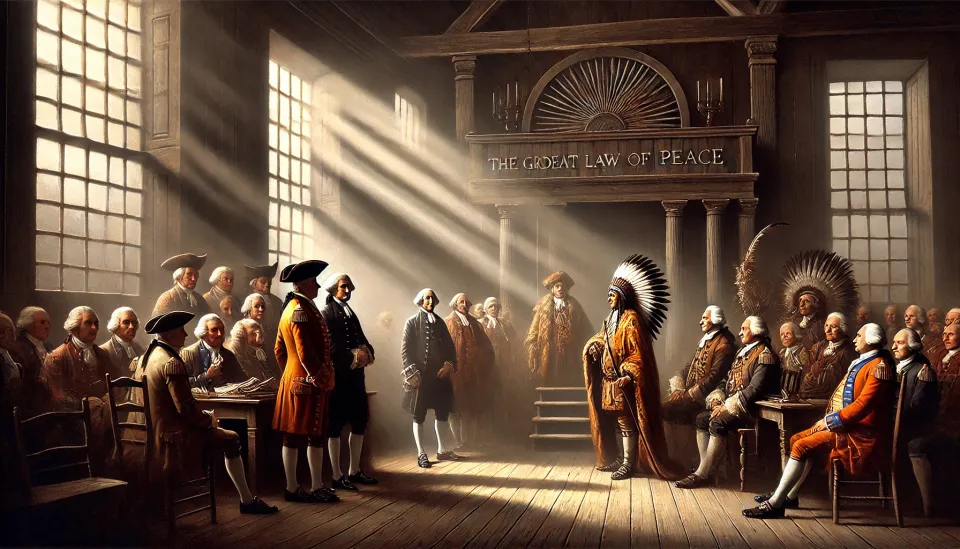
It is June 1754. The air in Albany, New York smells of pine smoke, damp wool, and the faint tang of iron from nearby forges. The courthouse is stifling. Wooden benches creak under the weight of delegates from seven British colonies who fan themselves with folded papers. Sweat darkens the collars of their coats as they wait for the council to begin. Among them sits Benjamin Franklin, spectacles slipping down his nose, already thinking beyond the borders of empire.
Outside, six men walk through the narrow dirt street lined with taverns and stables. They move with quiet confidence, their steps measured, their presence commanding attention. They are representatives of the Haudenosaunee Confederacy, known to the colonists as the Iroquois. They have traveled hundreds of miles from their longhouses and forests to renew an alliance and discuss peace, trade, and war. They come not as subjects or subordinates but as diplomats and equals. Theirs is a league of nations that has lasted for centuries, held together by a constitution called the Great Law of Peace.
Inside, the colonial delegates rise as the Haudenosaunee enter. The interpreters begin their careful work. The visitors describe how their league governs itself. Each nation retains sovereignty. Decisions that affect all are made in a Grand Council, where representatives deliberate until unity is reached. There is no majority rule and no simple vote to silence dissent. Every voice matters. Every argument is heard. They debate until harmony, not hierarchy, is achieved.
Each nation retains sovereignty. Decisions that affect all are made in a Grand Council, where representatives deliberate until unity is reached.
Leaders are chosen not for wealth or bloodline but for character. They must be patient, thoughtful, and self-disciplined. They are caretakers, not rulers, expected to make decisions that protect the next seven generations. The Confederacy can act as one in war but remains plural in peace, each nation independent yet interdependent.
Franklin listens carefully. This is not theory to him. He has met these men before as a colonial diplomat and publisher of their treaties. He knows their political order functions. He has seen stability maintained across vast distances without kings or standing armies. While European thinkers such as Montesquieu and Locke wrote about balance and liberty, the Haudenosaunee had been practicing both for hundreds of years.
He looks around at the colonial representatives, each jealous of their authority, each suspicious of the next. The British colonies cannot even agree on how to defend their frontier. He sees the irony. The so-called “savages” have accomplished what the empire’s brightest minds cannot: enduring cooperation among diverse peoples.
When the Haudenosaunee finish speaking, Franklin rises. His voice is calm but carries conviction:
“It would be a strange thing,” he says, “if Six Nations of ignorant savages should be capable of forming a scheme for such a union and be able to execute it in such a manner, as that it has subsisted ages, and appears indissoluble; and yet that a like union should be impracticable for ten or a dozen English colonies.”
Those words are not legend. They come from Franklin’s own letters. That same summer, he proposed the Albany Plan of Union, the first serious attempt to create a unified government among the colonies. The plan failed. The governors feared losing control. The assemblies feared higher taxes. But the idea did not die. It lingered like a spark, and two decades later it caught fire again in Philadelphia when the colonies gathered to declare independence and build a new nation.
Franklin did not merely witness diplomacy that day in Albany. He witnessed proof that decentralized democracy could thrive. He saw that unity did not need a monarch, papal authority, or tyranny. What European philosophers had only imagined, the Haudenosaunee had refined through lived experience.
Their confederacy was a political organism rooted in equilibrium, foresight, and moral accountability. It balanced liberty with responsibility and individuality with obligation to the whole. It embodied what would later be stamped on American coins: E pluribus unum, out of many, one. For the Haudenosaunee, that was not an abstract phrase. It was the lived structure of their world.
As the new republic emerged, history twisted the lesson. The founders borrowed the framework but buried the source. The Great Law of Peace faded from official memory, replaced by a mythology that traced all wisdom to Europe. The result was a nation that honored liberty in theory while ignoring those who had practiced it on the same soil for generations.
Part of our very way of life—our federations, our councils, and our checks and balances—was borrowed from the people we later dispossessed. The architecture survived, but the credit did not.
Part of our very way of life—our federations, our councils, and our checks and balances—was borrowed from the people we later dispossessed.
To tell this story truthfully is not to rewrite history but to complete it. Democracy was not a European export. It was born here too, in the smoke of council fires and the patience of consensus. The founders saw it with their own eyes and took what they needed. Acknowledging that debt does not diminish the Constitution. It gives it context. It proves that the human instinct toward cooperation and fairness is not owned by one civilization but shared by all.
If we cannot tell the truth about where our democracy came from, what hope do we have of preserving it? The Great Law of Peace still whispers through our institutions. It asks us to remember what we borrowed, what we forgot, and what we owe. That is the work of The Grounded: to tell the stories that were buried, to restore what was erased, and to hold power accountable to the truth that built it.
Author’s Note / Sources
- Benjamin Franklin, Letters on the Albany Plan of Union (1754).
- Albany Congress Proceedings (1754), Library of Congress.
- Great Law of Peace of the Haudenosaunee Confederacy, recorded by Arthur C. Parker (1916).
- U.S. Senate Concurrent Resolution 76 (1987) recognizing Haudenosaunee influence on the Constitution.
- Donald A. Grinde Jr. and Bruce Johansen, Exemplar of Liberty: Native America and the Evolution of Democracy (1991).
- Smithsonian Institution, National Museum of the American Indian, “Haudenosaunee Confederacy and the Constitution.”
Every claim in this article can be traced to these records and scholarly analyses.
If you find a factual error, prove it, and The Grounded will pay you $100. Truth deserves accountability.
Member discussion