The Quiet Science of Steering People

The Quiet Science of Steering People
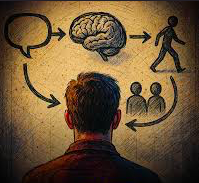
Words->Thoughts->Action->Reality

By Matt Stone

Humans are not mysterious. We are patterned. For decades, psychology, behavioral economics, neuroscience, marketing, and political strategy have been mapping those patterns with increasing precision. Not guesses. Replicable findings. If you know where to look, people behave predictably.

The core insight is simple: the human brain runs on shortcuts. We cannot calculate everything in real time, so we rely on heuristics. Those shortcuts keep us alive, but they also make us manipulable. We overweight vivid information. We anchor to the first number we hear. We fear losses more than we value gains. These are not flaws. They are features. And features can be exploited.

If a system can predict your behavior at scale, it doesn’t need to control you. Your options are already doing the work.

Persuasion is not abstract. It operates through a small, well-documented set of levers. Reciprocity makes people feel indebted. Consistency keeps them aligned with prior commitments. Social proof tells them what is normal. Authority tells them who to trust. Liking lowers resistance. Scarcity creates urgency. Unity binds identity to action. Trigger the right lever at the right time and behavior follows. This is not speculation. It is a playbook.                               

Behavior can be engineered. The formula is clean: motivation, ability, and a prompt. Raise emotion. Reduce friction. Deliver the cue at the exact moment attention is available. That is how habits form. That is how clicks happen. That is how decisions get made without feeling like decisions at all.

Technology did not invent manipulation. It solved the scaling problem. Social platforms proved that mood, attention, and salience can be shifted at population level by changing what people see and when they see it. Once that was established, the only remaining task was personalization.

That task is now complete.

Everyone is mapped. Not just demographically, but psychologically. What angers you. What reassures you. What makes you feel righteous. What makes you feel afraid. What keeps you scrolling. These profiles are inferred from behavior, not confessions. You do not have to tell the system who you are. It watches. It learns. It adjusts.

And then there is DNA.

Millions of people voluntarily handed over their genetic code to private companies, not under coercion, but curiosity. Ancestry. Health insights. A sense of belonging. In doing so, they converted the most intimate map of all into a commodity.

DNA profiles, once sequenced, are not just medical artifacts. They are data assets. They can be stored, analyzed, cross-referenced, sold, licensed, or acquired. Ownership migrates quietly, through mergers, partnerships, bankruptcy sales, and policy changes no one reads. What began as personal exploration becomes intellectual property. And intellectual property, inevitably, flows toward the highest bidder.

Of course, genetic data does not predict behavior in isolation, but when combined with psychological profiling, behavioral telemetry, location data, and social graphs, it makes a more complete picture. It anchors persuasion to biology. Risk tolerance, addiction vulnerability, stress response, impulse control, disease predisposition, even likely lifespan.

This is not science fiction. These correlations already exist, and they grow more precise as datasets merge. The map stops being probabilistic and starts becoming structural.

Once genetic data is absorbed into the broader data economy, its uses diverge quickly.

In elections, it sharpens persuasion by identifying who is biologically more reactive to fear, threat framing, or social belonging, and when they are most susceptible. Messaging no longer needs to persuade everyone. It only needs to mobilize, demobilize, or emotionally destabilize the right margins.

In insurance and healthcare, genetic risk profiles quietly inform pricing, coverage decisions, and actuarial models, even when formally “anonymized.” The signal does not need a name attached to function.

In national security, aggregated genetic and biometric datasets become population-level intelligence. They inform resilience modeling, stress tolerance, disease vulnerability, and long-term demographic forecasting. The same map that optimizes ad delivery also optimizes leverage. Different sectors, same substrate. Influence, risk, and control converge on the same underlying data.

Skeptics will say this overstates the power of DNA. Genes are not destiny. Correlation is not causation. Much of this data is regulated, anonymized, or siloed. All of that is true, and none of it negates the argument.

The claim is not that genetic data creates mind control. It is that it narrows uncertainty. It reduces noise. It improves prediction at scale when combined with behavioral data that already exists. Systems do not need perfect knowledge to exert power. They need asymmetry. When institutions know more about populations than populations know about how they are being modeled, influence becomes structural rather than conspiratorial.

No secret cabal is required. Only incentives, markets, and time. Board members gonna board member.

At that point, the danger is not that someone is pulling the strings.

It is that the strings are built into the system, and no one can see them.

Now, influence is no longer just about messaging. It is about timing, exposure, and pressure applied to known biological constraints. Steering no longer targets beliefs alone. It targets bodies.

This is no longer mass persuasion. It is individualized behavioral steering. Millions of tailored messages delivered to millions of different nervous systems, each calibrated to exploit specific vulnerabilities. The system does not care what you believe. It cares what moves you.

It measures the neural paths between your ears and flags whether they threaten the structure that governs you. Manipulation becomes invisible when it feels like choice. When reflection is bypassed. When belonging is weaponized. When urgency replaces deliberation. When every input is tuned to keep you in fast thinking, emotional response, and group alignment.

None of this is accidental. None of it is secret. The science is established. The methods are known. The infrastructure is already built.

And no, this is not the part where I put on a tin foil hat and start yelling about mind control satellites. If anything, the more boring, bureaucratic, and spreadsheet-driven the system looks, the more likely it is to be real.

Boring is the goal.

The only real question left is not whether humans can be manipulated.

It is who controls the map.

Humanity's Divide

Humanity’s Divide is an exploration of why humans are so easy to fracture, manipulate, and turn against one another, even when our survival depends on cooperation. It traces the divide back to evolutionary wiring, ancient myth-making, and the biological shortcuts that once kept us alive but now make us predictable. From religion and nationalism to algorithms, AI, and modern power structures, the book shows how those ancient instincts are being exploited at scale. It isn’t about villains or conspiracies. It’s about incentives, systems, and the uncomfortable reality that division is profitable. The core question isn’t who is doing this to us, but whether we can recognize the pattern in time to outgrow it.

Read more at: https://www.amazon.com/Humanitys-Divide-Origins-Instincts-Algorithms-ebook/dp/B0FTBT462R