The Truth Dies on the Way Up
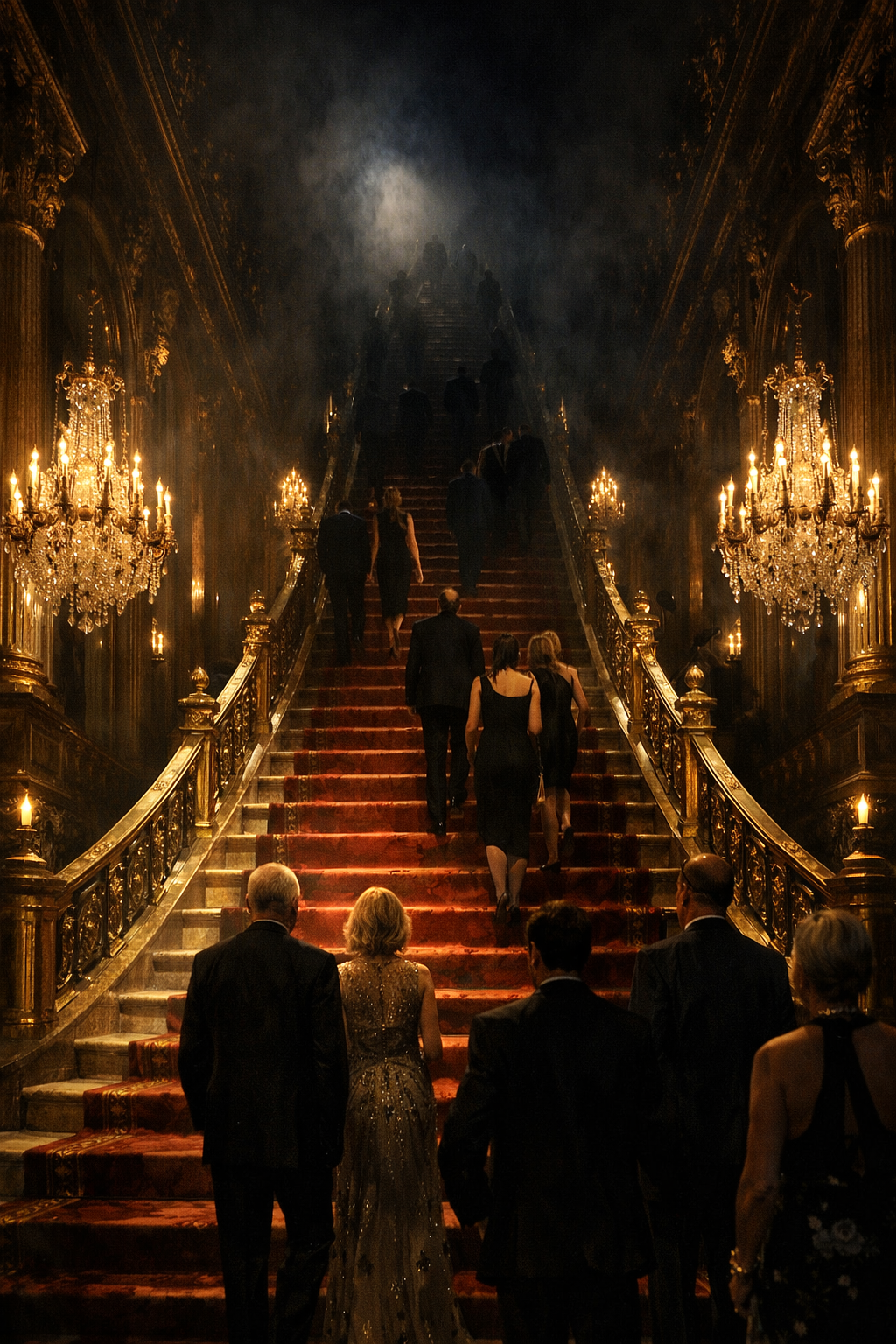
What happens when wealth buys not just power, but insulation from reality
By Matt Stone
The oldest lie in America is that the people at the top are there because they are better.
Smarter. Tougher. More disciplined. More serious. More fit to steer the machine.
That lie has had a good run. It has been dressed in enough patriotic language, donor money, Ivy League silk, and cable-news lighting to pass for truth in polite company. But the more you look at the people who actually run this country, the more the whole performance starts to collapse into farce. What we call leadership is too often a closed loop of wealth, access, inherited insulation, and well-managed stupidity. Not a meritocracy. Not a natural aristocracy. A club.
A rich guy club.
That is the whole rotten joke. America is not governed by its finest minds so much as managed by a protected social class of billionaires, heirs, donors, political mascots, media peacocks, and well-dressed halfwits who keep handing each other access to the machinery of the state and then acting offended when the public notices the machinery is coughing black smoke.
They are not better than everyone else.
They just know where the side door is.
For years, the public has been asked to kneel before this class as if it were carrying some rare strain of wisdom in its blood. We are supposed to believe these people belong at the top because they possess unusual gifts of judgment and character, that they have been refined by elite institutions into custodians of national life. They went to the right schools, learned the right manners, inherited the right Rolodexes, and emerged from think tanks, boardrooms, and dynastic compounds with the solemn self-regard of old priests and minor royalty.
But the more closely you look at them, the more absurd the whole thing becomes.
These are not philosopher-kings. They are not master strategists gripping the wheel of civilization with trembling moral seriousness while the mob howls outside the gates. More often, they are pampered opportunists with expensive haircuts and dead eyes, inflated by a culture that confuses confidence with intelligence and wealth with virtue. Strip away the handlers, the press releases, the family names, the campaign consultants, the attorneys, the flunkies, the makeup, the rituals, the donor dinners, and the protective fog of institutional language, and what you are often left with is not brilliance but vacancy. A polished vacancy. A branded emptiness. A set of teeth standing in front of a podium.
And these are the people running everything.
Or pretending to.
That distinction matters, because one of the dirtiest secrets of American life is that the people with the most power are often not the people with the most understanding. They are the people best positioned to inherit, buy, flatter, threaten, marry, bullshit, and network their way toward the controls. This is not a civilization organized around deep competence. It is a civilization organized around access. If you have enough money, enough family backing, enough immunity, enough shamelessness, and enough social insulation, you can fail upward for decades and still be introduced as a visionary.
That is not a bug in the system.
That is the system.
Truth Dies at The Top
One of the least discussed corruptions of wealth is not what it buys, but what it prevents.
A rich man does not merely acquire houses, lawyers, cars, security, and political access. He acquires insulation. He acquires a human buffer between himself and the raw texture of reality. He acquires an atmosphere. By the time a man reaches a certain altitude of money and influence, almost nobody around him is free to tell him the truth. Not the assistant. Not the consultant. Not the lawyer. Not the publicist. Not the campaign staffer. Not the executive under him angling for promotion. Not the journalist hoping to keep access. Not the friend whose lifestyle depends on staying in orbit. Not the lover enjoying the curated magic of proximity.
So the truth starts dying several rooms before it reaches him.
That is one of the hidden obscenities of the rich guy club. It is not just a network of money and influence. It is a system for filtering reality. The wealthy do not simply avoid consequences. They avoid unfiltered feedback. They stop hearing the word no in any meaningful tone. They stop being mocked by people who do not need them. They stop being corrected by anyone independent enough to risk offending them. They become surrounded by people whose survival depends, in one way or another, on preserving the mood of the king.
And once that happens, even a moderately flawed man starts to curdle.
A stupid idea does not get called stupid. It gets called bold. A reckless impulse does not get condemned. It gets reframed as unconventional leadership. A moral failure does not get named cleanly. It gets managed, spun, lawyered, and escorted through the side door in bloodless professional language.
The rich man begins confusing the absence of criticism with the presence of genius. He mistakes obedience for admiration. He mistakes silence for respect. He mistakes insulation for proof that he must be doing something right.
But he is not getting wiser. He is getting sealed off.
That is why so many rich men become distorted, erratic, and bizarre. Not because money automatically makes a man evil, though it certainly gives evil room to stretch its legs. It is because extreme wealth creates an epistemic breakdown. The man loses his ability to know where he ends and the performance begins. He no longer lives in ordinary reality. He lives inside a padded kingdom of handlers, flatterers, cowards, aspirants, and dependent little courtiers, all subtly rearranging the world to keep him comfortable. Every piece of information arrives massaged. Every problem arrives pre-softened. Every failure arrives with a narrative attached.
So he drifts upward through a fog of custom-tailored delusion, protected not only from consequences but from accuracy itself.
That is part of what makes the rich guy club so dangerous. It is not merely greedy. It is epistemologically broken. It cannot reliably recognize truth because everyone inside it is rewarded for managing appearances rather than naming reality. The richer the man becomes, the more his world fills with human insulation. The more insulation he acquires, the less likely he is to hear anything sharp enough to puncture his vanity. The less vanity gets punctured, the more grotesque his self-conception becomes. Before long, you have a man with the self-image of a titan and the emotional resilience of a spoiled child, wandering around with access to lawmakers, agencies, media platforms, data systems, and entire sectors of public life.
And still people ask why the ruling class gets so weird.
This is why.
Nobody around a rich man wants to be the one who tells him he sounds ignorant. Nobody wants to tell him he is embarrassing himself. Nobody wants to say the scheme is reckless, the speech is stupid, the appetite is diseased, the instinct is cruel, or the room has quietly begun to hate him. Too much is riding on his approval. Too many people are paid to convert his flaws into branding. Too many livelihoods depend on keeping the fantasy intact. So the fantasy grows.
It expands and hardens until it becomes a private reality, a sealed ecosystem where the man is not merely powerful but mythological in his own mind.
And once a man gets used to living inside that kind of false weather, he becomes almost impossible to govern from within. He does not seek truth. He seeks reinforcement. He does not want honesty. He wants loyal translation. He does not want correction. He wants narrative management. His circle stops functioning like a community of adults and starts functioning like palace staff, forever adjusting the mirrors so His Majesty does not have to see the swelling, the rot, the stupidity, the fear.
That is why the rich guy club should never be romanticized as a gathering of bold independent thinkers. It is often the opposite. It is a hermetically sealed hallucination populated by people too dependent, too compromised, too ambitious, or too frightened to speak plainly. A billionaire may have the entire world at his fingertips and still be one of the least honestly informed men in the country, because every fact that reaches him has been filtered through the career calculations of people who need him pleased.
That is the final joke. The rich man, so envied by the public and so feared by his subordinates, ends up living in a reality thinner than everyone else’s. He can buy almost anything except an honest room. He can command empires and still not know what people really think when he leaves. He can own platforms, houses, politicians, and half a coastline, and still be starved for the one thing that might save him from becoming absurd: a person with enough freedom to laugh in his face and tell him the truth.
The Protection Racket
That is what the rich guy club really is: a protection racket with better tailoring, private chefs, and a patriotic soundtrack.
It protects its own. It launders failure. It cushions disgrace. It turns incompetence into mystique and corruption into networking. It does not care about consistency, only about preserving the emotional atmosphere in which its members can continue to present themselves as indispensable. The same names, the same bloodlines, the same donor circles, the same television creatures, the same corporate creeps, the same dead-eyed operators keep surfacing at the center of national life like toxic driftwood the tide refuses to take back.
And when they are caught with their hands in the wiring, the insult is not just that they did it.
The insult is the expectation that the rest of us will accept it as normal.
Look at the social machinery of this class and the pattern repeats everywhere. Billionaires drift into public life not as servants but as owners. They do not approach government with humility or even with the minimal awareness that they are entering something that belongs to the people. They approach it the way a drunken landlord approaches a building superintendent, as something already theirs in spirit if not yet in paperwork. A networked rich man gets enough money and enough mythology around his name, and suddenly he is treated as though his whims deserve a tour through the nervous system of the state. Doors open. Staff make room. Lawyers start translating appetite into authority. The whole apparatus bends just enough to let him feel the texture of public power under his fingertips.
And why would he not expect that?
Everything in this country has been teaching him that rules are for people with less money. The rich guy club does not see government as a public trust. It sees it as another acquisition target. Another zone to enter, shape, strip, leverage, and convert into influence. Not a republic, but a venue. Not a common inheritance, but a set of premium controls. Get close enough to the wiring and eventually you start to believe you are the electricity.
That attitude is not some recent mutation. It is the logical product of a society that has spent decades worshipping capital without demanding character. We let rich men cosplay as prophets. We let CEOs posture as philosopher-engineers of the future. We let hedge fund goblins talk like they are nation-builders. We let media creatures recite the catechism of innovation while every institution around them fills up with dead language and managed decay. We let donors become statesmen and heirs become thought leaders and bored narcissists become public visionaries simply because they had enough money to stage the illusion at scale.
And while all that pageantry rolls on, ordinary people are told to tighten their belts, mind their tone, respect the process, and trust the adults in the room.
The adults in the room.
What a line.
You hear it long enough in this country and you start picturing granite-jawed figures with difficult consciences and real command of the machinery. Men and women who know history, understand consequence, read beyond the brief, and can explain why a policy exists in terms more substantial than optics or donor sentiment. That is what the phrase is supposed to conjure.
But then you watch the hearings. You watch the interviews. You watch the speeches, the votes, the hollow ceremonial indignation, the clumsy lies, the pre-chewed slogans, the grin of the man who has no clue what he is reading but knows the cameras are on. And the whole fantasy begins to smell like a dead rodent in the ductwork.
Because too many of these people are too fucking dumb.
Not folksy. Not plainspoken. Not strategically vague. Dumb. Or worse, shallow in a way that power should never permit. Superficial men in expensive ties, women trained to smile through moral vacancy, committee peacocks mouthing positions they barely understand, party creatures whose deepest skill is surviving donor ecosystems and speaking in the narcotic rhythm of consensus language.
They are not all idiots. Some are cunning. Some are disciplined. Some are cold and capable in the worst possible way. But far too many of them, once observed without the respectful lighting and the institutional music swelling behind them, turn out to be little more than socially successful mediocrities.
And this is where the rich guy club becomes more than an annoyance.
This is where it becomes a civilizational liability.
Because it would be bad enough if these people were merely vain and fraudulent. But they are not presiding over a harmless toy nation where their incompetence can be laughed off over cocktails. They are sitting on war powers, financial systems, collapsing infrastructure, surveillance tools, police systems, regulatory agencies, ecological disaster, digital platforms, and enough propaganda machinery to stupefy a continent.
Their ignorance is not decorative. It has consequences. Their shallow understanding does not remain trapped in green rooms and donor retreats. It spills outward into budgets, prosecutions, contracts, invasions, data systems, healthcare denials, labor exploitation, censored truths, and a thousand daily humiliations for people who never once set foot in the rooms where all these elegant frauds keep congratulating one another.
And then there is the filthier layer, the one the public keeps being instructed not to stare at too hard.
The Epstein world was not just the story of one predatory monster with money and appetite. It was a panoramic snapshot of what elite society looks like when the curtains get yanked down and the makeup starts streaking under the lights. It was proximity. Protection. Access. Shared silence. Social immunity. The dense stench of a ruling class so used to impunity that it drifted around depravity with the casual entitlement of men ordering room service. Every time another elite adjacency becomes harder to ignore, every time the public is told to remain very calm and very nuanced and not to draw any broad conclusions about what it all says about the people at the top, the insult deepens.
Because the broad conclusion is the point.
This class is rotten.
Not every individual. Not every rich person. Not every politician. Fine. Spare me the ritual throat-clearing. The pattern is what matters. The pattern is a social class that keeps turning up around fraud, abuse, blackmail, war-profiteering, corruption, insider dealing, sexual compromise, regulatory capture, and grotesque forms of immunity, then reacting with moral offense when ordinary people begin asking whether perhaps the entire arrangement is diseased at the root.
And it is diseased at the root.
The Facade is Gone
That is why their language feels so fake now. They keep talking about norms, decency, public trust, service, excellence, security, stewardship, guardrails, civic responsibility, and national values, but the words no longer carry their old narcotic effect because too many people have seen the men saying them. Too many people have watched these moral weather vanes slither from scandal to scandal while keeping their speaking slots and board seats. Too many people have watched billionaires receive the kind of deference once reserved for saints and conquerors only to reveal themselves as needy, overprotected little emperors with the emotional discipline of casino drunks.
The mystique is cracking.
That is the danger for them.
Because authority is never just force. Force matters, obviously. Ask the poor. Ask the incarcerated. Ask the bombed. Ask anyone who has felt the boot instead of merely hearing it in the distance. But for a ruling class to endure, force is not enough. It also needs belief. It needs atmosphere. It needs the emotional architecture of legitimacy. People have to believe, at least dimly, that those above them are in some meaningful sense more capable, more informed, more serious, more fitted for command.
Once that belief begins to rot, the whole social order gets a little unstable in the knees.
And the rich guy club can feel that happening.
That is why everything is so hysterical now. Why the image management is so frantic. Why the press language is so coordinated. Why criticism is treated not as disagreement but as contamination. Why every exposure must be neutralized, every scandal compartmentalized, every ugly pattern renamed as a complicated exception. The club understands, probably better than the public does, that its real vulnerability is not merely criminal exposure or financial risk.
Its real vulnerability is ridicule.
Once ordinary people stop seeing these men as titans and start seeing them as overprotected fools with inherited leverage and private jets, something essential slips. Contempt is fatal to false majesty.
And contempt is spreading.
You can feel it in the culture. The old awe has gone sour. The billionaire no longer effortlessly reads as a genius. The politician no longer automatically scans as a statesman. The executive no longer naturally appears as a builder of worlds. More and more of them look like what they are: salesmen for themselves. Frantic internal children wrapped in security details. Men who were told from the age of seven that they mattered more than everyone else and built entire empires to keep from ever encountering evidence to the contrary.
They are not calm stewards of civilization.
They are insecure mammals in tailored wool trying to turn social domination into a spiritual principle.
And still they expect reverence. Still they expect the teacher, the waitress, the veteran, the adjunct, the HVAC guy in August, the graduate student on fumes, the parent fighting insurance denials while their child is sick, the man driving for an app with no health coverage, all to stand there and nod while some overfed ghoul from the donor caste explains why the country must once again be entrusted to the exact people who ruined it.
No.
To hell with that.
The rich guy club has had enough grace. Enough benefit of the doubt. Enough flattering profiles, enough heroic framing, enough generous language, enough serious-cover books about complicated visionaries navigating turbulent times. We have seen what these people build when left unchecked. We have seen how they behave around money, around women, around power, around secrecy, around the law, around one another. We have seen them treat institutions as toys, publics as obstacles, suffering as collateral, and truth as a branding problem.
And we are still supposed to imagine they are the indispensable class.
Indispensable for what?
For laundering failure into prestige.
For converting wealth into political access.
For turning every public structure into an opportunity for extraction.
For dressing up class loyalty as national leadership.
For filling the air with enough expensive nonsense that people forget how obvious the scam really is.
That is the central obscenity. Not simply that the club is corrupt, but that it has managed for so long to market itself as merit. That is the masterpiece of the con. Not the money alone. Not the influence alone. The ability to convince generations of people that obscene access and inherited insulation were signs of superior fitness to rule.
They were never signs of superior fitness.
They were signs that the castle had a leak.
The rich guy club did not conquer America because it was wise. It conquered America because it understood that institutions can be hollowed out and still retain their ceremonial grandeur for a very long time. A rotten building can look majestic right up until the floor caves in. A ruling class can keep speaking in the language of excellence long after it has lost any real claim to the word. All it needs is enough money, enough media discipline, enough selective law enforcement, enough cultural intimidation, and enough exhausted people too busy surviving to inspect the walls.
But the walls are being inspected now.
And they are full of mold.
That is why this era feels different. Not because corruption is new. Corruption is ancient and probably immortal. Not because elites suddenly became decadent. Decadence is as old as power. It feels different because the performance is wearing thin. The public is getting too many glimpses backstage. Too many obvious frauds keep stumbling into daylight. Too many celebrated leaders keep revealing themselves to be hollow men, club creatures, or social climbers with security clearances. Too many people now understand, in their bones, that wealth is not evidence of virtue, access is not evidence of understanding, and institutional elevation is often just a cleaner word for selection by insiders.
That understanding will not save us by itself. A society can know it is being ruled by frauds and still go on being ruled by frauds. Empire has a high tolerance for obvious bullshit. People can hate their rulers and still obey them for generations if the penalties for noncompliance remain severe enough.
But clarity matters.
Clarity changes the emotional field. It means fewer people instinctively bowing before expensive confidence. It means more people hearing polished elite language as a sales pitch instead of a revelation. It means the billionaire’s prophecy sounds less like wisdom and more like a man trying to protect his tax position. It means the senator’s solemn speech sounds less like constitutional duty and more like a frightened actor protecting a donor lattice. It means the panel of respectable corpses on television starts to look less like a source of truth and more like a taxidermy exhibit for institutional decay.
And once enough people see that, the atmosphere shifts.
That is what the club fears.
Not just revolt. Revolt is messy and rare and often easy to crush in the short term. They fear demystification. They fear a public that no longer confuses polished surfaces with deep authority. They fear becoming legible. They fear being seen in broad daylight as a class of overpromoted insiders whose greatest talent was convincing the country that their privileges were proof of virtue.
Because once that illusion really dies, they have to rely more openly on what was always there beneath the rhetoric anyway: money, access, coercion, blackmail, gatekeeping, surveillance, lawfare, patronage, and force.
That is a harder sell than meritocracy.
So let us be honest about what this is.
This is not a republic guided by its finest minds.
This is not a meritocracy with a few unfortunate distortions around the edges.
This is not a nation occasionally embarrassed by a few bad apples in high office.
This is a decaying empire managed by a rich guy club that protects its own, feeds on public life, launders vice through status, and keeps demanding reverence long after it has forfeited any right to receive it.
That is the story.
And the ugliest part is that they still seem convinced the public will go on mistaking the costume for the man.
Maybe for a while. Empires can run on insult longer than anyone thinks. People can swallow astonishing amounts of humiliation when they are tired, fragmented, indebted, medicated, distracted, and afraid. But there is always a limit. A point where the makeup stops covering the rot. A point where the laughter turns from nervous to contemptuous. A point where even people who agree on almost nothing begin to sense that they are being ruled by a smug fraternity of compromised buffoons in good watches.
And once that recognition settles in, the club has a problem no amount of money can fully solve.
Because fear can sustain power.
Greed can sustain power.
Propaganda can sustain power.
But eventually, if enough people look up and see that the throne is occupied by a room-temperature IQ with a donor list, the spell begins to break.
And when the spell breaks, the rich guy club is no longer majestic.
It is just a gang.
Member discussion