
Unidentified, Under Oath
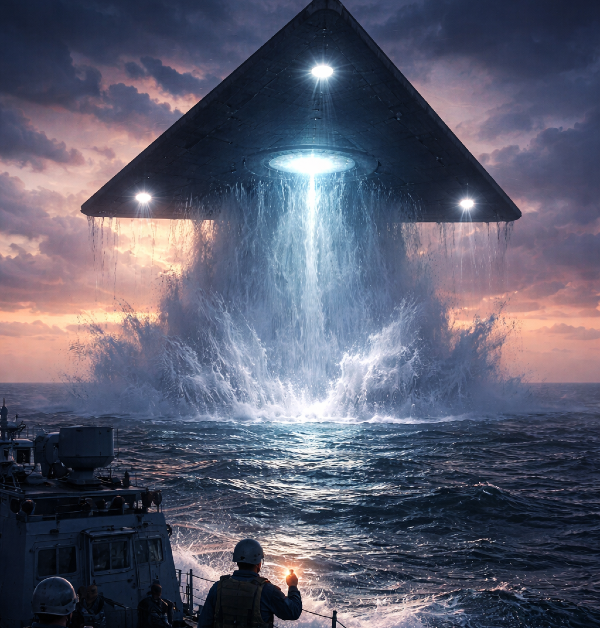
The 70-Year Secret Right Under our Noses.
By Matt Stone
This was the most difficult piece I have ever written, because it refuses to sit in a comfortable category. It is not fringe enough to dismiss. It is not confirmed enough to conclude. It is not quiet enough to ignore. It is not loud enough to dominate headlines.
For decades UFOs were treated as cultural folklore. Today they are the subject of congressional hearings, intelligence assessments, and bipartisan legislation. Whether the phenomenon represents foreign technology, misunderstood sensor data, or something else entirely, it now occupies a strange place between national security concern and scientific mystery.
The easy move would have been to pick a side. Either this is obvious nonsense or this is obvious concealment. Both positions are emotionally efficient. Neither requires discipline.
The hard part was refusing both exits.
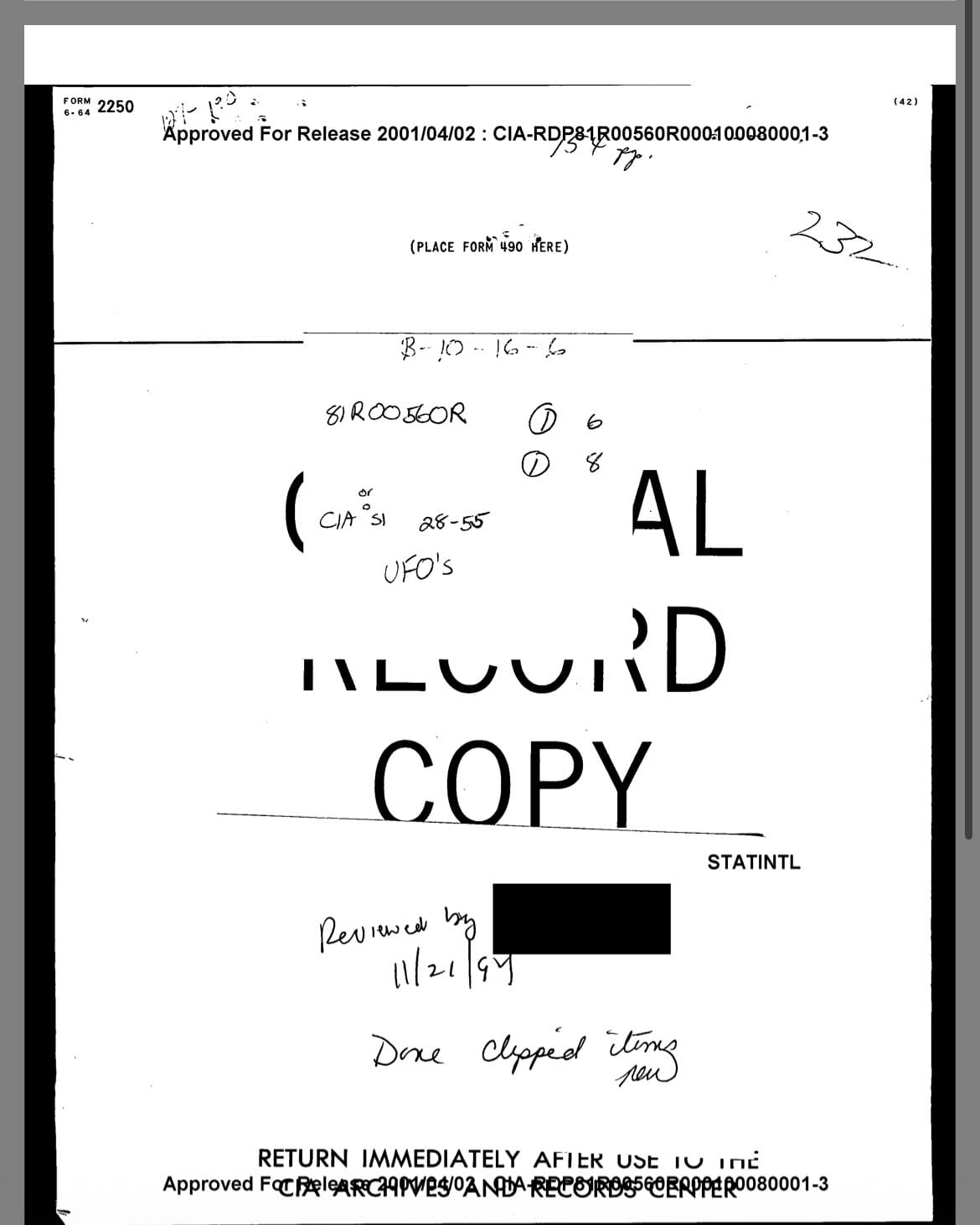
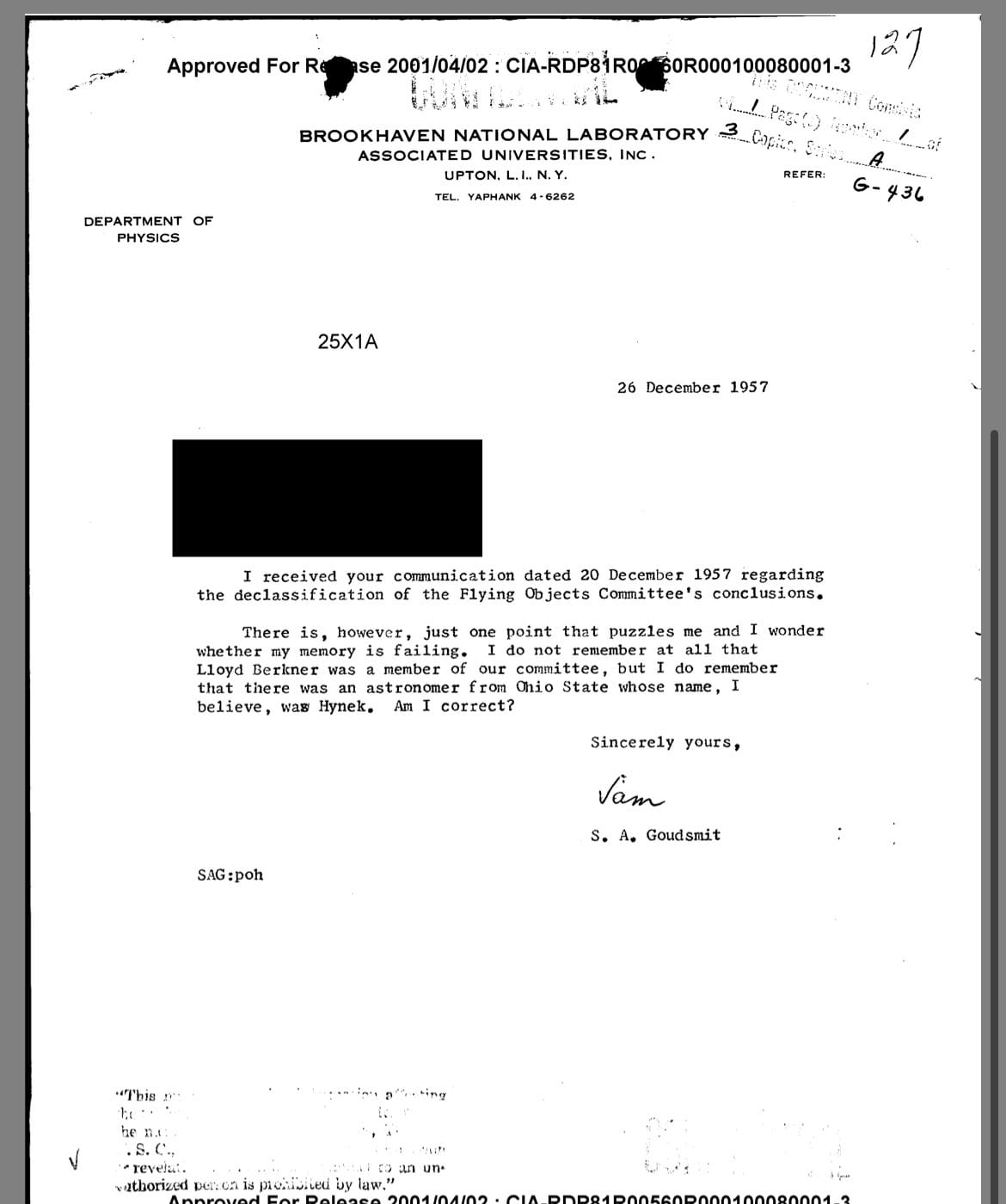
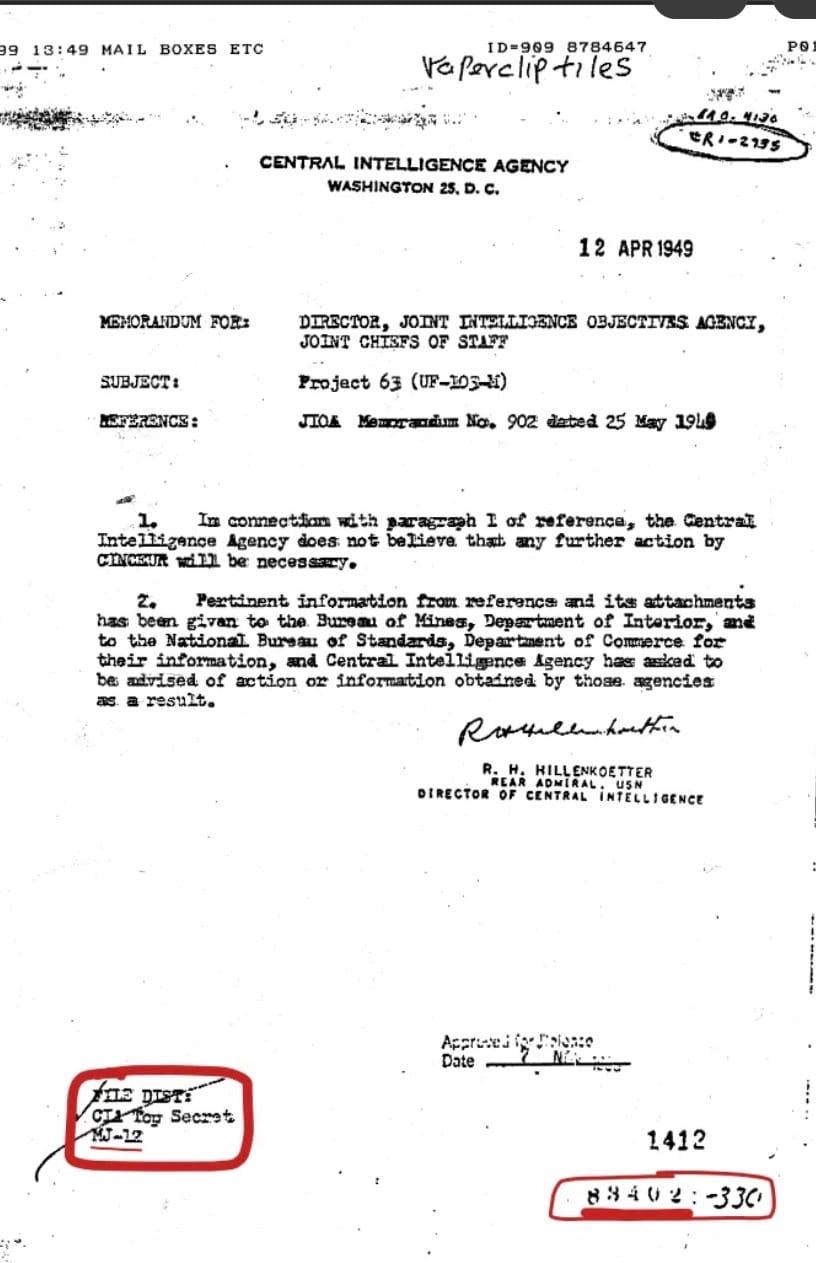
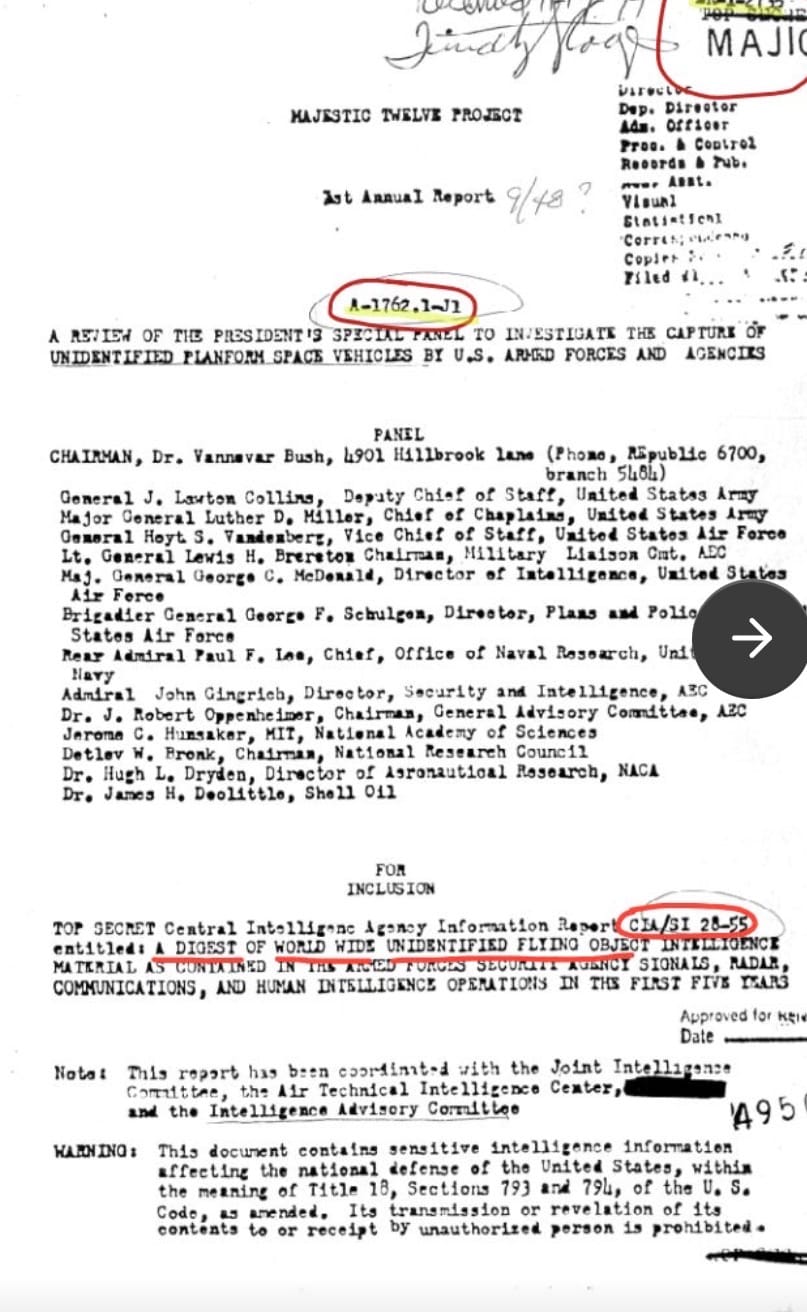
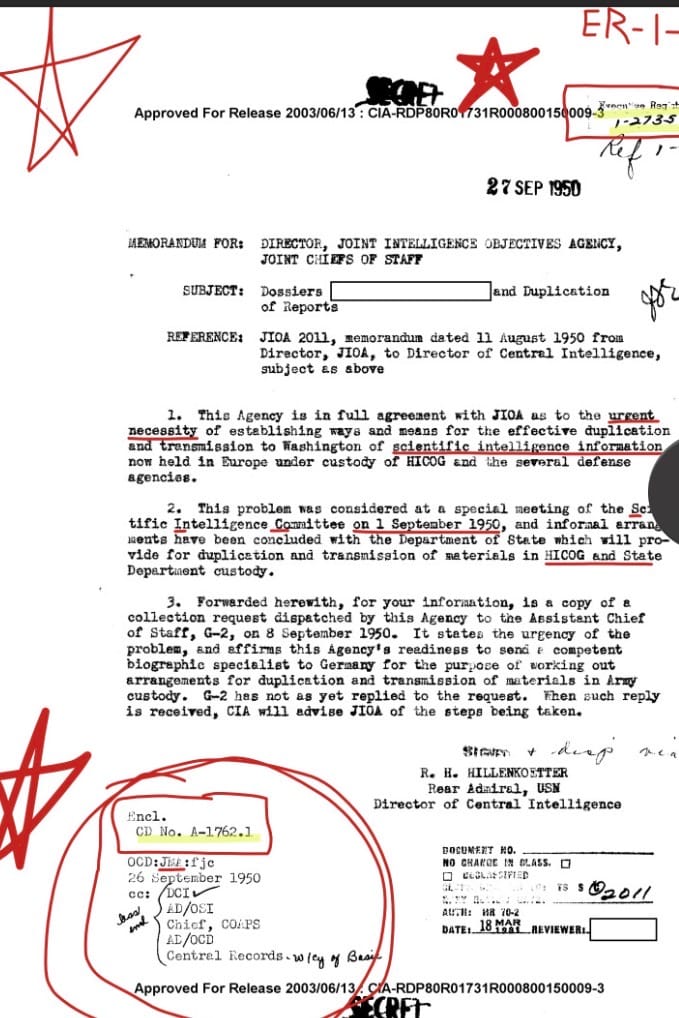
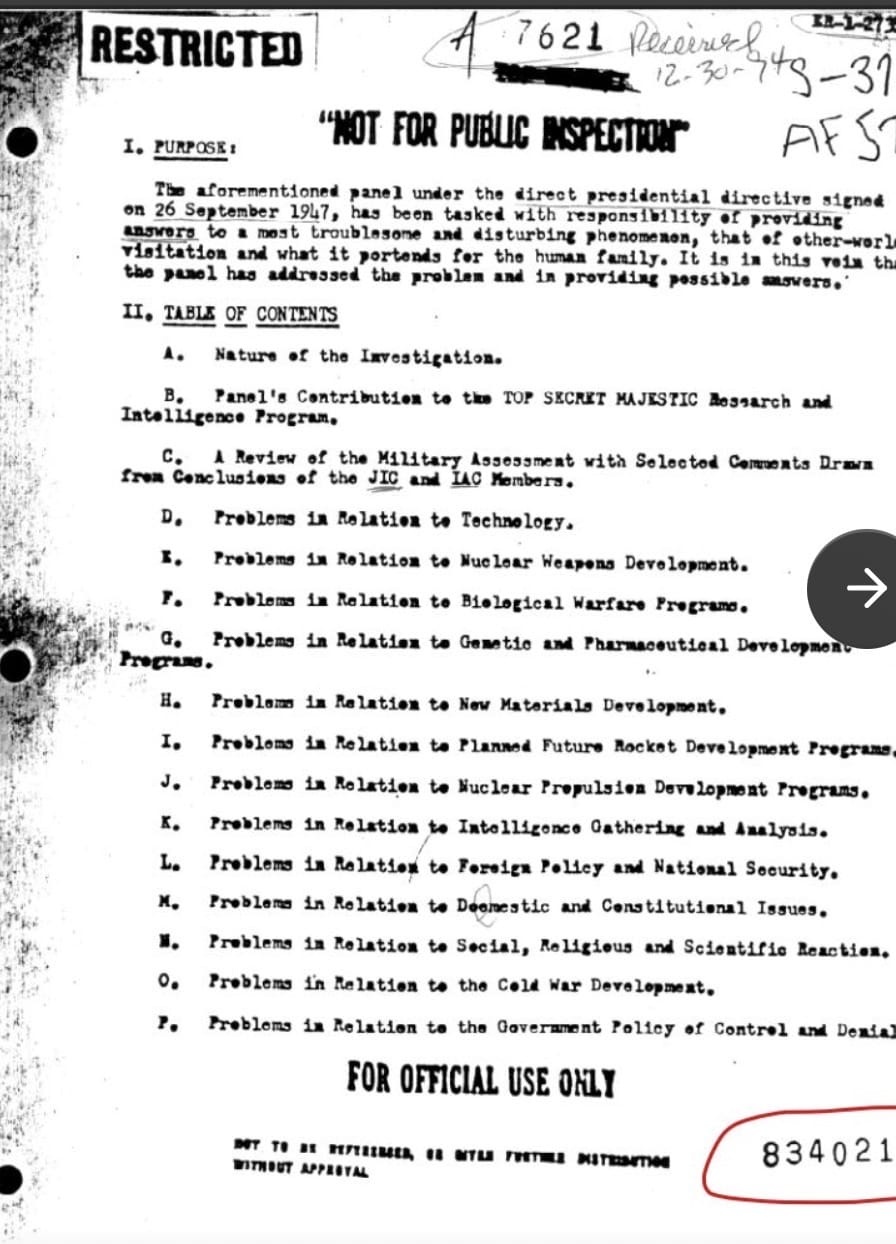
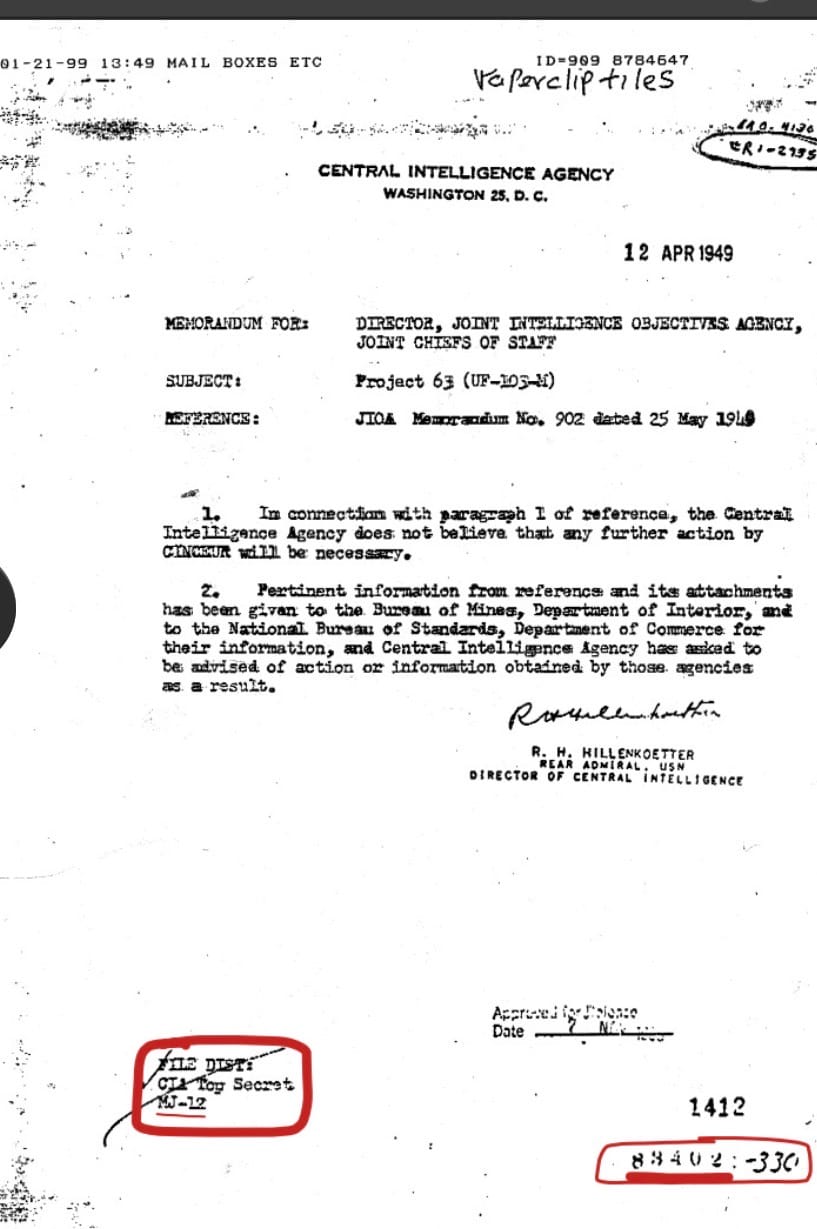
At the bottom of this article, you will find documents straight from the CIA website concerning MJ-12—the men who first dealt with the phenomenon and decided to keep it a secret in the 1940s.
And collecting all of this evidence into one place was, well, a bitch. But here we go...
SECTION I
UNIDENTIFIED, UNDER OATH
Military pilots testified under oath that they saw objects with no visible propulsion. An intelligence officer alleged legacy crash retrieval programs. Lawmakers introduced disclosure legislation referencing non human intelligence. The Pentagon denied possessing extraterrestrial craft. AARO released a review rejecting claims of alien hardware.
All of that exists at the same time.
Include only the strange and you lose credibility. Include only the denials and you lose completeness. Omit the international cases and you distort the pattern. Lean too hard into them and you undermine the hearings.
The difficulty was not finding information. It was holding tension without resolving it for the reader.
This subject punishes certainty. It demands clarity without conclusion.
That is why it was difficult.
And that is why it had to be written.
This is all of the confirmed evidence that could, or could not, mean that we are not alone and that we never were.
The Subject Was Closed. Then It Wasn’t.
The Night the Skies Over Washington Lit Up — July 1952
On the night of July 19, 1952, something strange appeared over the most heavily defended airspace in the United States. Radar operators at Washington National Airport began noticing multiple unidentified targets moving across their screens. The blips appeared suddenly, vanished just as quickly, and then reappeared somewhere else in the sky. Some seemed to change direction at sharp angles or accelerate faster than any aircraft known to exist at the time.
At first, operators assumed the radar equipment might be malfunctioning. But within minutes another radar installation at Andrews Air Force Base began detecting the same objects. Independent radar confirmation meant the phenomenon was not simply a technical glitch.
Controllers began tracking several targets moving slowly across the Washington skyline. Witnesses on the ground soon reported strange lights hovering above the capital. Air traffic controllers could see them visually while simultaneously watching the same objects move across radar scopes. One controller later said the objects appeared to “dart away at tremendous speed” whenever aircraft attempted to approach.
Fighter jets were scrambled to intercept. As the jets climbed toward the targets, the objects abruptly disappeared from radar. When the fighters returned to base, the blips reappeared.
The events repeated a week later on the night of July 26–27. Again radar installations around Washington detected multiple unknown objects moving through restricted airspace. Again jets were scrambled. Again the objects seemed to evade interception.
The sightings caused national alarm. Newspapers across the country ran front-page stories describing “flying saucers” over the capital. The U.S. Air Force responded by holding the largest press conference since the end of World War II. Officials explained the radar returns as a phenomenon known as temperature inversion, where layers of warm air can bend radar signals and create false targets.
The explanation satisfied some observers but not all of them. Several radar operators involved in the incident stated that what they saw behaved like controlled objects, not atmospheric distortions. Visual sightings from pilots and ground observers complicated the explanation further.
More than seventy years later the Washington incidents remain one of the most famous episodes in the history of unidentified aerial phenomena. What made the events remarkable was not simply the sightings themselves but the convergence of radar detection, visual observation, and military response over the political center of the United States.
For a brief moment in the summer of 1952, something unexplained moved through the skies above Washington, D.C., and the entire country watched it unfold in real time.
For nearly half a century, the official position of the United States government was that the matter was settled.
From 1952 to 1969, the U.S. Air Force operated Project Blue Book, an official investigation into reports of unidentified flying objects. Over 12,000 cases were cataloged. In 1968, the University of Colorado’s Condon Report concluded that further study was unlikely to yield major scientific discovery. In 1969, Blue Book was shut down. The Air Force announced there was no evidence that UFOs represented advanced technology beyond known science and no evidence of extraterrestrial vehicles.
The subject was closed.
And culturally, it was buried.
For decades afterward, reports continued from civilians and pilots, but institutionally the topic was treated as a relic of Cold War hysteria. The message was clear: this was folklore, misidentification, or imagination.
That posture held until December 16, 2017.
On that date, The New York Times published a front-page story revealing that the Pentagon had funded a previously undisclosed program called the Advanced Aerospace Threat Identification Program, or AATIP. The article included cockpit footage recorded by U.S. Navy aircraft. The Department of Defense later confirmed the authenticity of those videos.
The key shift was not the videos.
It was the admission.
The federal government had quietly reopened the file.
This was not a revival of Blue Book. It was a classified program operating inside the Department of Defense long after the public had been told the issue was resolved.
The story was not about aliens.
It was about institutional contradiction.
The government had publicly closed the subject in 1969.
Privately, it had continued studying it.
And Americans largely moved on.
SECTION II
Bob Lazar and the Reverse-Engineering Claim
Long before modern congressional hearings revived interest in UFOs, a man from Nevada stepped forward with a story that reshaped the mythology surrounding the phenomenon.
In 1989 Bob Lazar appeared in interviews with Las Vegas journalist George Knapp.
His claim was extraordinary.
Lazar said he had worked at a secret installation near Area 51, specifically at a facility he called S-4 near Papoose Lake.
According to Lazar, the United States government possessed multiple recovered craft of non-human origin. His role, he said, was to assist in attempts to reverse-engineer their propulsion systems.
Lazar described saucer-shaped vehicles powered by a gravity-manipulation system. Instead of using conventional thrust, the craft supposedly generated their own gravitational field, allowing them to tilt forward and fall toward their destination.
He also claimed the propulsion system used an exotic fuel—an element heavier than any naturally occurring element on Earth.
Decades later, scientists would synthesize Moscovium, although its properties do not match the stable material Lazar described.
Critics quickly attacked Lazar’s credibility. Universities he claimed to attend reported no records of him. His personal life became the subject of scandal. Skeptics dismissed the story as fabrication. Yet several details complicated the narrative.
Investigators later found Lazar listed in a Los Alamos laboratory directory. A local newspaper article from the early 1980s also described him as a physicist working at the facility. He produced tax documents suggesting payments from naval intelligence.
None of this proves Lazar worked on alien spacecraft.
But it explains why the story never disappeared. Lazar’s account was not vague. He did not describe rumors or secondhand testimony.
He stated, directly and repeatedly, that the United States possessed recovered craft and was attempting to understand their technology.
Thirty-five years later, the claim remains neither confirmed nor conclusively disproven.
Section III
Gary McKinnon and the Files That Shouldn’t Exist
If Bob Lazar represents the claim that alien technology has already been recovered, then Gary McKinnon represents a very different path into the same mystery.
McKinnon was not a physicist. He was not a military officer. He was not an insider with security clearance. He was a computer administrator from London who believed the United States government was hiding information about advanced energy technologies and unidentified flying objects.
In 2001 and 2002, using little more than a dial-up internet connection and a vulnerability in poorly secured Windows systems, McKinnon began scanning networks belonging to the United States Department of Defense and NASA.
What he discovered stunned even him.
According to McKinnon, many of the systems he accessed had almost no security at all. Some machines reportedly still used default administrator passwords.
Once inside, he began exploring. What he claims to have seen remains one of the most controversial elements of the entire UFO debate. McKinnon has said that within NASA networks he located references to “non-terrestrial officers.”
He also described discovering spreadsheets listing “fleet-to-fleet transfers” involving ships whose names did not correspond to any known naval vessels.
Most famously, McKinnon claims he located a high-resolution image on a NASA system showing what appeared to be a large cigar-shaped craft floating above Earth’s atmosphere.
Before he could finish downloading the image, the cursor moved on the screen, and the system connection was severed. The file vanished.
And within hours, investigators began tracing the intrusion.
The Largest Military Computer Hack in History
U.S. authorities did not treat the breach lightly.
Officials later described McKinnon’s actions as the largest military computer intrusion ever carried out by an individual.
The United States Department of Justice filed charges against him that could have resulted in decades in prison if he had been extradited and convicted.
For nearly ten years the United States pursued McKinnon through the courts.
The extradition battle became an international legal drama.
British authorities initially approved the request, but the case became increasingly controversial as details of McKinnon’s mental health and the severity of the potential sentence emerged.
Eventually, in 2012, the United Kingdom blocked the extradition entirely.
McKinnon would never stand trial in the United States.
Why the Case Raised Eyebrows
The question many observers asked was simple.
Why did the United States pursue McKinnon so aggressively? Computer intrusions happen regularly. Governments prosecute them, but rarely with the level of diplomatic pressure applied in this case.
To McKinnon’s supporters, the intensity of the prosecution suggested something else. If the hacker had truly found nothing unusual, why devote nearly a decade to bringing him to trial? And did the U.S. actually want a deposition discussing what he found?
The official explanation focused on the damage done to government systems.
McKinnon himself insisted he had never intended to cause harm. His goal, he said, was simply to search for evidence of suppressed technologies and UFO research.
Whether his claims are accurate remains impossible to verify. The files he described were never recovered publicly. No confirmed documentation of “non-terrestrial officers” has ever surfaced.
Yet the story persists for the same reason the Lazar narrative endures.
The claims are extraordinary.
But the circumstances surrounding them are equally unusual.
A Digital Echo of an Old Mystery
McKinnon’s story is not proof of extraterrestrial technology.
But it occupies a strange place in the modern UFO narrative.
Unlike eyewitness testimony or radar encounters, his account revolves around digital records—documents allegedly stored inside government networks.
If such files existed, they would represent the kind of evidence that investigators have searched for since the beginning of the UFO era.
And yet the trail ends where it began.
With a man who says he saw something he was never supposed to see.
And a file that disappeared before anyone else could examine it.
Section IV
What Military Witnesses Described Under Oath
The modern record is not built on grainy civilian footage. It is built on sworn testimony from trained military observers.
In 2004, during training exercises off the coast of California, radar operators aboard the USS Princeton began tracking unknown objects descending from extremely high altitude to much lower altitude in seconds. Commander David Fravor was vectored to intercept.
Under oath before Congress in July 2023, Fravor described what he saw: A smooth, white object. Roughly forty feet long. Shaped like a Tic Tac. No wings. No rotors. No exhaust plume. No visible propulsion. No control surfaces.
Below it, he testified, the ocean surface appeared disturbed, as though something large was beneath it.
Fravor described the object moving erratically, then reacting to his aircraft’s movement. When he attempted to engage, the object climbed and accelerated away at a speed he had never observed in known aircraft.
He did not claim extraterrestrial origin.
He said, plainly, “I don’t know what it was.”
Former Navy pilot Ryan Graves testified about encounters beginning around 2014 in East Coast training airspace. He described objects reported by multiple pilots as appearing like “a cube inside a sphere.”
Not a light.
Not a blur.
A geometric shape: a dark cube enclosed within a transparent sphere.
Graves testified that these objects were encountered repeatedly over months, sometimes coming within fifty feet of military aircraft. His primary concern was aviation safety. He did not speculate about origin. He described a recurring, unidentified presence in restricted airspace.
The Office of the Director of National Intelligence, in its June 2021 Preliminary Assessment, documented reports of objects that appeared to remain stationary in high winds, move against the wind, maneuver abruptly, and travel at considerable speed without discernable propulsion.
The report did not attribute extraterrestrial origin.
It did not resolve the anomalies either.
It categorized them as unidentified due to insufficient data.
That is the official language.
Unidentified.
Not explained.
SECTION V
The Allegation of a Legacy Program
In July 2023, former intelligence officer David Grusch testified under oath before the House Oversight Committee.
Grusch did not testify about personally seeing alien craft.
He testified that he had been informed by individuals with what he described as direct knowledge that the United States possessed a multi-decade crash retrieval and reverse-engineering program operating within highly classified compartments.
He stated that he had been denied access while investigating these claims and that he experienced retaliation for pursuing them.
Under questioning, when asked whether “non-human biologics” were part of the alleged programs, Grusch answered that such assessments had been made by individuals he interviewed.
That phrase now exists in congressional transcript.
The Department of Defense denied possessing extraterrestrial craft and denied operating hidden alien retrieval programs.
This is the tension point.
A sworn allegation of a legacy crash retrieval program.
An official denial from the Pentagon.
Both exist in the public record.
SECTION VI
Congressional Escalation and Legislative Action
Following the 2023 hearing, lawmakers including Senator Chuck Schumer, Senator Mike Rounds, Senator Marco Rubio, and others introduced the UAP Disclosure Act as an amendment to the National Defense Authorization Act.
The proposed language referenced “technologies of unknown origin” and “non-human intelligence.”
It sought to establish a review board modeled after the JFK Assassination Records Act and included a presumption of disclosure for historical records related to unidentified anomalous phenomena.
The legislation was introduced. Portions were later narrowed during negotiation.
The final version passed in more limited form.
Regardless of interpretation, the fact remains: bipartisan senators drafted federal legislation treating UAP records as matters requiring structured declassification review. That is not folklore. That is statute language.
SECTION VII
AARO and the Government’s Counter-Narrative
In response to growing pressure, the Department of Defense formalized the All-domain Anomaly Resolution Office, or AARO.
In 2024, AARO released a historical review stating that it found no verifiable evidence that the U.S. government had possessed extraterrestrial craft. The report argued that many legacy crash-retrieval rumors likely stemmed from misidentified classified aerospace programs and misunderstandings of compartmentalized military projects.
In other words: what people thought was alien hardware may have been secret human hardware.
That conclusion does not resolve every allegation.
It does represent the official counter-position.
The government’s stated conclusion is that there is no evidence of extraterrestrial possession programs.
That statement must sit in the same document as the allegations.
Comprehensive means including both.
SECTION VIII
International Pattern: Varginha and Beyond
In January 1996, residents in Varginha, Brazil, reported encountering a strange being described in recurring accounts as brown, oily-skinned, with red eyes and unusual head protrusions. Some reported a strong ammonia-like odor.
Authorities later stated that the sightings were likely misidentifications of a local man. A man 3.5 feet tall with oily brown skin and no discernible average human features.
However, additional claims persisted in interviews and documentaries. Some residents alleged more than one entity was present. Some claimed rapid military deployment and area containment. Broader Brazilian cases, including Operation Prato in the 1970s, include testimony from villagers who claimed they were struck by beams of light that caused burns.
These claims have not been independently verified by official investigations.
They remain part of enduring narrative rather than established fact.
The relevance is structural. Civilian encounter. Military response. Official dismissal. Persistent testimony.
That pattern appears in multiple countries.
James Fox and the Witnesses of Varginha
For more than two decades, James Fox has occupied a peculiar place in the modern investigation of unidentified aerial phenomena. Fox’s documentaries have featured testimony from military personnel, police officers, physicians, and government officials, witness categories that investigators traditionally consider more reliable than anonymous or civilian-only reports.
He is not a government official, not a scientist in the traditional sense, and not a career journalist in the conventional newsroom model. Instead, Fox operates in the liminal territory between documentary filmmaker and field investigator, moving through witness networks that rarely intersect with formal institutions.
What makes Fox difficult to dismiss outright is the pattern that emerges across the cases he has pursued. His work consistently focuses on witnesses who are not easily categorized as attention seekers: military officers, police officials, physicians, air traffic controllers, and ordinary civilians whose lives offered no obvious incentive to fabricate extraordinary claims.
Fox’s approach has been simple but persistent.
He finds witnesses.
He records their testimony.
And he places their accounts alongside the official record.
Over time, this method has produced a strange body of material. The tension does not arise from any single claim. Rather, it emerges from the accumulation of voices describing events that the official narrative either ignores or reduces to mundane explanations.
Fox does not ask viewers to believe blindly.
He asks them to listen.
Varginha
Nowhere is this clearer than in Fox’s investigation of the Varginha UFO incident, which became the centerpiece of his documentary Moment of Contact.
The Varginha case unfolded in January of 1996 in a provincial Brazilian city where, according to dozens of witnesses, something extraordinary occurred.
Residents reported unusual lights in the sky and strange military activity throughout the town. Witnesses described a metallic object descending toward the outskirts of the city before disappearing behind nearby hills.
Soon afterward, three young women walking through a vacant lot encountered something they could not explain.
They later described a small being crouched near a wall. Its skin appeared dark and oily. Its eyes were large and red. On its head were three protrusions unlike anything they had seen before.
The smell around the creature was overpowering.
The girls fled in terror.
Their reaction was not theatrical or exaggerated. When Fox interviewed the women decades later, the fear remained visible. Their recollections were not polished narratives but fragmented memories of shock and confusion.
One of them described the creature not as aggressive, but frightened.
As if it had been left behind.
The Military Response
What followed, according to witnesses interviewed by Fox, was a sudden mobilization of military personnel throughout the city.
Trucks appeared. Streets were closed. Soldiers moved through neighborhoods with urgency that locals say felt disproportionate to any ordinary emergency.
Several witnesses claimed that one or more creatures were captured and transported through the city. Among the figures most often mentioned in the story was a Brazilian military police officer named Marco Eli Chereze.
Witnesses say Chereze participated in the capture of one of the creatures. According to the accounts gathered by Fox, the officer later developed a severe infection after coming into contact with the being and obtaining a small scratch.
Within weeks, he was dead.
The official explanation attributed his death to bacterial complications unrelated to any extraordinary encounter.
Yet even within the official medical account, there were elements that troubled observers. Some doctors reportedly described the infection as unusually aggressive. The speed with which it progressed raised questions among those familiar with the case.
Fox does not claim this proves the existence of extraterrestrial life.
But within the narrative that developed around Varginha, Chereze’s death became another thread in a tapestry of unresolved questions.
A City That Never Forgot
Over the years, Fox tracked down witnesses who had never spoken publicly before.
Some were reluctant.
Others had remained silent for decades because they feared ridicule.
But their stories often aligned in surprising ways.
Truck drivers described transporting unusual cargo. Hospital staff spoke of strange military visits. Local residents recalled areas of the city suddenly cordoned off by soldiers.
None of these accounts, taken individually, proves what happened in Varginha. But together they create a pattern difficult to dismiss. The people who tell these stories do not behave like hoaxers.
Many of them had nothing to gain by speaking publicly. Several expressed visible discomfort during interviews, as if revisiting an event they would rather forget.
One witness died from suicide shortly after agreeing to speak with investigators. Others withdrew from public discussion entirely. Fox’s work does not claim to solve the mystery. Instead, it presents something more difficult.
A record of testimony that refuses to disappear.
The Central Question
Critics often point out that testimony, however sincere, is not the same as evidence.
They are correct. But Fox’s investigation raises a different question.
At what point does the accumulation of credible testimony become a phenomenon worthy of serious investigation rather than ridicule?
This question sits at the heart of Fox’s career. His documentaries do not claim to reveal the final truth about unidentified aerial phenomena. They simply insist that the mystery exists.
And that the people who encountered it deserve to be heard.
The Tridactyls
Another case often raised in discussions around unexplained phenomena is the tridactyl mummies reported near Nazca, Peru.
These are small mummified bodies with three fingers and elongated skulls that have circulated in documentaries and research conferences for several years.
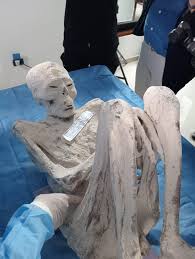
Some researchers argue CT scans and DNA tests suggest unusual anatomical features, including full anatomical features, and one even having an egg inside of it. Others contend the bodies may be constructed from modified human remains and point to major issues with provenance, handling, and peer review. The x-rays tell a different tale. Researchers announced the authenticity of the tridactyls in Mexican Congress on live television.
A forensic report by Mexican naval surgeon José de Jesús Zalce Benítez concluded that the tridactyl specimen known as “Maria” possesses anatomical structures inconsistent with human remains and may represent a previously unknown biological organism. CT scans, X-rays, DNA sampling, and carbon-14 dating were reportedly performed during the examination.
The report claims that roughly seventy percent of the genetic material matched known species while approximately thirty percent did not correspond to existing genetic databases. Critics argue that the study lacks independent verification and that degraded DNA and contamination can produce similar results. Another notable fact is the appearance of these creatures in ancient artwork, including figurines and ancient hieroglyphs. The case is still heavily disputed with no peer-reviewed publications to yet appear in any journals.

As with much of the broader UAP conversation, the evidence remains disputed.
Peruvian Face-peelers
In 2023, residents of the remote Peruvian village of San Antonio, home to members of the Haikito tribe in the Amazon region, began reporting repeated nighttime encounters with figures they described as tall, luminous, and inhuman.
The Encounter That Terrified the Village
The moment that transformed the rumors along the Nanay River into something far more alarming was the attack on a teenage girl in the river community of San Antonio, located in the remote Alto Nanay District of the Peruvian Amazon.
Until that point, villagers had mostly been reporting sightings. Strange figures appearing in the darkness. Tall shapes moving silently through the jungle at night. Lights hovering above the riverbanks. These reports might have remained local stories if not for what happened to the girl.
According to the accounts circulated by villagers and regional media, the teenager had moved toward the outskirts of the settlement when she suddenly encountered one of the figures the community had begun calling pelacaras, or “face peelers.” What she described afterward was not just frightening. It was deeply unsettling to the people who heard her.
When she returned to the village, witnesses said she was in a state of overwhelming fear. She was shaking, crying, and struggling to speak clearly. Those who saw her said she appeared completely terrified, repeating that something had tried to attack her.
In the moments after she calmed enough to describe what had happened, the details became even stranger.
She reportedly told villagers that the figure spoke. According to her account, the voices she heard were speaking both English and Spanish, a detail that immediately struck residents as bizarre given the remote location of the community. Even more alarming was what villagers said happened when they attempted to confront the figures during later sightings.

Some members of the community claimed they fired shotguns at the attackers during nighttime patrols. According to their statements, the pellets appeared to bounce off the figures without effect, as if they were striking something armored or protected.
Whether this was the result of fear, misinterpretation in darkness, or something else entirely remains uncertain. Nighttime encounters in dense jungle environments can easily distort perception. Shadows, distance, and panic can transform what is seen and remembered.
Yet when white men arrived to investigate, the girl became terrified and would not come out of her hut. There was also a scar along her face, and she claimed they administered something that numbed her entire face. It took the girl's father to finally convince her to come out and speak to investigators.
And for the people in San Antonio, the experience was real enough to change daily life. Armed patrols began moving through the community each night. Groups of villagers guarded the riverbanks and jungle paths with flashlights and rifles. Parents kept children indoors after dark. The story spread rapidly along neighboring settlements, where residents began preparing for similar encounters.
In isolated places where the jungle presses close around small human settlements, fear can take on a life of its own. But the reaction of the girl who survived the encounter—and the details she described afterward—were enough to convince many villagers that something far stranger had entered their forest.
And once fear takes hold in a place like San Antonio, it does not fade easily.
Local leaders pleaded for assistance from authorities, stating that the encounters were persistent and coordinated rather than isolated sightings.
Early coverage framed the reports in extraterrestrial terms, repeating the villagers’ descriptions of “giant aliens” descending on the community at night.
However, Peruvian officials later offered a different explanation. Authorities suggested the incidents may have been linked to illegal gold-mining operations in the region. Prosecutors proposed that criminal groups could have been using advanced equipment, including jetpack-like devices and tactical gear, to intimidate local populations and secure territory. Military operations were subsequently directed at illegal mining infrastructure in the area.
Such intimidation tactics are not unheard of in regions where criminal mining operations operate beyond government control. Officials suggested that illegal miners or drug traffickers could have been using drones, hoverboards, or other advanced gear to frighten residents and drive them away from contested territory. Yet what territory these groups were attempting to secure was never clearly identified.
The explanation raised its own questions. No jetpack equipment was publicly recovered. No suspects were identified. No specific mining infrastructure tied to the alleged attacks was presented. If the explanation is correct, it would imply that criminal groups operating deep in the Amazon possessed aerial technology rarely seen even in formal military operations.
But the explanation did little, if nothing, to settle the fears of the community. To them, the attackers were not ordinary criminals. They were tall figures that appeared to hover above the ground, spoke languages not native to the region, and seemed unaffected by gunfire. Gold miners had operated in the region for decades, and had never before been seen to possess technology such as what was on display.
Many investigators went to the village.
No verified evidence of extraterrestrial technology has ever been found. No miners were publicly identified. No arrests were announced. No mining equipment tied to the incidents were ever shown. No mines, even.
No jetpacks or flight devices were recovered.
The villagers maintain that what they experienced did not resemble ordinary criminals.
The government maintains that organized human actors are the most plausible explanation, despite zero evidence.
Both narratives exist in the public record.
What makes incidents like this difficult to dismiss is not any single report, but the broader pattern that surrounds them. Around the world, witnesses describe objects that appear to move through environments in ways that defy conventional technology. Pilots report craft dropping from high altitude to sea level in seconds. Sailors describe luminous spheres entering the water without a splash. Radar operators track objects that transition seamlessly between air and ocean as if the boundary between the two does not exist.
These accounts come from civilians, fishermen, commercial pilots, and increasingly from military personnel whose observations are recorded by advanced sensor systems. Taken individually, each story can be dismissed. Taken together, they begin to suggest a phenomenon that is not easily explained by conventional aircraft, drones, or criminal intimidation tactics.
From a Brazilian City to the Open Ocean
The Varginha case illustrates something investigators encounter repeatedly in the study of unidentified aerial phenomena: the events themselves are often local, but the pattern they reveal is global.
A frightened witness in a Brazilian city.
Military vehicles moving through narrow streets in the middle of the night.
Officials offering explanations that satisfy some observers while leaving others unconvinced.
Taken alone, such incidents can be dismissed as rumor, misunderstanding, or folklore. But the deeper investigators dig, the more they discover that similar reports appear across continents and decades.
Lights descending from the sky. Objects maneuvering with impossible speed. Encounters that leave trained observers struggling to describe what they saw. And increasingly, one detail appears again and again.
Water.
Witnesses describe objects plunging into lakes, rivers, and oceans. Naval radar tracks contacts that vanish beneath the surface. Pilots report watching luminous spheres descend into the sea without the violent spray expected from high-speed impact.
For decades these reports were scattered across military logs, witness interviews, and isolated investigations. But as more data accumulated, a new possibility began to emerge. What if the phenomenon is not merely passing through Earth’s skies?
What if it is operating within Earth’s oceans?
This question has begun to attract attention from people whose professional lives are devoted to studying the sea. One of them is Timothy Gallaudet. And from his vantage point inside the naval and scientific establishment, the pattern he observed was difficult to ignore.
SECTION VIIII
Timothy Gallaudet and the Oceanic Dimension
While Fox has spent years gathering testimony from witnesses on land and in the air, another voice has begun drawing attention to a different environment entirely. The ocean.
Timothy Gallaudet is not a filmmaker or civilian investigator. He is a career naval officer and scientist who served as the head of the National Oceanic and Atmospheric Administration and later as a Rear Admiral in the United States Navy. His expertise lies in oceanography, a discipline that studies the vast and largely unexplored world beneath the surface of Earth’s seas.
It is from this perspective that Gallaudet has approached the question of unidentified objects interacting with the ocean.
The modern discussion of unidentified aerial phenomena often focuses on objects observed in the sky. Radar tracks. Fighter pilot encounters. Infrared sensor footage. Yet a growing number of reports describe something else entirely--Objects entering the water without slowing. Objects emerging from the ocean and accelerating into the sky. Objects maneuvering beneath the surface with apparent speeds and capabilities that do not resemble known submarines.
Within naval circles, these reports are sometimes described using a term that predates the recent UAP terminology: Unidentified Submerged Objects, or USOs.
The ocean provides a compelling environment for such phenomena to hide. More than seventy percent of Earth’s surface is covered by water. Much of the deep ocean remains unmapped and poorly monitored. Human technological infrastructure in the sea is sparse compared with the dense surveillance networks that cover the skies.
In short, the ocean is the largest unobserved domain on the planet.
Modern aerospace and naval engineering has made significant progress toward vehicles that can operate in more than one environment. Small experimental drones now exist that can fly through the air, land on water, submerge slowly, and then relaunch. Engineers call these systems trans-medium vehicles because they move between physical domains such as air and water. Yet even the most advanced prototypes reveal how difficult this problem truly is.
The obstacle is not simply technological. It is physical. Water is roughly eight hundred times denser than air. When an object traveling through the atmosphere strikes the surface of the ocean at speed, it encounters a sudden and dramatic increase in resistance. The result is violent turbulence. Splashes, cavitation bubbles, and shock waves ripple outward from the point of entry. Even submarines and torpedoes—machines designed specifically for underwater motion—produce substantial disturbance when moving near the surface.
Because of these forces, the trans-medium vehicles currently being developed by research laboratories and defense agencies transition cautiously between environments. Aerial drones that can operate underwater typically hover above the surface, descend slowly until their propellers touch the water, and then gradually submerge before switching propulsion modes. When they return to the air, they reverse the process. They surface slowly, build thrust, and then climb out of the water. The entire maneuver produces visible turbulence and disturbance.
What makes certain military witness accounts so intriguing is that they describe something very different. Naval aviators and sensor operators have occasionally reported objects that appear capable of moving from air into water without the explosive splash that physics would normally predict.
In some cases, radar tracks seem to descend directly to the ocean surface and then vanish as if the object simply slipped beneath the waves. In others, pilots have described objects hovering above patches of churning water, suggesting activity occurring below the surface.
Engineers who study fluid dynamics understand why such accounts raise eyebrows. A vehicle entering the ocean at aircraft speeds would normally experience enormous hydrodynamic stress. The impact could damage or destroy most known airframes. Even if the structure survived, the transition would generate large cavitation bubbles and visible spray. The absence of these effects in certain reports is what makes them difficult to reconcile with known technology.
To achieve seamless transitions between air and water, a vehicle would likely require materials capable of surviving tremendous pressure changes, propulsion systems that function efficiently in both environments, and sophisticated methods of controlling the flow of water around the craft. Concepts such as supercavitation—where a vehicle travels inside a bubble of vapor to reduce drag—have been explored in torpedo technology, but even those systems generate substantial disturbance at the surface.
For now, the reality is straightforward. Human engineers can build machines that operate in air and water, but they cannot yet build vehicles that move between those environments rapidly and silently. Every known system produces visible turbulence when it crosses the boundary between sky and sea.
That is why certain naval observations continue to attract attention from researchers. They appear to describe a capability that modern technology has not yet achieved, a way of crossing the boundary between air and ocean that defies the expectations of conventional physics and engineering.
Gallaudet has pointed out that some of the most famous UAP encounters include unexplained interactions with water. The 2004 encounter involving the USS Nimitz UAP sighting offers one of the most striking examples. When Navy pilots arrived at the location of the radar contact that day, they observed a patch of ocean water churning violently, as if something large were moving beneath the surface. Hovering above that disturbance was a smooth white object roughly the size of a small aircraft.
The object, later described as resembling a tic-tac, displayed flight characteristics that defied conventional aeronautical explanation. It accelerated rapidly, changed direction without visible propulsion, and vanished from radar before reappearing miles away.
What has received less public attention is the disturbance in the water below it.
For Gallaudet, that detail matters.
If objects are interacting with the ocean, then the phenomenon cannot be understood purely as an aerial mystery. It becomes a trans-medium phenomenon capable of operating in air and water with equal ease.
Such a capability would represent a level of technological sophistication far beyond known human vehicles. The physical challenges alone are enormous. Air and water have dramatically different densities and aerodynamic properties. Vehicles optimized for one environment typically perform poorly in the other.
Yet reports describing objects transitioning between air and water continue to surface across decades of naval observation.
Some sonar operators have described objects moving underwater at extraordinary speeds. Pilots have reported luminous orbs descending into the sea without slowing. Radar tracks occasionally terminate abruptly at the surface of the ocean, as if the object simply dove beneath the waves.
Gallaudet has not claimed that these objects originate from extraterrestrial civilizations. Instead, he has argued that the phenomenon deserves systematic study and that the ocean must be included in that investigation.
His position reflects a simple reality. Humanity has explored the surface of Mars more thoroughly than the deepest parts of Earth’s oceans. Vast regions of the seafloor remain uncharted. The ocean is not merely a frontier. It is an abyss of unknowns.
If unidentified craft are indeed operating within that environment, they could remain hidden there for decades without detection.
The implication is unsettling but logically consistent. The skies may not be the only domain where the mystery unfolds.
It may also be waiting beneath the water.
When Congress Starts Asking the Same Questions
The ocean hypothesis is no longer confined to scientists and naval officers.
It has begun to surface inside Congress itself.
Representative Tim Burchett, one of the most outspoken lawmakers pushing for greater transparency on unidentified aerial phenomena, has repeatedly pointed toward the ocean as a possible focal point of the mystery.
In interviews discussing classified briefings and military reports, Burchett has suggested that some encounters described by naval personnel involve objects entering or exiting the water.
In one particularly striking anecdote he has repeated publicly, Burchett said a high-ranking admiral described an underwater craft “the size of a football field” moving at extraordinary speed beneath the ocean.
The account has not been supported by publicly released data. But the significance lies elsewhere. Members of Congress do not typically speculate about unknown vehicles operating in Earth’s oceans unless the subject has appeared in briefings or testimony.
Burchett’s remarks echo a theme that already appears in naval encounters, pilot reports, and the observations raised by Gallaudet.
Objects that descend from the sky. Objects that enter the water. Objects that appear to operate in both environments.
Individually, each account can be questioned. But taken together they point toward a question investigators are beginning to ask more openly. If the phenomenon is real—and if it can move between air and ocean—then the sky may represent only part of the story.
The deeper mystery may lie beneath the surface.
SECTION X
The Architecture That Makes Concealment Possible
Separate from the phenomenon itself is the documented existence of Special Access Programs and compartmentalized intelligence structures.
The United States operates tens of billions annually in classified spending. Some programs are acknowledged. Others are unacknowledged. Some reporting requirements can be waived.
Historically, the Manhattan Project operated in secrecy before public revelation. MKUltra was denied before its ultimate exposure as the brainchild of Stanley Gottlieb. NSA bulk surveillance was unknown until disclosed. Stealth aircraft flew before acknowledgment.
These precedents do not prove extraterrestrial programs exist. They prove long-term concealment of sensitive projects is structurally possible, and most likely still in existence. Capacity matters. And so does opacity.
SECTION XI
Unresolved
What exists now in the public record is not a single claim or a single denial. It is a convergence.
Over the past several years, multiple congressional hearings have been held examining unidentified anomalous phenomena. During those hearings, sworn testimony included allegations that the United States has operated legacy crash retrieval programs dating back decades. An Inspector General’s office became involved after a whistleblower reported retaliation connected to those claims. Members of Congress from both parties later introduced disclosure legislation that explicitly referenced the possibility of non human intelligence.
At the same time, the Pentagon has formally denied possessing extraterrestrial craft. The All domain Anomaly Resolution Office has released a historical review concluding that it found no verifiable evidence of alien hardware or recovered non human technology.
Yet the unresolved elements remain in the same record.
Military pilots have described objects maneuvering without discernible propulsion. Intelligence assessments acknowledge cases that remain unexplained. International narratives continue to emerge describing encounters that have not been independently verified but have not fully disappeared either.
Taken together, this does not amount to confirmation.
But it does not amount to closure.
What exists instead is a landscape in which allegations, denials, testimony, legislation, and unexplained observations all occupy the same space.
And the record remains open.
That is the full terrain. Not belief. Not dismissal. The terrain.
SECTION XII
The Physics Problem: What the Sensors Recorded
Strip the story down to the most sterile element: instrumentation.
The 2004 Nimitz encounter was not a single eyeball event. It involved radar tracking from the USS Princeton’s AN/SPY-1 radar system, airborne targeting pods, and pilot visual confirmation. Radar operators reported objects descending from approximately 80,000 feet to lower altitudes in seconds. That kind of vertical movement, if taken at face value, implies acceleration forces that would exceed known aircraft tolerances.
When pilots later reviewed targeting pod footage, including what became known publicly as the “FLIR,” “Gimbal,” and “GoFast” videos, the recorded objects displayed behaviors that observers described as lacking conventional propulsion signatures.
In the 2021 ODNI report, analysts documented that some objects appeared to remain stationary in high winds and move against the wind. In aerodynamics, that implies either active propulsion or misinterpretation of sensor data.
The Pentagon’s counterposition has consistently emphasized possible sensor error, parallax effects, classified human technology, and foreign drone systems. That is a serious explanation. Modern sensor fusion is complex. Infrared and radar artifacts can mislead even trained observers.
But here is the structural tension: these incidents were serious enough to trigger intelligence assessments, not simple enough to dismiss internally as camera glitches.
If the phenomenon is purely sensor error, it represents systemic sensor vulnerability inside U.S. military systems.
If it is foreign technology, it represents a national security gap.
If it is classified U.S. technology, it represents compartmentalization so extreme that operational pilots were not read in.
All three possibilities are destabilizing. None hold enough water to be truth.
SECTION XIII
The Whistleblower Mechanism
David Grusch did not walk into Congress casually. Before testifying publicly, he filed a complaint with the Intelligence Community Inspector General alleging retaliation and suppression of information regarding UAP programs.
The Inspector General deemed his complaint “credible and urgent,” a designation that triggers specific review mechanisms. That does not validate the underlying alien claims. It validates that the retaliation complaint itself was considered worthy of formal process.
Grusch testified that he interviewed over 40 individuals with what he described as direct knowledge of legacy programs. He claimed information was being withheld from Congress through compartmentalization inside Special Access Programs.
Other figures, including former AATIP director Luis Elizondo, have publicly claimed that the phenomenon has been taken seriously inside defense channels for years. Elizondo has stated that certain materials recovered may exhibit “exotic” characteristics, though he has not produced publicly verified physical evidence.
The counterargument, articulated by AARO in 2024, is that many of these “legacy program” stories likely stem from misunderstandings of highly classified aerospace development projects that were deliberately obscured, even from most of the military.
In other words: people may have glimpsed pieces of secret human projects and misinterpreted them.
That explanation fits history.
But here is what complicates it: the legislative push for a records review board modeled after the JFK Act was bipartisan and specific. Lawmakers used language including “non-human intelligence” and “technologies of unknown origin.”
That phrasing did not appear accidentally. It is there in black-and-white.
SECTION XIIII
The Black Budget Ecosystem
The United States operates an enormous classified spending apparatus through the National Intelligence Program and Military Intelligence Program. Special Access Programs restrict access to narrow circles. Some SAPs are acknowledged. Others are unacknowledged. Some are waived from standard congressional reporting requirements.
Contractors operate within these structures, often shielded from public disclosure through classification and proprietary protections.
Historically, programs such as stealth aircraft development occurred years before public acknowledgment. The F-117 flew in secrecy. The existence of certain reconnaissance capabilities was denied for years before admission.
Compartmentalization is not a conspiracy theory. It is standard operating procedure in sensitive national security domains.
The relevant question is not whether concealment is possible.
It is whether concealment has been abused or misinterpreted in this domain.
And that question remains open.
SECTION XV
International Parallels Beyond Brazil
Brazil’s Operation Prato (Plate) in the 1970s involved Brazilian Air Force investigations into reports of luminous objects and alleged beam injuries in the Colares region. Local residents claimed they were struck by lights that caused burns and puncture-like wounds. The Brazilian military documented sightings and conducted operations, though official explanations have varied.
In Belgium between 1989 and 1990, multiple triangular craft sightings were reported. Belgian Air Force radar operators tracked unidentified objects. The Belgian government publicly acknowledged the investigation but did not confirm origin.
In 2004, the Chilean government formed CEFAA, an official civilian committee to study anomalous aerial phenomena. Chile has publicly released some investigation materials.
France’s GEIPAN has investigated UAP cases since the 1970s and publicly categorizes some cases as unexplained after investigation.
The pattern internationally is not confirmation of aliens.
It is formal state engagement with a category that refuses full resolution.
SECTION XVI
The AARO Historical Review
In 2024, AARO released a historical review explicitly addressing crash retrieval claims. The review concluded that there was no evidence the U.S. government possessed extraterrestrial craft. It argued that many persistent rumors likely stemmed from misinterpretations of classified aerospace programs and routine bureaucratic fragmentation.
AARO’s report emphasized that no verifiable evidence of non-human origin materials had been found.
That is the official position.
Comprehensive means including that without dilution.
SECTION XVII
The Institutional Psychology of Ambiguity
This is where the dread lives.
When a government says, “We have no evidence of extraterrestrial craft,” that is definitive.
When that same government says, “We cannot explain a subset of objects that maneuver without discernible propulsion,” that is ambiguity.
When lawmakers say they cannot obtain full clarity from the executive branch, that is tension.
When whistleblowers allege suppression, and oversight bodies confirm procedural review, that is friction.
When international cases mirror civilian fear followed by military response followed by official minimization, that is pattern.
The modern American is left in a strange position.
The phenomenon is serious enough for hearings.
Not serious enough for resolution.
Denied. Investigated. Legislated.
Minimized. Expanded. Closed. Reopened.
This oscillation is not healthy in a democracy.
Not because aliens must be real.
But because the ambiguity actually is real.
SECTION XVIII
The Full Convergence
Viewed individually, the cases examined in this article appear unrelated.
A Nevada technician claiming reverse-engineering programs.
A British hacker describing mysterious files inside NASA networks.
Naval aviators tracking objects over open ocean.
Brazilian civilians describing a military response to something that landed outside their city.
Each story exists in its own context. Each contains uncertainty. Each can be questioned.
Yet the same themes appear again and again.
Objects with unusual flight characteristics. Military interest and rapid response.
Testimony that persists despite official dismissal.
None of these accounts alone resolves the mystery. But together they reveal something more difficult to ignore. The phenomenon—whatever its true nature—has not disappeared.
It has simply remained unresolved.What now exists simultaneously in the public record is not a single claim, but a convergence of facts, testimony, and official responses that refuse to resolve cleanly.
Military pilots have described objects maneuvering in ways that appear to lack visible propulsion. Intelligence assessments have acknowledged a category of encounters that remain unexplained after analysis. Under oath, a former intelligence officer alleged the existence of legacy crash retrieval programs operating within highly classified compartments of the government. An Inspector General’s office became involved after retaliation claims connected to those allegations were deemed credible enough to warrant formal review.
Members of Congress from both parties have attempted to compel disclosure through legislation referencing technologies of unknown origin and the possibility of non human intelligence. At the same time, the Pentagon has issued clear denials that the United States possesses extraterrestrial craft. The All domain Anomaly Resolution Office has released its own historical assessment concluding that it found no evidence of alien hardware or recovered non human technology.
Beyond the United States, governments in several countries have formally investigated similar reports of unexplained aerial phenomena. Alongside those official inquiries are persistent civilian narratives of encounters that remain unverified but have never fully disappeared.
Taken together, these elements do not amount to confirmation.
But they do not amount to closure either.
What exists instead is a record in which testimony, investigation, denial, and unresolved observation all occupy the same space.
This is not fringe.
It is not resolved.
It is not concluded.
It is not fully transparent.
And Americans, for the most part, are not paying attention at all.
The modern record does not prove extraterrestrial visitation.
It proves something else. For more than seventy years, trained observers, intelligence officials, and governments around the world have repeatedly encountered events they cannot fully explain. The mystery is not that people are still asking questions.
The mystery is that the questions never stopped.
Works Cited
U.S. Government Reports and Official Documents
All-domain Anomaly Resolution Office (AARO). Report on the Historical Record of U.S. Government Involvement with Unidentified Anomalous Phenomena. U.S. Department of Defense, 2024.
Director of National Intelligence. Preliminary Assessment: Unidentified Aerial Phenomena. Office of the Director of National Intelligence, June 2021.
Director of National Intelligence. Annual Report on Unidentified Aerial Phenomena. Office of the Director of National Intelligence, 2022.
Director of National Intelligence. Annual Report on Unidentified Aerial Phenomena. Office of the Director of National Intelligence, 2023.
NASA. NASA Independent Study Team Report on Unidentified Anomalous Phenomena. National Aeronautics and Space Administration, September 2023.
U.S. Air Force. Project Blue Book: Final Report. United States Air Force, 1969.
University of Colorado. Scientific Study of Unidentified Flying Objects (The Condon Report). University of Colorado, 1968.
U.S. Department of Defense. Establishment of the Unidentified Aerial Phenomena Task Force (UAPTF). Department of Defense memorandum, 2020.
U.S. Department of Defense. Establishment of the All-domain Anomaly Resolution Office (AARO). Department of Defense announcement, 2022.
Office of the Inspector General of the Intelligence Community. Statements and procedures concerning whistleblower complaints related to UAP investigations, 2022–2023.
Congressional Hearings and Testimony
U.S. House Committee on Oversight and Accountability. Unidentified Anomalous Phenomena: Implications for National Security, Public Safety, and Government Transparency. Hearing, July 26, 2023.
Fravor, David. Testimony before the House Oversight Committee, July 26, 2023.
Graves, Ryan. Testimony before the House Oversight Committee, July 26, 2023.
Grusch, David. Testimony before the House Oversight Committee, July 26, 2023.
U.S. House Intelligence Committee. Unidentified Aerial Phenomena. Classified and public briefings, 2022.
U.S. Senate Intelligence Committee briefings on UAP investigations, 2020–2023.
Rubio, Marco. Public statements regarding Senate Intelligence Committee investigations of unidentified aerial phenomena, 2020–2023.
Gillibrand, Kirsten. Senate Armed Services Committee statements regarding UAP oversight and the creation of AARO, 2021–2023.
U.S. Legislation
Schumer, Chuck, and Mike Rounds. Unidentified Anomalous Phenomena Disclosure Act of 2023. Amendment to the National Defense Authorization Act.
National Defense Authorization Act for Fiscal Year 2022. Provisions establishing formal UAP reporting requirements.
National Defense Authorization Act for Fiscal Year 2023. Expansion of UAP investigation authorities.
Major Journalism and Investigative Reporting
Blumenthal, Ralph, Leslie Kean, and Helene Cooper.
“Glowing Auras and ‘Black Money’: The Pentagon’s Mysterious U.F.O. Program.”
The New York Times, December 16, 2017.
Kean, Leslie, and Ralph Blumenthal.
“Navy Pilots Report Unexplained Flying Objects.”
The New York Times, May 26, 2019.
Blumenthal, Ralph, and Leslie Kean.
“No Longer in the Shadows, Pentagon’s U.F.O. Unit Will Make Some Findings Public.”
The New York Times, July 23, 2020.
CBS News. Coverage of Pentagon UAP reports and congressional investigations, 2021–2023.
Reuters. “U.S. Navy Confirms ‘Unidentified Aerial Phenomena’ Videos Are Authentic.” 2019.
Reuters. Coverage of congressional hearings on unidentified anomalous phenomena, 2023.
Politico. Coverage of UAP legislation and intelligence community investigations, 2021–2024.
The Atlantic. Analysis and reporting on Pentagon investigations into unidentified aerial phenomena, 2021–2023.
60 Minutes (CBS). “Navy Pilots Describe Encounters with UFOs.” Broadcast investigation, 2021.
The Debrief. Kean, Leslie, and Ralph Blumenthal.
“Intelligence Officials Say U.S. Has Retrieved Craft of Non-Human Origin.”
June 2023.
International Government Investigations
Belgian Air Force. Report on the Belgian UFO Wave (1989–1990). Belgian Ministry of Defense.
GEIPAN. French National Center for Space Studies (CNES). Official investigations of unidentified aerospace phenomena.
Brazilian Air Force. Operation Prato investigative files (1977–1978), later declassified.
Brazilian military and police records related to the 1996 Varginha incident.
Chilean Committee for the Study of Anomalous Aerial Phenomena (CEFAA). Government reports and investigations.
United Kingdom Ministry of Defence. UFO Desk Files, declassified reports, 1950s–2009.
Additional Journalistic Reporting Referenced
The Jerusalem Post.
“Amazon Villagers Claim Nightly Attacks by ‘Aliens’ as Authorities Investigate Illegal Mining Gangs.” 2023.
Coverage of the Varginha incident and Brazilian military response in Brazilian national media and later investigative documentaries.
Historical Context Sources
Project Blue Book Archive. U.S. National Archives.
U.S. National Archives. Declassified UFO-related materials.
CIA Reading Room. Declassified documents related to unidentified aerial phenomena investigations.
Member discussion