Dope Dynasty: The Sackler Family
How Purdue sold OxyContin, who stamped the label, and what the Sacklers said about the dead.
By Matt Stone
The Party
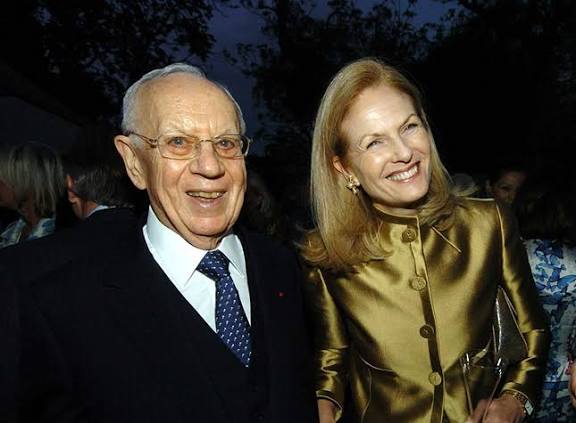
In 1996, Purdue Pharma threw a launch party for a pill. Somewhere in the room were the sales reps who would carry it into every doctor's office in America, and at the front of the room was Richard Sackler, the senior vice president in charge of sales.
Nobody has told us what he wore. I like to imagine a black turtleneck. Steve Jobs, Elizabeth Holmes, all the great entrepreneurs apparently have the same stylist. It is the uniform of men (and women) who believe they are not selling a product so much as bestowing one, and it fits the speech Sackler gave.
He asked the audience to imagine a series of natural disasters. An earthquake. A volcanic eruption. A hurricane. A blizzard. Then he delivered the line he would spend the next twenty-five years being asked about: "The launch of OxyContin Tablets will be followed by a blizzard of prescriptions that will bury the competition. The prescription blizzard will be so deep, dense, and white."
Sit with the creative choices for a second. A man standing before his sales force, given every metaphor in the English language for success, reached for a list of things that kill people. He did not pick a rising tide or a rocket launch. He picked the disasters, and then he picked the one that buries.
Years later, the family's lawyers offered an explanation. Richard was late to the event, they said, because an actual blizzard had closed the airports. He was just being topical. It is a defense in roughly the way "I was only talking about the weather" is a defense, and it does not explain the earthquake, the volcano, or the hurricane.
The blizzard came. But before it could fall, somebody had to sign off on it.
The Permit
In December 1995, the Food and Drug Administration approved OxyContin. The medical reviewer overseeing that approval was Dr. Curtis Wright.
Thirty-five years earlier, another FDA medical reviewer sat at that same kind of desk. In 1960, in her first weeks on the job, Dr. Frances Kelsey was handed the application for thalidomide. The drug was already on the market in dozens of countries. The company pressed her again and again to approve it. She kept asking for proof it was safe and kept refusing until she got it. She never got it. Thousands of babies abroad were born with severe birth defects, while the United States was largely spared. President Kennedy gave her the highest civilian honor a federal employee can receive. Wright’s job was the same as hers. He went another route, and made a different choice.
The label the FDA approved carried a sentence that would become the most valuable piece of real estate Purdue ever owned. Because OxyContin's controlled-release coating delayed absorption, the label said, that delay was "believed to reduce the abuse liability of the drug." No study had established this. It was a belief, printed on a federal label, and it handed every sales rep in the country a line that sounded like the government's own reassurance. The same label told doctors that addiction was "very rare" when opioids were used legitimately for pain. In 2001, the FDA quietly struck the abuse-liability line and replaced the addiction claim with an admission that nobody actually knew the rate.
Who wrote it? Under oath in a deposition, Wright conceded that he "might" have written that portion of the package insert himself. According to Patrick Radden Keefe's reporting in Empire of Pain, Wright had Purdue send documents to his home office, and he reviewed clinical study reports on OxyContin's safety with the help of Purdue employees. The regulator and the regulated were, at points, working the same desk.
This was not the first time Wright had been "helpful." Earlier in the process, in 1993, Purdue wanted to test OxyContin in patients with osteoarthritis, and others at the FDA balked. Court filings describe Wright suggesting a workaround: rewrite the protocol so the arthritis patients were described as "pain models" rather than target patients. Same patients. Same drug. New vocabulary.
About a year after OxyContin's approval, Wright left the FDA. He spent a stint at a company called Adolor, then joined Purdue in 1998. Keefe reports his first-year compensation package was $400,000. Wright has denied ever discussing a job with Purdue while he was still at the agency. In 2017, he told Esquire that no company in the history of pharmaceuticals had worked harder to prevent abuse of its product than Purdue.
He said this after the deaths. We will get to the deaths.
The Machine
With the label line in hand, Purdue built a sales operation around it.
Reps told doctors the risk of addiction was less than one percent. The figure traced back to a 1980 letter in the New England Journal of Medicine by Jane Porter and Hershel Jick. It was five sentences long. It looked at hospitalized patients who received narcotics under supervision, not people sent home with a month of pills for back pain. It was not a study of chronic pain patients, and it was never designed to be one. In 2017, the journal attached an editor's note to the letter warning that it had been heavily and uncritically cited. That warning came from a study published in the same journal, which counted 608 citations of the five-sentence letter, with a sharp jump after OxyContin hit the market. Nearly three in four cited it as evidence that addiction was rare. Four in five never mentioned that the patients had been in the hospital. Ordinary letters the journal published alongside it were cited a median of 11 times.
When patients started showing signs of addiction anyway, Purdue had a word for that too: pseudoaddiction. The concept was coined in 1989 by Dr. J. David Haddox, who later became a Purdue executive. The idea was that drug-seeking behavior was not addiction at all, but a sign the patient's pain was undertreated. The prescribed remedy was more opioids. It is hard to design a better product theory than one in which every symptom of the danger is also a reason to buy more.
Then there was the twelve-hour promise. OxyContin's selling point was that one dose lasted twelve hours, sparing patients the round-the-clock schedule of older painkillers. A 2016 Los Angeles Times investigation found that for many patients, it did not last twelve hours, and they slid into withdrawal before the next dose. Purdue's answer was not to recommend more frequent dosing, which would have undercut its marketing edge. It pushed reps to steer doctors toward higher strengths instead. Stronger pills, same schedule, deeper hook.
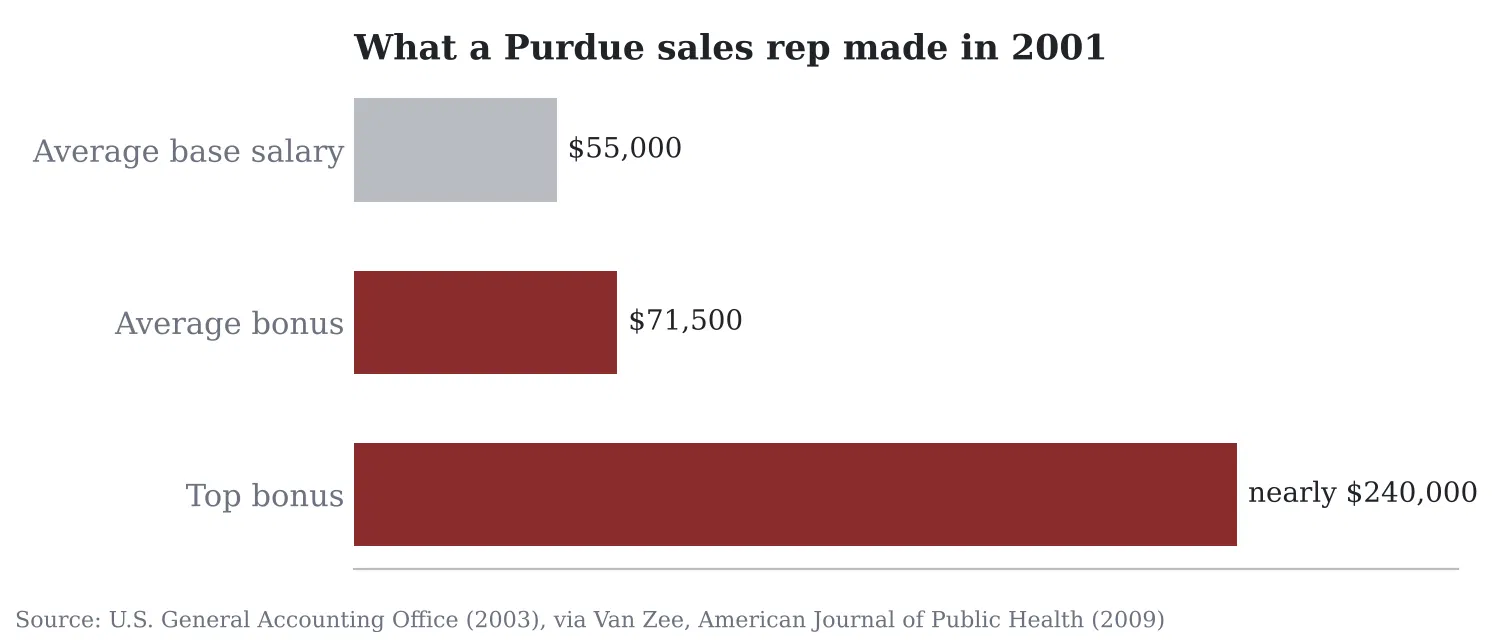
The marketing had a gift shop quality to it. A 2009 analysis in the American Journal of Public Health by Dr. Art Van Zee documented the branded fishing hats, the plush toys, and the swing music CDs titled "Get in the Swing With OxyContin." Purdue handed out coupons for free starter prescriptions. It produced a promotional video called "I Got My Life Back," featuring patients describing their recoveries. In 1998, Purdue mailed 15,000 copies of that video to doctors without submitting it to the FDA. The agency did not review a later version until 2002, after congressional investigators asked about it, and it found the video minimized OxyContin's risks and made unsubstantiated claims. That year, the FDA had 39 staff members to review roughly 34,000 pieces of drug promotion. Sales bonuses were enormous; Van Zee reported Purdue paid about $40 million in sales incentive bonuses in 2001 alone.
The average rep’s bonus that year was $71,500, on top of a $55,000 salary. The top earner took home nearly $240,000 in bonuses alone.
It worked. OxyContin sales went from roughly $48 million in 1996 to nearly $1.1 billion in 2000. The blizzard was falling right on schedule.
The Culprits
By 2001, the bodies were showing up in local news. Rural communities in Appalachia and New England were reporting overdose deaths and crime tied to OxyContin. The pill that was supposed to be hard to abuse was being crushed, snorted, and injected, because the coating that supposedly reduced abuse liability came off with a little effort. Purdue knew it would. The company’s own testing in 1995, before OxyContin ever launched, found that crushing a tablet released 68 percent of its oxycodone.
The pills landed hardest where the reps had aimed them. In 2000, Dickenson County, Virginia, received nearly seven times the national average of OxyContin per person, and the counties around it were not far behind. Those were the first places to bury their dead.
Richard Sackler, by then Purdue’s president, had a theory about who was to blame. In a 2001 email later made public by the Massachusetts attorney general, he wrote that Purdue would have to “hammer on the abusers in every way possible.” They were, he wrote, “the culprits and the problem.”
Not the label. Not the one-percent claim. Not pseudoaddiction or the higher strengths or the fishing hats. Richard Sackler decided the fault lay with the people who got addicted to the drug Purdue told their doctors would not addict them.
Plenty of them never bought a pill in a parking lot. They had a prescription. Their doctor wrote it after a Purdue rep visited the office, carrying a federal label that said abuse was unlikely and a script that said addiction was rare. When they needed more, the company called it pseudoaddiction and recommended a higher dose.
Strip away the logo and Purdue ran the oldest playbook on the corner. Dealers hand out testers, because the first one’s free and the second one isn’t. Purdue called its testers starter coupons, and by 2001 patients had redeemed some 34,000 of them. Dealers work territories and reward whoever moves the most product. Purdue mapped the country’s heaviest prescribers, sent reps to their doors, and paid out $40 million in bonuses in a single year. When a customer’s habit outgrows the dose, a dealer sells them something stronger. When patients slid into withdrawal before twelve hours were up, Purdue pushed higher strengths. And when someone overdoses, the dealer swears it was the user’s fault for not handling it. Richard Sackler put that one in writing: the abusers were “the culprits and the problem.” The only real difference between Purdue and the guy on the corner is that the guy on the corner never got a museum wing.
I have personally had dealers cut me off because they were worried about my safety. They would not sell to me unless I went home and slept and ate and took care of myself. Street dealers have more of a conscience than the Sackler family does.
In 2001, the FDA added a black box warning to OxyContin, its strongest warning. In 2007, the federal government caught up with Purdue. The Purdue Frederick Company pleaded guilty to felony misbranding of OxyContin with intent to defraud or mislead, admitting that its people had marketed the drug as less addictive and less subject to abuse than other opioids. Three executives pleaded guilty to misdemeanors. The company and its executives paid about $634.5 million. Nobody went to prison.
And then sales kept going. In 2014, Purdue explored a plan it called Project Tango: selling treatment for opioid addiction. An internal report prepared with Kathe Sackler and other company leaders called it “an attractive market,” pointing to a large unmet need among a “vulnerable, underserved and stigmatized patient population.” The company that had sold the disease was studying the market for the cure. The family shelved the plan in March 2015.
The Math
In 2008, the year after its guilty plea, Purdue began working with McKinsey & Company, the most prestigious consulting firm in the world. McKinsey's job was to help Purdue sell more OxyContin. One of its plans was described as a way to "turbocharge" sales.
In a 2017 presentation, McKinsey laid out options for shoring up the business. One of them was to pay Purdue's distributors a rebate for every OxyContin overdose attributable to pills they sold. The consultants ran the numbers. They projected that in 2019, 2,484 CVS customers would either overdose or develop an opioid use disorder. At a rebate of $14,810 per "event," Purdue would owe CVS $36.8 million that year.
Read that again with the turtleneck in mind. Someone built a spreadsheet in which a person's overdose was a line item called an event, assigned it a dollar value, and multiplied. Elsewhere in the same body of work, McKinsey was helping Purdue figure out how to counter the emotional messages coming from mothers whose teenagers had overdosed.
CVS and Anthem both say they never received any such rebates. The fact that the idea made it into a slide deck is the point. McKinsey has since paid nearly $1 billion to settle opioid lawsuits, and in December 2024 it agreed to pay another $650 million under a deferred prosecution agreement on federal charges of conspiring to misbrand a drug and obstruction of justice. Martin Elling, a senior partner on the Purdue account, had sent himself a to-do note in 2018: delete old Purdue documents from his laptop. He did. In May 2025, he was sentenced to six months in federal prison. Of everyone tied to OxyContin's rise, the man who went to prison was a consultant. Not for the deaths. For obstruction of justice.
No
In November 2020, Purdue pleaded guilty again, this time to three federal felonies, including conspiracy to defraud the United States and conspiracy to violate federal anti-kickback laws. The Sacklers agreed to pay $225 million in civil damages. No member of the family was charged with a crime. Purdue was finally sentenced on those felonies in April 2026, paying the Justice Department $225 million, while the people who ran it avoided charges entirely.
In August 2021, Richard Sackler testified by video in Purdue's bankruptcy case. He was asked whether he bore any responsibility for the opioid crisis. Whether his family did. Whether the company did. To each question, he gave the same answer: "No."
The Supreme Court threw out the first bankruptcy deal in 2024 because it would have shielded the Sacklers from lawsuits without the consent of the people suing them. The replacement deal, worth $7.4 billion, became effective on May 1, 2026. It permanently bars the Sacklers from selling opioids in the United States, transfers Purdue's operations to a new company, and requires the release of more than 30 million documents about their opioid business. Those documents are headed to a public archive run by the University of California, San Francisco and Johns Hopkins. The Grounded will be reading them.
About 806,000 Americans died of opioid overdoses from 1999 through 2023, in waves the CDC traces back to the prescribing boom of the 1990s. The family that lit the fuse kept billions and has never admitted fault.
Give Richard Sackler this much: he called it. He stood in front of that room in 1996 and told them exactly what was coming. The prescriptions came. The competition got buried. So did people we love. So did everyone else.
Purdue printed a claim it couldn’t back up and let a federal label vouch for it. We do the opposite. The Grounded stands behind every factual claim it publishes with a $100 accuracy guarantee. Find an error of fact and tell us. If you’re right, we pay.
Sources
- Associated Press via PBS NewsHour, “Drug maker pushed OxyContin despite danger signs, prosecutor says”: https://www.pbs.org/newshour/amp/nation/drug-maker-pushed-oxycontin-despite-danger-signs-prosecutor-says
- PBS NewsHour, “Family behind OxyContin calls Massachusetts opioid suit false, misleading”: https://www.pbs.org/newshour/nation/family-behind-oxycontin-calls-massachusetts-opioid-suit-false-misleading
- Business Insider, “An FDA official who led the approval of OxyContin got a $400,000 gig at Purdue Pharma a year later”: https://businessinsider.nl/an-fda-official-who-led-the-approval-of-oxycontin-got-a-400000-gig-at-purdue-pharma-a-year-later-a-new-book-reveals/
- ProMarket, “Purdue Circumvented the Regulator to Promote OxyContin, Hiding Its Real Risk of Addiction”: https://www.promarket.org/2020/01/06/purdue-circumvented-the-regulator-to-promote-oxycontin-hiding-its-real-risk-of-addiction/
- MovieMaker, on Curtis Wright’s career timeline and Esquire interview: https://www.moviemaker.com/dr-curtis-wright-painkiller-netflix-fda
- Art Van Zee, “The Promotion and Marketing of OxyContin: Commercial Triumph, Public Health Tragedy,” American Journal of Public Health 99, no. 2 (2009): https://pmc.ncbi.nlm.nih.gov/articles/PMC2622774/
- Jane Porter and Hershel Jick, “Addiction Rare in Patients Treated with Narcotics,” New England Journal of Medicine 302 (1980): 123: https://www.nejm.org/doi/full/10.1056/NEJM198001103020221
- Pamela T. M. Leung et al., “A 1980 Letter on the Risk of Opioid Addiction,” New England Journal of Medicine 376, no. 22 (2017): 2194–95: https://www.nejm.org/doi/full/10.1056/NEJMc1700150
- Los Angeles Times, “‘You want a description of hell?’ OxyContin’s 12-hour problem” (2016): https://www.latimes.com/projects/oxycontin-part1/
- BuzzFeed News, “The Billionaire Family Behind OxyContin Explored Profiting Off People Addicted To Opioids”: https://www.buzzfeednews.com/article/claudiakoerner/oxycontin-family-opioid-treatment-profit-allegations
- Boston Globe, “McKinsey proposed paying pharmacy companies rebates for OxyContin overdoses”: https://www.bostonglobe.com/2020/11/27/nation/mckinsey-proposed-paying-pharmacy-companies-rebates-oxycontin-overdoses
- Al Jazeera, “McKinsey to pay $650m to settle US opioid consulting probe”: https://www.aljazeera.com/economy/2024/12/13/mckinsey-to-pay-650m-to-settle-us-opioid-consulting-probe
- U.S. Attorney’s Office, Western District of Virginia, “Former Senior Partner of McKinsey & Company Sentenced”: https://www.justice.gov/usao-wdva/pr/former-senior-partner-mckinsey-company-sentenced
- U.S. Department of Justice, “Opioid Manufacturer Purdue Pharma Pleads Guilty to Fraud and Kickback Conspiracies” (2020): https://www.justice.gov/opa/pr/opioid-manufacturer-purdue-pharma-pleads-guilty-fraud-and-kickback-conspiracies
- Boston.com (AP), “Ex-chair of Purdue denies responsibility for opioid crisis”: https://www.boston.com/news/national-news/2021/08/19/ex-chair-of-purdue-denies-responsibility-for-opioid-crisis/
- NPR, “Purdue Pharma sentenced in criminal opioid case while company leaders avoid charges” (2026): https://www.npr.org/2026/04/29/nx-s1-5793938/purdue-pharma-sentenced-in-criminal-opioid-case-while-company-leaders-avoid-charges
- Nevada Attorney General, “Purdue/Sackler $7.4 Billion Opioid Settlement Goes into Effect” (2026): https://ag.nv.gov/News/PR/2026/Purdue/Sackler_$7_4_Billion_Opioid_Settlement_Goes_into_Effect/
- UCSF, “New Documents Show McKinsey’s Role in Opioid Epidemic” (Opioid Industry Documents Archive): https://www.ucsf.edu/news/2022/06/423191/new-documents-show-mckinseys-role-opioid-epidemic
- CDC, “Understanding the Opioid Overdose Epidemic”: https://www.cdc.gov/overdose-prevention/about/understanding-the-opioid-overdose-epidemic.html



Member discussion