It Took A Billionaire
Bill Gates says AI could drive a billion deaths. He's not wrong. He's late, and he left out the part that matters.
By Matt Stone
What he said
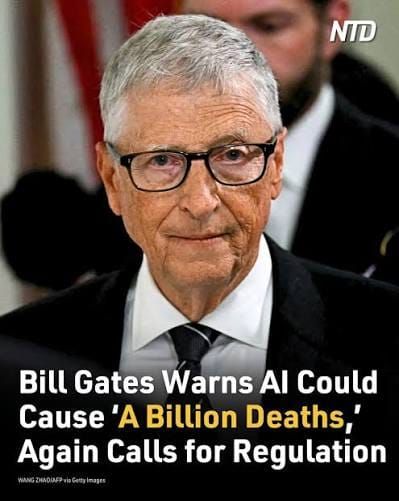
On Meet the Press, Bill Gates said this: “AI is certainly powerful enough to drive events that, you know, cause a billion deaths.”
That was the headline everywhere. NBC, Bloomberg, Newsweek, Fortune, TMZ. A billion deaths. Bill Gates. Done.
But read the sentence again. He did not say AI will kill a billion people. He said it is powerful enough to drive events that could. That is a claim about capability, not a forecast. The headlines cut the middle out of his sentence and kept the scary number.
In the same interview he told viewers what he meant. “There's never been a weapon as powerful as the combination of people with ill intent using the latest AI tools.” In a separate interview with Ezra Klein at the New York Times, he got specific. AI, he said, has “crossed the threshold” where “its ability to empower a bioterrorist to kill hundreds of millions” already “exists today.”
So the real claim is narrower than the headline. The danger is not a robot uprising. The danger is a person with bad intent and a very good assistant.
His fix: “No one thinks self-regulation is enough.” Kill switches won't do it alone. Government and both political parties need to work together, now.
All of that is reasonable. None of it is new.
The same man, three years ago
In May 2023, Gates signed the Center for AI Safety statement that put AI extinction risk next to pandemics and nuclear war. Two months later, on July 11, 2023, he published an essay on his own blog with this title: “The risks of AI are real but manageable.”
Manageable. That was the word in 2023. Now it makes nuclear weapons “look like nothing.”
The technology got stronger, sure. But the people who were paying attention in 2023 were not saying manageable. They were saying the thing that would make it unmanageable was already happening. I fucking know, because I was one of them. In fairness, Gates has a history of spotting danger a few years late. In June he told House investigators that meeting Jeffrey Epstein, years after Epstein's 2008 conviction, was "a grave error in judgment." That relationship was manageable too, until it wasn't.
What I wrote in 2023
My master's thesis at American University asked one question: how is the rise of nationalism around the world affecting the way countries build and regulate AI? I looked at the three biggest players, China, the European Union, and the United States, and how each was approaching AI governance.
The answer was not good. Every major power was racing to get there first, to get theirs first, and treating the rules as something to write after they won.
Gates now says self-regulation is not enough. In 2023, I looked at the main American AI policy document of the time, the Blueprint for an AI Bill of Rights. The document opened with a disclaimer saying it was “strictly voluntary” and not official U.S. policy. I called it what it was: toothless. Congress had passed nothing binding on the private sector. The EU's own ethics guidelines were non-binding too. Watchdog groups were already warning that voluntary promises with no one to enforce them were not promises at all.
Gates now names bioterrorism as the big threat. In November 2023, 28 countries and the European Union, China included, signed the Bletchley Declaration on AI safety. I wrote about it in the thesis. The signers said they were "especially concerned" about AI risks "in domains such as cybersecurity and biotechnology."
They warned that AI "may amplify risks such as disinformation" and could be used to "generate deceptive content." They wrote that "substantial risks may arise from potential intentional misuse." And they put it plainly: "There is potential for serious, even catastrophic, harm, either deliberate or unintentional." Bio-terror, misuse, catastrophe. All of it was on paper three years ago, signed by the countries that matter.
Gates now says the parties need to work together. In 2023, I pointed to a poll that found 85 percent of Americans wanted a nationwide effort across government, industry, and academia to make AI safe. The public was already there. The people with the power were not.
The part he left out
Here is where Gates's warning falls short. He talks about bad actors and kill switches. He does not talk about the race.
Vladimir Putin said the quiet part out loud back in 2017: "Whoever becomes the leader in this sphere will become the ruler of the world." Nobody racing to rule the world stops to consider the consequences of succeeding.
Here's the irony. AI exists because people shared. In my thesis I wrote that "most of the big advancements in AI" came from "knowledge-sharing and collaboration between the global tech community." Researchers in different countries published openly, borrowed each other's code, and built on each other's work. In 2021, American and Chinese researchers co-wrote 9,660 AI papers, more than any other pair of countries. The technology was born open. Now the same governments that benefited from that openness are walling it off, racing to own something nobody could have built alone, to pull the ladder up behind them as fast as possible.
A bio-terrorist with an AI assistant is a real danger. But the reason that danger keeps growing is that the countries building these systems decided that winning matters more than agreeing. That was the whole point of my thesis. The U.S. and China were cutting each other off from chips, talent, and research while still being, at the time, each other's biggest AI research partners. Everyone knew cooperation was the only thing that could keep this under control. Everyone kept choosing the race anyway.
I wrote that “a technologically bifurcated world will see the regulation and governance of more advanced technologies become much more difficult to comprehend and will require a concerted effort to mitigate.” That concerted effort never came. What came instead was three more years of racing.
You cannot stop a weapon that the builders refuse to agree on. Kill switches and usage records only work if the people with the switches answer to someone. Right now, they mostly answer to their shareholders and their own governments' need to win. Morality didn't make the list.
What It Looks Like
Gates gave the number. He didn't give the picture. So here's the picture. None of these have happened. All of them line up with risks the Bletchley signers named in 2023. And in every single one, the weapon isn't what fails. The cooperation is.
An unusual outbreak shows up in two countries in the same week. Doctors can't tell if it's natural or engineered, because the tools that could have designed it are the same tools scientists use every day to make vaccines. Washington points at Beijing. Beijing points at Washington. There's no shared inspection system, because nobody wanted to give the other side a look inside their labs. The arguing eats the first three weeks. Those are the weeks that matter.
A ransomware attack hits rural hospitals across a dozen states in one night. The code was written and rewritten faster than anyone could patch it. Emergency rooms go back to paper charts. Ambulances get sent two counties over. The countries that could help trace it stopped sharing threat information years ago, because sharing looked like losing.
During a real emergency, a perfect fake video of a public health official tells people the danger has passed and they can go home. It spreads faster than any correction. By the time the real official gets on air, half the country doesn't know which one to believe, and the other half has already decided.
Notice what's missing from all three: a rogue robot. Gates is right that the danger is people with bad intent and powerful tools. What he didn't say is that the response depends on rivals trusting each other in the worst moment of their lives. We spent the last three years making sure they won't.
That's the billion-death scenario. Not a machine that turns on us. A world too busy racing to pick up the phone. Too busy racing to create God without asking themselves: "Should we?"
Why it matters who said it first
This isn't about credit. Plenty of people saw this coming, and most of them had a lot less money and a lot fewer cameras than Bill Gates.
It matters because of what it says about how warnings work. When graduate students, researchers, and watchdog groups said this in 2023, it was a footnote. When an Epstein-adjacent billionaire says it in 2026, it is the top story on every network. The information was the same. The only thing that changed was who was holding the microphone.
That gap costs time. Three years of time, in this case. Three years in which the rules could have been written before the race got this far.
Gates is right to sound the alarm. I'm glad he did. But the alarm has been going off since at least 2023. The question was never whether AI could be this dangerous. The question was whether anyone with power would listen before a billionaire said it on Sunday morning TV.
Now we know the answer.
The Grounded stands behind every factual claim it publishes with a $100 accuracy guarantee. Find an error of fact and tell us. If you are right, we pay.
Sources
Axios, “Bill Gates warns AI is powerful enough to cause ‘a billion deaths’” (Sept. 2026): https://www.axios.com/2026/09/25/bill-gates-ai-deaths-doom
NBC News, Meet the Press video: https://www.nbcnews.com/meet-the-press/video/bill-gates-says-ai-powerful-enough-to-cause-a-billion-deaths-270470213819
Fortune, “‘A billion deaths’: Bill Gates warns about AI in the wrong hands” (Sept. 30, 2026): https://fortune.com/2026/09/30/bill-gates-ai-dangers-bioweapons/
Bloomberg, “Bill Gates Warns AI Powerful Enough to Lead to ‘a Billion Deaths’”: https://www.bloomberg.com/news/articles/2026-09-25/bill-gates-warns-ai-powerful-enough-to-lead-to-a-billion-deaths
Bill Gates, “The risks of AI are real but manageable,” Gates Notes (July 11, 2023), as reported by TIME: https://time.com/6293735/bill-gates-ai-risk/
Center for AI Safety, Statement on AI Risk (May 2023): https://en.wikipedia.org/wiki/Statement_on_AI_Risk
https://www.cnn.com/2017/09/01/world/putin-artificial-intelligence-will-rule-world
UK Prime Minister's Office, The Bletchley Declaration (Nov. 2023): https://www.gov.uk/government/publications/ai-safety-summit-2023-the-bletchley-declaration/the-bletchley-declaration-by-countries-attending-the-ai-safety-summit-1-2-november-2023
White House OSTP, Blueprint for an AI Bill of Rights (2022)
Munn, Luke. “The Uselessness of AI Ethics.” AI and Ethics 3, no. 3 (2023): 869–877.
Stone, Matt. “How is a rising tide of nationalism across the globe affecting global collaboration, development, and the regulation of AI technologies?” M.A. thesis, American University, 2023.
Member discussion