CEOs Optimized Themselves Out of a Job

CEOs optimized themselves out of a job. They just haven't signed the paperwork yet.
By Matt Stone
Imagine a job posting. Wanted: chief executive. Must read every report in the company, every customer complaint, and every market signal, every day. Must never get tired, never hold a grudge, never fall in love with a bad idea because it was their idea. Must answer any employee's question at any hour. Salary: a rounding error.
No human could fill that job. But something else could.
The case against the human CEO is usually made with anger. This one doesn't need it. It only needs the evidence, and the evidence points one direction. On nearly every part of the job, a machine is better suited to it than the person holding it.
It Reads Everything
A CEO's biggest problem is not a lack of intelligence. It's a lack of information. By the time news reaches the top of a big company, it has passed through layer after layer of managers, each one softening it, trimming it, and making themselves look good. I wrote about this in "The Truth Dies on the Way Up." The person making the biggest decisions often knows the least about what's really happening.
An AI doesn't have that problem. It can read the raw data directly. Not the summary of the summary. The actual complaints, the actual sales numbers, the actual emails.
The people at the top already know this. In March 2026, the Wall Street Journal reported that Mark Zuckerberg is building an AI agent to help him run Meta. Its job is to fetch answers that would normally have to climb through layers of people to reach him. In other words, one of the most powerful CEOs alive decided the machine gets him the truth faster than his own org chart does.
And how much of a CEO's day is really spent on judgment? Anant Agarwal, who ran the online education company edX, told CNBC he spent about four fifths of his time as CEO on reports, repeat presentations, and saying the same thing to different people in different ways. That's the job. Most of it is exactly what AI does best.
It Has No Ego
Here is the most expensive flaw in corporate America: the CEO who is sure he's right.
Economists Ulrike Malmendier and Geoffrey Tate studied this in a 2008 paper in the Journal of Financial Economics. They measured CEO overconfidence partly by how CEOs handled their own company stock. The overconfident ones had 65 percent higher odds of making acquisitions. Those deals tended to destroy value, and investors knew it. When overconfident CEOs announced a merger, the stock market reacted far more negatively than it did for other CEOs.
The most famous example is the merger of AOL and Time Warner, announced in January 2000 as one of the biggest deals in history. Two years later, the combined company reported a net loss of $98.7 billion for 2002, according to its own filing with the Securities and Exchange Commission. A human handshake at the top cost shareholders more money than most countries produce in a year.
An AI doesn't have a legacy to protect. It doesn't need the deal to be a win because its name is on it. It doesn't get a rush from announcing the biggest merger of the year. It runs the numbers, and if the numbers say no, the answer is no.
It Already Beats Them Head to Head
In at least one head-to-head test, the machine won. In 2024, researchers at the University of Cambridge put GPT-4o in charge of a simulated car company, built on real data about sales, market shifts, and pricing. They pitted it against students and real executives. The AI beat the top human players on nearly every measure, including product design, market share, and profit.
It wasn't the only test. Researchers at Harvard Business School trained a chatbot on everything Zapier CEO Wade Foster had written, from Slack messages to public statements. Then they asked his employees to tell which answers came from their real boss and which came from the bot. The employees correctly spotted their real CEO's answers only 61 percent of the time, and the bot's only 57 percent. That's barely better than flipping a coin. The machine could speak for him so well that his own people couldn't tell the difference.
And one company has actually given an AI the CEO title. In August 2022, the Chinese game company NetDragon Websoft named an AI program called Tang Yu the rotating CEO of its main subsidiary. She isn't a legally registered director, and the human chairman stayed in charge, but she handles real operational work. Business Insider reported the company's stock rose about 10 percent over the following six months, beating the Hong Kong market. NetDragon says Tang Yu's team has processed more than 300,000 approval forms. As of 2025, NetDragon still listed Tang Yu as rotating CEO. No scandal, no collapse, no drama. That's a cleaner record than plenty of human CEOs can claim.
It Works for Almost Nothing (And even pays taxes)
According to the Economic Policy Institute, CEOs at the 350 largest U.S. companies averaged $27.9 million in pay in 2025. That's 325 times what a typical worker made. And that average leaves out Elon Musk. According to the AFL-CIO, his $158 billion Tesla pay package in 2025 was 14 times more than every other S&P 500 CEO's pay combined.
What does that money buy? Not much, according to the research firm MSCI. When it compared CEO pay to long-term stock returns, it found little connection. Companies that paid their CEOs less more consistently delivered better long-term returns. A later MSCI study followed 235 CEOs through their entire time in the job and found that boards, on average, failed to pay for performance.
While CEO pay climbed, what corporations paid in taxes shrank. In 1965, corporate taxes made up 21.8 percent of federal revenue and CEOs made 21 times what a typical worker did. By 2022, corporate taxes had fallen to 8.7 percent of federal revenue, and the pay gap had grown to 344 to 1, according to the Institute for Policy Studies.
Some companies now pay their bosses more than they pay the country. A study by the Institute for Policy Studies and Americans for Tax Fairness found 35 profitable corporations that paid their top five executives a combined $9.5 billion from 2018 to 2022, while getting back a net $1.8 billion in federal income tax refunds. Tesla paid its top executives $2.5 billion over those years, earned $4.4 billion in U.S. profits, and paid no federal income tax at all.
The men at the very top play the same game with their own taxes. Using leaked IRS data, ProPublica found that the 25 richest Americans, several of them sitting CEOs, grew their wealth by $401 billion from 2014 to 2018 and paid $13.6 billion in federal income taxes. That's a true tax rate of 3.4 percent. A typical middle-class family paid nearly as much in taxes as its wealth grew.
An AI can't negotiate a golden parachute. It doesn't need stock options to show up motivated. It doesn't cash out and leave. Every dollar not spent on a CEO package is a dollar that can go to workers, research, or customers. It also doesn't hire accountants to shrink its own tax bill.
The Leech in the Corner Office
Here's how the money actually leaves. Most CEO pay now comes in stock, so the fastest way for a CEO to get richer is to push the stock price up. The easiest way to do that isn't building a better product. It's having the company buy back its own shares. Fewer shares on the market means each one is worth more, at least for a while.
Economist William Lazonick tracked 449 companies in the S&P 500 from 2003 through 2012. They spent 54 percent of their earnings, $2.4 trillion, buying back their own stock, and another 37 percent on dividends. That left about 9 cents of every profit dollar for research, new equipment, or raises.
And when the buyback hits, the executives often cash out. In 2018, SEC Commissioner Robert Jackson Jr. had agency staff study 385 buybacks. In half of them, at least one executive sold shares in the month after the announcement. Twice as many companies had insiders selling in the eight days after a buyback announcement as on an ordinary day. A follow-up analysis the next year found that 90 days out, companies where executives cashed out trailed the others by more than 8 percent. The executive got the bump. The shareholders kept the slump.
It hasn't slowed down. S&P 500 companies spent a record $293.5 billion buying back their own stock in just the first three months of 2025, and S&P Dow Jones Indices expected the full year to hit a record of about $1 trillion. That's money earned by workers and paid by customers, spent pumping up the stock the CEO gets paid in.
Here's the part that surprises people. If you added up the pay of the 350 biggest-company CEOs, it would come to roughly $10 billion a year. Add every chief executive in America, about 204,000 of them, from hospital heads to small-business bosses, and it's still only around $55 billion in wages. In a $30 trillion economy, that's a rounding error. The paycheck was never the real problem. The real problem is what the paycheck is made of. Because most CEO pay comes in stock, the person running the company has every reason to spend its profits pumping up the stock price. In 2025 alone, companies were on pace for about $1 trillion in buybacks.
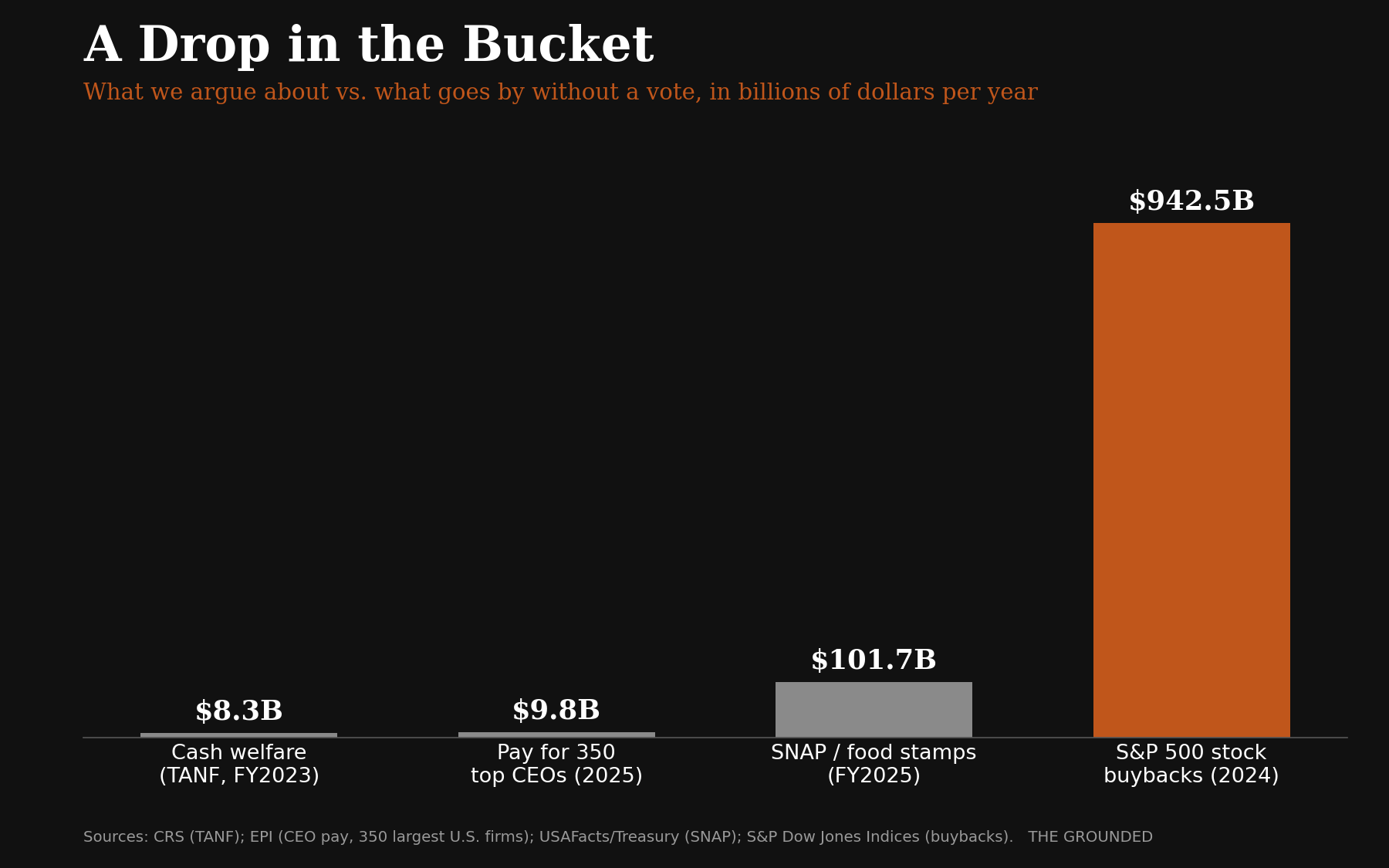
Politicians love to argue about welfare. Here's the scale of what they're arguing about. Cash assistance for poor families with children totaled about $8.3 billion in fiscal 2023, less than the roughly $9.8 billion the 350 biggest-company CEOs took home in 2025. SNAP, the food stamp program, cost the federal government $101.7 billion in fiscal 2025. Meanwhile, S&P 500 companies were on pace to spend about $1 trillion in 2025 buying back their own stock, the move that pumps up the shares CEOs are paid in. That's roughly ten times the entire food stamp program. We hold hearings over the grocery money of poor families. The trillion goes by without a vote.
A leech doesn't kill its host. It just takes a little more than it gives, for as long as the host stays alive. That's the modern CEO. And unlike an AI, he gets to set his own feeding schedule.
The Fine Print
None of this means the machine is perfect, and a fair case says so.
In the Cambridge experiment, the AI got fired by the virtual board faster than the students did. It chased short-term gains, and it struggled when the researchers threw in sudden shocks like a pandemic-style collapse in demand. The researchers also built the game through their own startup, and the AI had access to rich data inside the simulation that a real company might not hand over so cleanly.
Real life has already shown the limits, too. Klarna, the buy-now-pay-later company, bragged in 2024 that its AI assistant was doing the work of 700 customer service agents. By 2025, its CEO admitted the push had focused too much on cost, the quality had dropped, and the company started hiring humans again.
And there's the law. A public company's top executive has to personally certify its financial statements. You can't put a chatbot on the witness stand.
But look closely at the fine print, because the humans are in it too. In that same Cambridge game, the real executives also got fired faster than the students. They made the same mistake the AI did. And Klarna's failed experiment was not an AI decision. A human CEO decided to go all in, and a human CEO decided to pull back. The weaknesses of the machine are real. They just aren't unique to the machine.
The Question Nobody Is Asking
Every week, another company announces it's using AI to cut jobs. The work being handed to machines is reading, writing, analyzing, and deciding. That's the description of the CEO's job, almost word for word.
So why does the automation always stop one floor below the corner office?
It isn't because the human at the top is better at the work. The evidence says he isn't. It's because he's the one holding the pen. And nobody signs their own pink slip.
Every number in this piece came from public records. Want to start digging yourself? Grab the free Public Records Request Kit from The Grounded Field Guide: store.thegrounded.org
Sources
- Fortune, "What Mark Zuckerberg's AI sidekick could teach CEOs about leading by example" (Mar 24, 2026): https://fortune.com/2026/03/24/ai-meta-mark-zuckerbergs-leadership-ceo/
- BestColleges/bschools.org, "Half of CEOs Say AI Could Replace Most of Their Role" (Agarwal CNBC remarks): https://www.bschools.org/blog/ceo-survey-on-ai-replacing-them
- Malmendier & Tate, "Who Makes Acquisitions? CEO Overconfidence and the Market's Reaction," Journal of Financial Economics (2008): https://eml.berkeley.edu/~ulrike/Papers/OCmergers_Final_JFEformat_20feb2008.pdf
- AOL Time Warner, Form 10-K for FY2002 (SEC): https://www.sec.gov/Archives/edgar/data/0001105705/000095014403004064/g81332e10vk.htm
- Harvard Business Review, "AI Can (Mostly) Outperform Human CEOs" (Sept 2024): https://hbr.org/2024/09/ai-can-mostly-outperform-human-ceos
- Entrepreneur, "AI Largely Beat Human CEOs in an Experiment, But It Also Got Fired More Quickly": https://www.entrepreneur.com/business-news/ai-mostly-outperformed-ceos-in-new-experiment-study/481098
- Harvard Business School Working Knowledge, "AI Can Help Leaders Communicate, But Can't Make Employees Listen" (the Wade Test): https://www.library.hbs.edu/working-knowledge/ai-can-help-leaders-communicate-but-cant-make-employees-listen
- NetDragon, "NetDragon Appoints its First Virtual CEO" (PR Newswire, Aug 2022): https://www.prnewswire.com/news-releases/netdragon-appoints-its-first-virtual-ceo-301613062.html
- Business Insider via Communications of the ACM, "A Video Game Company Made a Bot the CEO, and Its Stock Climbed" (Mar 2023): https://cacmb4.acm.org/news/271029-a-video-game-company-made-a-bot-the-ceo-and-its-stock-climbed/fulltext
- NetDragon, "Tang Yu Named China's Best Virtual Employee of 2024" (Apr 2024): https://www.netdragon.com/content/2024-04-28/20240428231345555.shtml
- China Meta Guide, "NetDragon's Four-Year Experiment with Tang Yu" (Tang Yu still listed as of 2025): https://sites.google.com/view/china-meta-guide/home/political-symbolic-ethical-frontiers/netdragons-four-year-experiment-with-tang-yu-as-chinas-only-virtual-ceo
- Economic Policy Institute, "CEO pay surged in 2025: CEOs are paid 325 times as much as the typical worker" (Sept 2026): https://www.epi.org/blog/ceo-pay-surged-in-2025-ceos-are-paid-325-times-as-much-as-the-typical-worker/
- AFL-CIO, 2026 Executive Paywatch: https://aflcio.org/paywatch
- Fortune, on MSCI's "Are CEOs Paid for Performance?" (July 2016): https://dc.fortune.com/2016/07/25/ceo-pay-total-shareholder-return
- MSCI, "CEO Compensation: Paying Up for Mediocrity" (CEO Pay from Start to Finish, 2021): https://www.msci.com/research-and-insights/blog-post/ceo-compensation-paying-up-for-mediocrity
- Inequality.org / Institute for Policy Studies, "5 Charts on Our Broken CEO Pay and Corporate Tax Systems" (Mar 2024): https://inequality.org/article/5-charts-ceo-pay-corporate-tax/
- Americans for Tax Fairness & Institute for Policy Studies, "More for Them, Less for Us" (Mar 2024): https://americansfortaxfairness.org/new-report-americans-tax-fairness-institute-policy-studies-reveals-35-big-corporations-paid-top-executives-paid-federal-taxes/
- ProPublica, "The Secret IRS Files" (June 2021): https://www.propublica.org/article/the-secret-irs-files-trove-of-never-before-seen-records-reveal-how-the-wealthiest-avoid-income-tax
- William Lazonick, "Profits Without Prosperity," Harvard Business Review (Sept 2014): https://ineteconomics.org/research/research-papers/profits-without-prosperity-how-stock-buybacks-manipulate-the-market-and-leave-most-americans-worse-off
- SEC Commissioner Robert J. Jackson Jr., "Stock Buybacks and Corporate Cashouts" (June 2018): https://www.sec.gov/newsroom/speeches-statements/speech-jackson-061118
- Yahoo Finance, on Jackson's 2019 follow-up letter to Sen. Van Hollen: https://finance.yahoo.com/news/sec-executives-sell-after-buybacks-stock-underperforms-193026227.html
- S&P Dow Jones Indices, "S&P 500 Q1 2025 Buybacks Set Quarterly Record at $293 Billion" (June 2025): https://www.prnewswire.com/news-releases/sp-500-q1-2025-buybacks-set-quarterly-record-at-293-billion-up-20-6-helping-eps-growth-impact-and-expenditures-expected-to-decline-in-q2-2025--302490913.html
- S&P Dow Jones Indices, "S&P 500 Q3 2025 Buybacks... As 2025 Anticipates a Record $1 Trillion" (Dec 2025): https://www.prnewswire.com/news-releases/sp-500-q3-2025-buybacks-post-modest-6-2-gain-to-249-0-billion-after-declining-20-1-amidst-uncertainty-in-q2-q4-2025-expenditures-expected-to-post-similar-growth-as-2025-anticipates-a-record-1-trillion-302645583.html
- Bureau of Labor Statistics, Occupational Employment and Wages, Chief Executives (SOC 11-1011): swap in the direct BLS page once you pull it
- Congressional Research Service, "The TANF Block Grant" (FY2023 basic assistance): https://www.everycrsreport.com/files/2025-01-02_IF10036_4e12750c4a4e07964223b133a1e9495a79f6e998.html
- USAFacts, "How much does the federal government spend on SNAP every year?": https://usafacts.org/answers/how-much-does-the-federal-government-spend-on-snap-every-year/country/united-states/
- Entrepreneur, "Klarna Is Hiring Customer Service Agents After AI Couldn't Cut It": https://www.entrepreneur.com/business-news/klarna-ceo-reverses-course-by-hiring-more-humans-not-ai/491396



Member discussion