Karma’s Most Wanted #8: Boeing
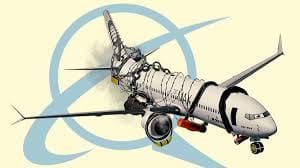
Profit Over Gravity. After all of the deaths, Boeing has changed not a god damn thing.
There was a time when Boeing sounded like America doing something hard and doing it right. Not pretending. Not branding. Not chanting about greatness while the wiring smoked behind the walls. Actual greatness. Steel, math, discipline, consequence. The old religion of engineering. The belief that somewhere in this country there were still serious adults who understood that when you send hundreds of people into the sky in a metal tube, you do not get to be sloppy. A Boeing plane was supposed to mean that somebody, somewhere, had respected reality.
Then reality ran into the modern corporation.
And the modern corporation has one great talent above all others: it can take anything built on duty, skill, and long memory and feed it into a system that worships speed, optics, market share, and the quarterly hallucination. It can take an institution that once meant competence and turn it into a polished machine for explaining why the obvious should not be treated as obvious. It can take a cathedral and turn it into a conference call.
That is what happened to Boeing.
Not all at once. That is never how these things happen. Institutions do not usually leap off a cliff. They sink into rot by degrees. A shortcut here. A softened warning there. A little pressure from the market. A little managerial euphemism. A few more layers between the people making decisions and the people who will live or die by them. Nobody has to announce that the soul of the institution is being strip-mined. They just have to keep calling it efficiency while the old standards are hauled away under a tarp.
Then, eventually, the bill comes due.
And when it came due for Boeing, people died.
That is where this story begins. Not with public relations. Not with investor relations. Not with a parade of executives assuring the public that safety is their highest priority, that sacred phrase recited so often in corporate America it ought to be classified as a controlled substance. It begins with the dead. Lion Air Flight 610 in October 2018. Ethiopian Airlines Flight 302 in March 2019. The FAA says the two 737 MAX crashes took 346 lives. Three hundred forty-six people who boarded a plane and never came home.
And that is exactly the kind of fact corporate culture hates most: a fact so simple it cannot be laundered.
Because once you say it plainly, the whole deodorized circus starts to look obscene. The acronyms. The statements. The press releases. The smooth professional language designed to make catastrophe sound like a regrettable process event. “Lapses.” “Breakdowns.” “Compliance deficiencies.” “Lessons learned.” Always the same calm font, the same tranquil voice, the same managerial incense burned over the site of moral failure. The bodies hit the ground and somebody opens PowerPoint.
The technical core of the story is not even difficult to grasp, which makes it worse. Boeing needed the 737 MAX to compete. The plane’s larger engines changed the handling characteristics. Instead of treating that like the sort of reality that deserves deep humility in a machine carrying human beings through the sky, Boeing relied on MCAS, a flight-control system that in its original form could activate based on data from a single angle-of-attack sensor. After the crashes, Boeing changed the system so it would compare input from both sensors before activating. That detail alone should be enough to put a permanent twitch in the national eyelid. Redundancy became urgent after 346 people were dead.
That is the whole American disease in miniature.
Not just greed. Greed is too small and too stupid a word for this. Greed makes it sound like the problem is merely appetite. The deeper sickness is abstraction. It is the ability of powerful institutions to put so many layers of management language, legal distancing, internal incentives, and bureaucratic procedure between action and consequence that death can become administratively manageable. Once that happens, the moral fact at the center of the thing starts dissolving into workflow.
And that is how modern corporate evil works. Not with capes, horns, or villains barking into phones from dimly lit boardrooms. That version is almost comforting because at least it is easy to spot. No, the real horror is much more American than that. It wears a badge. It leads the meeting. It says “going forward” and “we take this seriously” and “there were process failures.” It builds a culture in which no one has to say, “Let people die.” They only have to keep rewarding the habits that make death more likely. A little pressure here. A little silence there. A little deference to the schedule. A little more obedience to the market. A few more compromises so small that no single one feels like a crime until the sum of them becomes a crater.
That is why this story matters.
Because nobody needs to intend mass death for a rotten system to produce it.
The system can do that all by itself.
And yes, name names, because institutions adore the fog of impersonal blame. During the MAX disaster era, Boeing’s chief executive was Dennis Muilenburg. He was the public face of the company while the disaster unfolded and while Boeing tried to assure everyone that the adults were still in charge.
Today, Boeing’s CEO is Kelly Ortberg, who took over in August 2024 and now presides over the same company while selling the public the oldest product in American commerce: trust restored, culture repaired, lessons absorbed, please board normally. Boeing’s own materials identify Ortberg as president and chief executive officer.
But if this were only about one past scandal, it would be ugly and familiar and still not enough for this list. Boeing belongs on Karma’s Most Wanted because the stench kept rising through the floorboards.
In May 2024, the Department of Justice said Boeing had breached its deferred prosecution agreement by failing to design, implement, and enforce a compliance and ethics program sufficient to prevent and detect fraud violations across its operations.
Read that again and strip the legal starch out of it. After the crashes. After the global outrage. After the hearings, reforms, apologies, and executive theater. The federal government was still saying Boeing had not adequately fixed the culture beneath the machinery. That is not a fluke. That is not a communications problem. That is rot with investor relations.
Then came Alaska Airlines Flight 1282 in January 2024, when a Boeing 737-9 lost a mid-exit door plug shortly after takeoff from Portland. No one died. That is not exoneration. That is luck, and luck is not a safety system. In June 2025, the NTSB said the probable cause was Boeing’s failure to provide adequate training, guidance, and oversight to its factory workers, and it also faulted the FAA for ineffective oversight of Boeing’s known record-keeping issues. There it was again: same company, different failure, same bureaucratic odor of corners cut, warnings softened, accountability diffused, reality postponed.
That repetition is the indictment.
This was not one freak accident or one cursed design choice that fell out of the sky from nowhere. It was a pattern. A culture. A way of governing reality through euphemism until reality finally lost patience and tore a hole in the aircraft. Oversight failures. Training failures. Record-keeping failures. Compliance failures. A giant institution becoming so practiced at self-protection that even after mass death it could still keep generating fresh proof that the lessons had not sunk deep enough to matter.
And if all of this feels familiar, it should, because Boeing is not some alien monster. Boeing is a recognizable American institution in an advanced stage of moral abstraction.
That is what makes it so useful as a symbol. We have done this everywhere. We let hospitals become billing engines with some medicine attached. We let universities become debt foundries wrapped in mission statements. We let tech companies run mass psychological experiments and call it progress. We let journalism become an engagement casino. Everywhere the same shabby miracle: take an institution with a public function, hollow out its ethic, flood it with incentives, then act surprised when the results become grotesque.
Boeing is simply the version that falls out of the sky.
That is why “profit over people” is true but still too soft. Too familiar. Too bumper-sticker. The deeper obscenity is that the institution learns to metabolize consequences. Human beings die and the event is translated into exposure, liability, remediation, governance reform, quality control, trust recovery, reputational management. The dead are real, but inside the system they become inputs. The grief gets converted into process.
That is what should make people sick.
Not just that people died. Not even just that powerful people made terrible decisions. But that the whole machinery of modern corporate life is now so good at professionalizing catastrophe that it can continue speaking in the polished tone of responsible adulthood while the wreckage is still smoking.
That is Boeing’s real achievement in this story. Not just failure. Not just negligence. The seamless conversion of human disaster into administrative language.
Boeing used to symbolize American excellence. Now it symbolizes something more revealing and far more common: a powerful institution so shaped by market panic, internal self-protection, and professional euphemism that catastrophic risk can become operationally normal. Not morally normal. Operationally normal. And that may be worse, because moral monsters are easier to spot than systems that still wear the face of legitimacy.
That is why Boeing belongs on Karma’s Most Wanted.
Not because it is uniquely evil.
Because it is horribly recognizable.
Because 346 people are dead.
Because the Justice Department said Boeing breached the agreement that was supposed to force reform.
Because the NTSB later blamed Boeing’s failures in training, guidance, and oversight in the Alaska door-plug blowout, while also faulting the FAA’s oversight.
Because Dennis Muilenburg was there when the MAX era became a global disgrace, and Kelly Ortberg is there now asking the public to believe the culture can finally be trusted again.
And because in America, the most dangerous institutions are rarely the ones foaming at the mouth.
They are the ones still speaking professionally while the wreckage is smoking.


Member discussion