The Children Who Remember Dying

True or the Woo | Matt Stone
Ryan Hammons was four years old when the nightmares started. He would wake up in Muskogee, Oklahoma, grabbing his chest and telling his mother his heart had exploded in Hollywood.
His parents were not the type to go looking for this. His mother was a deputy county clerk. His father was a police lieutenant. They were Protestant Christians, and nothing in their faith had room for what their son kept telling them: that he used to be somebody else.
Then Ryan pointed at a man in a still from an old movie and said that was him.
The man was an extra. Nobody knew his name. It took a film archivist to find one: Marty Martyn, a Hollywood agent who died in 1964, nearly forty years before Ryan was born.
It only gets weirder from there. Ryan once complained that it wasn’t fair to die at 61 and come back as a baby. Martyn’s death certificate said he was 59. The kid was wrong.
Except he wasn’t. The death certificate was. His death certificate lists his birth year as 1905. Other records put his birth in 1903. Marty Martyn, the man Ryan insisted he was in a former life, was truly 61 years old when he died.
His mother had been writing it all down. Her journal held more than 200 things Ryan had said. Forty-seven of the ones that checked out were said before anyone knew Marty Martyn’s name.
Ryan was later flown to Los Angeles to meet Martyn’s daughter. She had been eight years old when her father died. Ryan was confused. He could not understand why she was all grown up.
Ryan is not a one-off. He is one file in a cabinet. Researchers at the University of Virginia have been collecting cases like his since the 1960s, and they now have more than 2,000 of them, from Oklahoma to India to Turkey. Of the roughly 2,500 cases in UVA’s files, about 1,700 ended with a real person identified: someone who had died and whose life matched what the child described. Most of these kids started talking about it between the ages of two and five.
And the files have a pattern in them. This year, researchers went through 1,319 of the cases and measured the gap between a death and the birth of the child who later described it. When the death was expected, the typical gap was 21 months. When it came out of nowhere, like a crash, a shooting, or a sudden collapse, it was 12. The pattern was stronger in families whose religion has no room for reincarnation. The researchers did not claim to know why.
The Boy From the Wrong Side of Turkey
Kemal Atasoy was six when a researcher named Jürgen Keil sat down in his family’s home in Hatay, near the Syrian border, and wrote down what the boy said.
Kemal said he had been an Armenian Christian named Karakas. He said he lived in a big three-story house on the water in Istanbul, with boats out front and a church behind it. He said he carried a leather bag. He said he was shot. He also had a birthmark on his chest. Kemal said that was where the bullet went in.
His family were Alevi Muslims living more than 500 miles from Istanbul. They had no relatives there and knew no Armenians. They had never tried to check any of it.
Keil did. In Istanbul he found the house. At first nobody remembered an Armenian living there. Then he found a local historian, born in 1924, and asked who used to live in that house. He did not tell the man what Kemal had said.
The historian told him: an Armenian Christian named Karakas. His family sold leather goods. He was known for carrying a big leather bag.
Karakas had been dead for fifty years when Kemal was born.
The Pilot
James Leininger was two when he started screaming in his sleep. Always the same dream. A plane on fire. A man who could not get out.
Over the next few months, he gave his parents details. He said he flew off a boat called Natoma. He said he had a friend there named Jack Larsen. He said he was shot down near Iwo Jima. He signed his drawings of air battles “James 3.”
His father, Bruce, set out to prove it was nonsense. Instead, he found the USS Natoma Bay, a small carrier that fought at Iwo Jima. He found a Jack Larsen who had served on it. And he found the one Natoma Bay pilot killed in that operation: James M. Huston Jr.
Junior. Which would make the next James the third.
This is the case skeptics have hit hardest. Philosopher Michael Sudduth argued the parents were not reliable witnesses and may have steered the boy without meaning to. He also found that a Blue Angels video James watched over and over as a toddler shows a fighter plane on fire after being hit in combat. The family’s answer is a videotape. In 2002, ABC taped an interview with his parents for a program that never aired, and it was recorded before his father had identified Huston.
The worry that parents shape these stories is a real one, and researchers have tried to test it. In India and Sri Lanka they compared two kinds of cases: ones where the child’s statements were written down before the two families ever met, and ones written down after. If families were cleaning up the stories, the second group should have looked better. It didn’t. The two groups were about equally accurate.
James said he flew a Corsair. Huston had flown Corsairs, but on his last mission he was in a Wildcat.
The Bridge
Thusita Silva was about two and a half when she started telling her family in Elpitiya, Sri Lanka, about another life in a town called Akuressa. She would not let it go. She said she had been pregnant. She said she fell from a narrow hanging footbridge into a river and drowned, and that her husband jumped in after her and almost drowned too.
Her older brother got tired of hearing it. He went to Akuressa himself, found nobody who fit, came home, and scolded her for lying.
In 1990, when Thusita was eight, a researcher named Erlendur Haraldsson sat down with her and her mother. He wrote down what she said before anyone went looking again.
Then his team went to Akuressa, 30 miles away. There is only one suspension bridge in the area. In December 1973, a plank gave way under a 27-year-old woman named Chandra Nanayakkara as she crossed it with her husband. She was seven months pregnant. She went into the flooded Nilwala River, and her body was found three days later. Her husband had gone in after her and nearly drowned.
Thusita had given the name Nanayakkara. She was born nine years after Chandra died.
She did not get everything right. She said her husband was a postman. He drove a bus. His brother was the postman. She said she had a yellow bicycle. The family’s bicycle was black.
And the last test never happened. Haraldsson wanted to take Thusita to Akuressa to see what she recognized. Her brother said no.
The Woman Who Went Home
Dorothy Eady was born in a London suburb in 1904, the only child of a tailor. At three she fell down a flight of stairs, and for a short time everyone thought she was dead. When she came around, she started asking to be taken home.
She was home. That was the problem.
On a trip to the British Museum she tore through the Egyptian rooms kissing the feet of the statues. Later her father brought home a magazine with a photograph of the Temple of Seti I at Abydos. She told him she remembered the place. But something was off. She wanted to know where the gardens had gone. He told her to stop telling lies.
It never wore off. At fifteen she said the mummy of Seti I visited her at night, and the sleepwalking and nightmares that came with it put her in sanatoriums more than once. She taught herself anyway. She learned hieroglyphs. In the early 1930s she married an Egyptian man and moved to Cairo. She named her son Sety. Selim Hassan, one of Egypt’s great archaeologists, hired her, which made her the first woman his department ever employed. Some nights she slept alone inside the Great Pyramid.
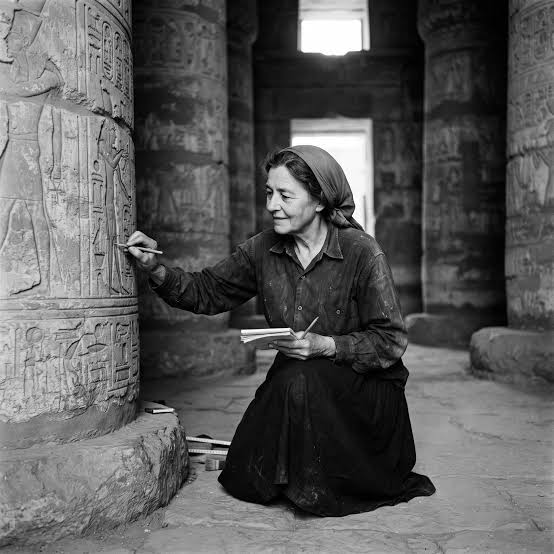
In Cairo the story filled in. Dorothy said a spirit named Hor-Ra came to her at night and, over about a year, dictated the life she had lived before. She wrote down some seventy pages of it. Her name had been Bentreshyt. She was a girl of humble birth, the daughter of a vegetable seller, who became a priestess in the temple at Abydos. And it was in the temple garden, she said, that she first met the pharaoh Seti I.
She said she had one aim in life: to go to Abydos, live in Abydos, and be buried in Abydos.
She made her first visit in 1952. She told a story about what happened there. The chief inspector of antiquities had heard her claims and decided to test her. He named paintings on the temple walls and told her to go stand in front of them. In the dark. She said she found them.
On March 3, 1956, at fifty-two, she went. She never left. For 25 years she kept the temple, guided visitors through it, and told anyone who asked that she had lived there before, three thousand years ago.
She lived the part. She took off her shoes before she walked into the temple. Morning and evening she went to the shrine, burned incense, and prayed. In 1957 she wrote out a calendar of the ancient feast days, and on those days she would not eat fish, beans, onions, or garlic before crossing the threshold. She brought the gods beer, wine, bread, and tea biscuits. When a cobra started visiting her office in the temple, she fed it boiled eggs and milk, to the horror of the guards.
Early in 1959 the money for the restoration ran out, and her job went with it. The Antiquities Department told her to come back to Cairo. She refused. She spent her last coins on eggs for her cats, went into the temple, and explained her situation to Osiris. Then her boss showed up at her door. Cairo had called. Her contract was being renewed.
Several things prevent this from being an open-and-shut case. No researcher ever investigated her. Most of what we know about her memories comes from Dorothy herself. And by the time she reached Abydos, she had twenty years of real training behind her.
But there is the garden. Dorothy said the temple once had one, and she said where: off its south side. Sometime between 1956 and 1959, workers laying foundations for a restoration workshop hit it. Tree roots. Vine roots. Watering channels. A well that, she said, “still had water in it.”
Her friend Hanny El Zeini didn’t take her word for it. He had the foreman show him. The man counted off some paces, dug, and in less than five minutes an ancient tree stump came out of the sand. Then he walked ten more paces and dug again. A second stump came up, bigger than the first, with roots twisting out in every direction. The row, he said, ran at least fifty meters.
A few months later El Zeini put the question to the Antiquities inspector in charge of restoring the temple. The inspector told him Dorothy was directly responsible for finding those tree roots, and that she had helped locate a tunnel under the north end of the temple too. He said he would not start a dig at Abydos without talking to her first.
Dorothy Eady died on April 21, 1981, and was buried in the desert near Abydos.
A little girl in London once looked at a photograph in a magazine and asked where the gardens were. It took about fifty years, but somebody finally dug one up.
The Grounded stands behind every factual claim it publishes with a $100 accuracy guarantee. Find an error of fact and tell us. If you are right, we pay.
- Cott, Jonathan, with Hanny El Zeini. The Search for Omm Sety: A Story of Eternal Love. Doubleday, 1987, pp. 71, 84, 136-138, 174. https://archive.org/details/searchforommsety00cott_0
- Egyptian Streets. “From London to Ancient Egypt: the Reincarnation of Dorothy Eady.” https://egyptianstreets.com/2021/09/13/from-london-to-ancient-egypt-the-reincarnation-of-dorothy-eady/
- El Zeini, Hanny, and Catherine Dees. Omm Sety’s Egypt. St. Lynn’s Press, 2007, pp. 15, 22.
- IFLScience on the UVA database (2,254 cases, 74 percent matched). https://www.iflscience.com/study-of-1600-cases-claims-to-have-found-an-odd-correlation-in-reincarnation-reports-84976
- Kean, Leslie. Surviving Death: A Journalist Investigates Evidence for an Afterlife. Crown Archetype, 2017, pp. 78-79.
- Keil, H. H. J., and Tucker, J. B. “Children Who Claim to Remember Previous Lives: Cases with Written Records Made before the Previous Personality Was Identified.” Journal of Scientific Exploration 19(1), 2005, 91-101.
- Lesko, Barbara S. “Omm Sety, 1904-1981,” in Breaking Ground: Women in Old World Archaeology, edited by M. S. Joukowsky and B. S. Lesko.
- Matlock, James G. “Clarifying Muddied Waters, Part 2.” Journal of Scientific Exploration 36(4), 2023, 760-781. https://journalofscientificexploration.org/index.php/jse/article/view/2765
- Mills, A., Haraldsson, E., and Keil, H. H. J. “Replication Studies of Cases Suggestive of Reincarnation by Three Independent Investigators.” Journal of the American Society for Psychical Research 88 (1994), 207-19.
- Omm Sety. Omm Sety’s Living Egypt: Surviving Folkways from Pharaonic Times. Edited by Nicole B. Hansen. Glyphdoctors, 2008, pp. xv-xvi.
- Sadeghi, Saeedeh, et al. “A Large-Scale Analysis of Temporal Patterns in Children’s Purported Past-Life Memories: Shorter Intervals Following Unexpected Deaths.” Psychology of Consciousness: Theory, Research, and Practice, 2026. https://psycnet.apa.org/doiLanding?doi=10.1037/cns0000493
- Schouten, Sybo, and Ian Stevenson. “Does the Socio-Psychological Hypothesis Explain Cases of the Reincarnation Type?” Journal of Nervous and Mental Disease 186 (1998), 504-506.
- ScienceAlert on the Sadeghi study of UVA’s case archive. https://sciencealert.com/scientists-found-a-bizarre-pattern-in-over-1000-cases-of-alleged-human-reincarnation
- SPR Psi Encyclopedia: Dorothy Eady / Omm Sety. https://psi-encyclopedia.spr.ac.uk/articles/dorothy-eadyomm-sety-reincarnation-case/
- SPR Psi Encyclopedia: Kemal Atasoy. https://psi-encyclopedia.spr.ac.uk/articles/kemal-atasoy-reincarnation-case/
- SPR Psi Encyclopedia: Reincarnation Cases with Records Made Before Verifications. https://psi-encyclopedia.spr.ac.uk/articles/reincarnation-cases-records-made-verifications/
- SPR Psi Encyclopedia: Ryan Hammons. https://psi-encyclopedia.spr.ac.uk/articles/ryan-hammons-reincarnation-case
- SPR Psi Encyclopedia: Thusita Silva. https://psi-encyclopedia.spr.ac.uk/articles/thusita-silva-reincarnation-case/
- Sudduth, Michael. “The James Leininger Case Re-examined.” Journal of Scientific Exploration 35(4), 2021.
- Sudduth, Michael. “Response to Jim Tucker.” Journal of Scientific Exploration 36(1), 2022, 91-99. https://journalofscientificexploration.org/index.php/jse/article/view/2515
- Tucker, Jim B. “The Case of James Leininger: An American Case of the Reincarnation Type.” Explore 12(3), 2016, 200-207. https://med.virginia.edu/perceptual-studies/wp-content/uploads/sites/360/2017/04/REI42-Tucker-James-LeiningerPIIS1550830716000331.pdf
- Tucker, Jim B. “Response to Sudduth’s ‘James Leininger Case Re-Examined.’” Journal of Scientific Exploration 36(1), 2022, 84-90. https://journalofscientificexploration.org/index.php/jse/article/view/2487
- Vice. “The Hard Science of Reincarnation.” https://www.vice.com/en/article/hard-science-of-reincarnation-past-lives/
- Visoni, Vitor Moura. “How To Improve the Study and Documentation of Cases of the Reincarnation Type? A Reappraisal of the Case of Kemal Atasoy.” Journal of Scientific Exploration 24(1), 2010, 101-108. https://journalofscientificexploration.org/index.php/jse/article/view/71/117
- WBUR Here & Now, child reincarnation segment (Nov. 11, 2026). https://www.wbur.org/hereandnow/2026/11/11/child-reincarnation




Member discussion