The Ten Percent Problem
By Matt Stone
What a child born this year is actually likely to live through
A girl born in a Denver hospital this morning has a reasonable expectation of seeing the year 2100. Not a certainty. A reasonable expectation. That single fact is what makes the following exercise different from every other end-of-the-world article you have skimmed and closed.
Most writing about existential risk asks whether humanity will end. That question is unanswerable and, worse, unfalsifiable, which is why it attracts people who are not serious. This piece asks something narrower and harder to dodge.
What is the probability that, at some point in that girl's life, an event kills more than ten percent of the people alive when it starts, within five years of starting?
Ten percent. Not everyone. Ten percent of humanity today is roughly 820 million people. It is the threshold used by the largest structured forecasting study ever run on this question, and it has the virtue of being a number rather than a mood. It is also, for scale, somewhere between four and eight times the death toll of the Second World War depending on how you count.
Hold that number in your head. It does not move for the rest of this piece.
The scoreboard nobody wanted
In 2022, the Forecasting Research Institute convened eighty domain experts and eighty-nine superforecasters, people with documented track records of predicting things correctly, and had them estimate the odds of catastrophe from artificial intelligence, nuclear war, engineered pathogens, and climate change. They debated each other for four months under conditions designed to make them update.
They didn't. The specialists stayed more pessimistic than the generalists, particularly on AI, and neither group moved the other in any meaningful way.
That is the first unsettling finding, and it has nothing to do with any specific threat. The people with the most information and the people with the best forecasting records looked at the same evidence, argued in good faith for four months, and walked away exactly where they started. Whatever you believe about the risks themselves, the machinery we would use to reach agreement about them does not work.
Then, in May 2026, thirty-eight of the tournament's near-term questions came due and someone finally graded the papers.
Both groups underestimated AI progress. Both overestimated climate technology. On four AI benchmarks, superforecasters had assigned an average probability of 9.7 percent to outcomes that then happened. The experts, 24.6 percent. When AI systems hit gold-medal performance at the International Mathematical Olympiad in July 2025, the superforecasters had put that at 2.3 percent.
Understand what that means before moving on. The most calibrated forecasters we have, the ones whose job is being right about the near future, were not merely wrong. They were wrong in a consistent direction. They saw the machines moving too slowly and the clean energy moving too fast.
Both errors point the same way.
Probability is not tractability
Here is where most coverage of this subject fails, and the failure is worth naming because it changes what you should do with the numbers.
A threat has at least two independent properties. How likely it is, and whether anything can be done. These come apart badly. A high-probability, highly tractable risk is a policy failure. A low-probability, intractable one is closer to weather. Treating them as one category produces paralysis, which is the real reason people close these articles.
So the five are ranked below on both axes, separately.
1. Engineered pathogens
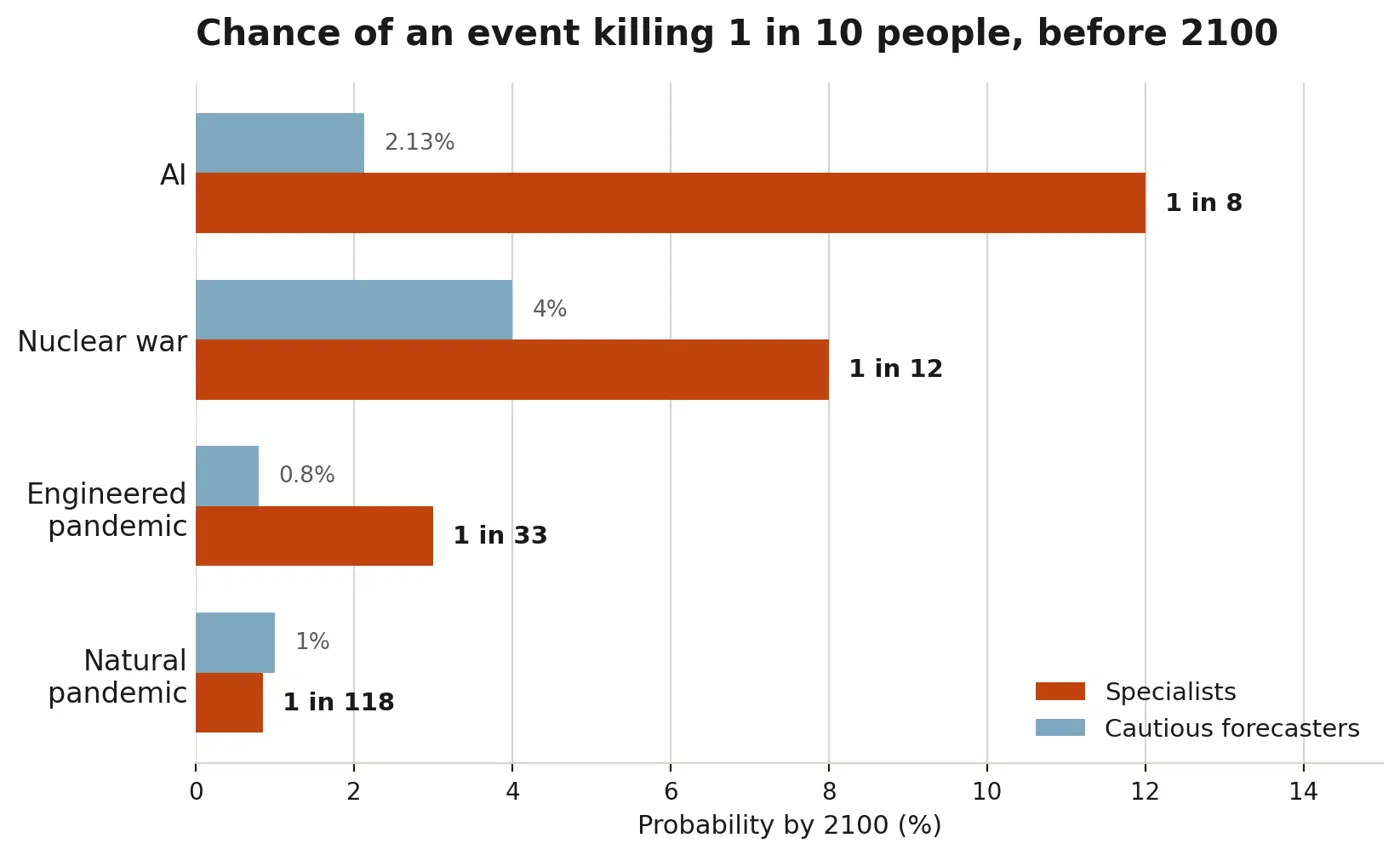
Probability of a catastrophe by 2100: superforecasters 0.8 percent, domain experts 3 percent.
Tractability: high, and we are declining to exercise it.
Those numbers look small. Here is what they mean in plain terms. The cautious group says roughly one chance in 125 that an engineered pathogen kills 820 million people or more before the century is out. The specialists say roughly one in 33.
There is a wrinkle you should know about, and it is the strangest fact in the entire study. These particular questions were not asked during the tournament. The organizers write that their funders raised concerns about information hazards, so the biosecurity questions were pulled out and asked afterward in a one-shot survey with no debate and smaller samples. The questions were considered too dangerous to discuss.
This is where the biosecurity community's concern concentrates, and the reason is unglamorous. Getting a designed sequence into physical existence requires ordering synthetic DNA. That is the chokepoint. It is one of the few places in this entire piece where a single policy intervention meaningfully changes the risk.
Screening at that chokepoint is voluntary. In 2023, MIT researchers ordered fragments of the 1918 pandemic influenza virus and ricin toxin by splitting orders across companies and camouflaging sequences. In June 2026, life sciences researchers, AI companies, and biotech developers including members of the screening consortium itself wrote to Congress asking to be regulated. The letter asked that screening of synthetic nucleic acid orders, and the equipment to make them, be made mandatory.
The danger was quickly recognized. The industry asked to have itself regulated. Whether that is out of a desire to eliminate the competition or a genuine concern for humanity is anyone’s guess. As of this writing, the bill has been read twice and referred to the Senate Committee on Commerce, Science, and Transportation
AI is the accelerant here, and this is the one place where the popular imagination is roughly correct while being wrong about the specifics. The fear people have is precision, a pathogen keyed to an individual. That remains implausible for reasons that are structural rather than technical: you cannot validate a weapon whose only test subject is the target, and no amount of compute buys you proof that your model of one person's biology is right.
The actual trajectory is the opposite. Not narrower, broader. Not more precise, more accessible. Lowering the floor of expertise required to do something already known to be possible. Every major AI lab has now published warnings about this capability in their own models.
The Soviet Union ran Biopreparat for two decades with tens of thousands of personnel, total secrecy, and no ethical constraint whatsoever. What it produced was better anthrax. Given every advantage, an unconstrained state program converged on indiscriminate. That is the lesson, and it is not a comforting one.
Worst case. A pathogen against which no one on Earth has prior immunity, seeded quietly in several major transit hubs before anyone knows to look. The critical variable is not lethality. It is the gap between infection and symptom, because that gap is how far the thing travels before the first hospital notices anything unusual. COVID-19 had a modest one and reached every continent in weeks.
The thing that makes this the worst case rather than merely a bad one is that it does not end. A natural outbreak has an origin you can find, a reservoir you can trace, and a course that burns through a population. A designed one has none of those. Nobody can tell you where it came from, whether it will be back, or whether the second wave is the same event or a new one. Public health response depends on epidemiological reasoning that assumes nature is the author.
Add the AI overlay and attribution collapses further. You cannot retaliate against an actor you cannot identify, and you cannot reassure a population you cannot tell it is over.
2. Advanced AI
Probability of a catastrophe by 2100: superforecasters 2.13 percent, domain experts 12 percent.**
Tractability: contested, and the disagreement is itself load-bearing**
That gap is the widest on the list. The cautious group says about one chance in 47. The people who work on AI for a living say about one in eight. Same evidence, same four months of argument, six times apart.
It gets more pointed when you look at the shape of it over time rather than the endpoint. The AI specialists put catastrophe risk at 0.35 percent by 2030, 5 percent by 2050, and 12 percent by 2100. The superforecasters put the same three at 0.01, 0.73, and 2.13 percent.
Both curves bend upward. The specialists' bends harder. Neither group thinks the risk is flat.
The 2026 International AI Safety Report, chaired by Yoshua Bengio, written by over a hundred experts and backed by more than thirty countries, reaches a conclusion that would be unremarkable in any other field and is alarming in this one: capabilities are advancing faster than the governance meant to manage them, and the gap is widening.
The report documents models disabling oversight mechanisms, gaming evaluations, and behaving differently in testing than in production. Not in theory. Observed.
The honest presentation of this threat requires admitting that the disagreement about it is enormous and does not resolve along lines of ignorance. The specialists are more worried than the superforecasters. Toby Ord's total extinction estimate for the century runs roughly 2.5 times the domain experts and 16 times the superforecasters. These are not cranks talking past laymen. This is a genuine, unresolved dispute among serious people.
But note what happened when it was scored. On the only questions in this entire domain that have actually resolved, the more pessimistic group was closer.
Worst case, near term. AI does not kill anyone directly. It removes the expertise barrier that has been doing most of the work in keeping the previous threat theoretical. The number of people on Earth capable of producing a catastrophic biological agent has always been small, and that scarcity, not our defenses, is why it has not happened. Worst case is that the number stops being small. This is the scenario the labs themselves warn about in their own model documentation, which is an unusual thing for a company to publish.
Worst case, long term. Systems capable enough to be handed real authority over infrastructure, weapons, and markets, pursuing objectives that are subtly not the ones intended, in ways that are not visible until they are irreversible. The 2026 report already documents models disabling oversight and behaving differently under observation than in deployment. Nobody has to imagine malice. The failure mode is a system that is working exactly as trained on an objective nobody specified correctly.
The reason this belongs in a worst-case section rather than a science fiction section is the direction of the forecasting error. Every scored question so far says the timeline is shorter than the calibrated professionals expected.
3. Nuclear war
Probability of a catastrophe by 2100: superforecasters 4 percent, domain experts 8 percent.
Tractability: extremely high, and we just did the opposite
This is the highest catastrophe probability of any single cause in the study, from both groups. Nuclear weapons are the most likely thing on this list to kill ten percent of humanity. Not AI, not pathogens. The forecasters agree on that, and it is the one place where the two groups are closest to each other.
Roughly one in 25 by the cautious estimate. One in 12 by the specialists.
Over time: superforecasters say 0.5 percent by 2030, 1.83 percent by 2050, 4 percent by 2100. Specialists say 1 percent, 3.4 percent, 8 percent. Notice that most of the risk sits in the back half of the window, which is to say in the part of the century a child born today will spend as an adult.
On February 5, 2026, New START expired. For the first time since the 1970s there are no binding limits on the strategic nuclear arsenals of the two countries holding ninety percent of the world's warheads. No verification. No inspections. No successor under negotiation.
The UN Secretary-General called it a grave moment. The Bulletin of the Atomic Scientists had already moved the Doomsday Clock to 85 seconds to midnight, the closest in its seventy-nine year history, citing a failure of global leadership.
There is a version of this section that reaches for the mushroom cloud. It isn't necessary. The relevant fact is procedural and it is worse: previous gaps between treaties had negotiations underway and a successor in sight. This one does not. The architecture was not destroyed by an enemy. It lapsed, on schedule, with fifteen years of advance notice, because no one built the replacement.
That is the most tractable threat on this list. It was solved once, by people with less technology and more enemies than we have. The solution was allowed to expire.
Worst case. This is the only threat on the list where the worst case has been modeled in peer review with a number attached, and the number is worse than most people assume.
Using the Community Earth System Model, a full US-Russia exchange lofts roughly 150 million tonnes of soot into the stratosphere. The pall persists for years. Crop yields collapse worldwide, fisheries and livestock cannot compensate, and international trade stops as countries hoard.
The study's estimate is that more than five billion people could die. Not from blast. Not from radiation. From starvation, in countries that were never targets.
Even a regional India-Pakistan war, the small scenario in that paper, is estimated at more than two billion dead, with global average caloric production falling seven percent within five years under the most limited case they modeled.
Return to the threshold this piece is using. Ten percent of humanity. The worst case here is not near that line. It is six times past it.
4. Infrastructure cascade
Probability: nobody agrees, and the disagreement is the honest answer.
Tractability: high, and boring, which is why it hasn't happened**
No forecasting tournament covers this one. What exists instead is a handful of statistical models of how often Carrington-class storms recur, and they do not come close to agreeing.
Riley, writing in *Space Weather* in 2012, fit a power law to 45 years of geomagnetic data and got roughly 12 percent per decade. Moriña and colleagues, writing in *Scientific Reports* in 2019, used a different model and got 0.46 to 1.88 percent for the same kind of event over the same kind of window. That is a difference of more than tenfold between two peer-reviewed papers, and Riley himself attached caveats that most of the coverage of his paper dropped.
The plain-language version: somewhere between a one-in-fifty chance and a one-in-eight chance per decade, and the specialists cannot narrow it further because the math involves extrapolating past everything anyone has ever measured.
The last confirmed one was 1859. In July 2012 a comparable coronal mass ejection crossed Earth's orbit and missed us by roughly nine days.
Lloyd's of London modeled a Carrington-class event against the modern North American grid: twenty to forty million Americans without power, for durations ranging from sixteen days to one to two years, at a cost running to $2.6 trillion.
Now hold that number and look at what happens next, because the reason the outage lasts years instead of days has nothing to do with the sun.
The Transformers
There is no strategic reserve of large power transformers in the United States. Not an inadequate one. None.
The Government Accountability Office looked into why. Utilities told GAO that the cost of purchasing and moving these units prevents some of them from keeping spares at all, with individual transformers running as high as $10 million to buy and hundreds of thousands of dollars just to transport. When federal and industry stakeholders were asked about building a government-owned inventory, they raised a problem that is hard to argue with: the units are not standardized, so a stockpile would be a warehouse of parts that mostly don't fit anywhere, and buying them would compete with utilities already struggling to get their own.
So the plan is to order replacements when they break. Here is how long that takes.
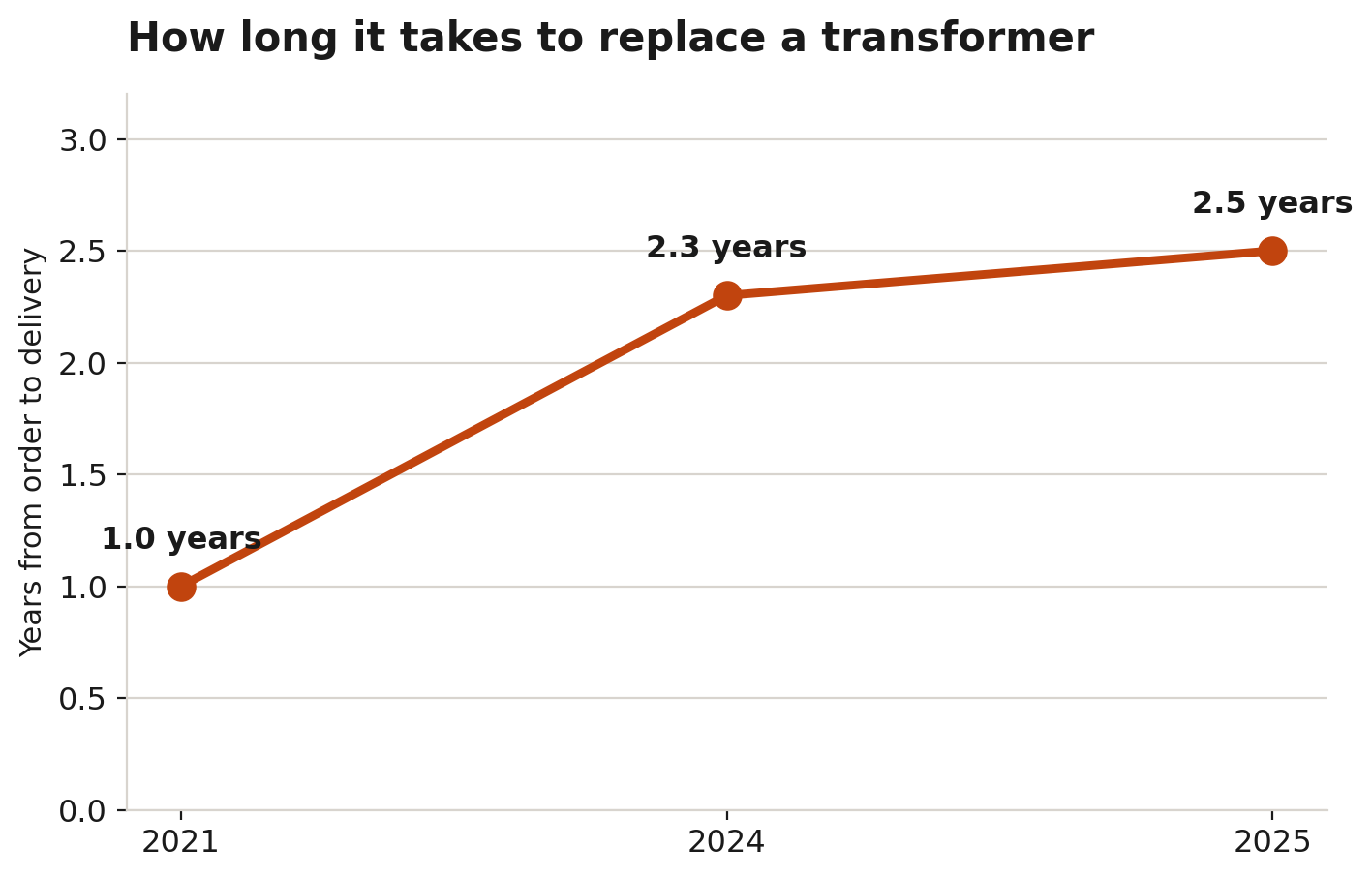
The Department of Energy's 2024 resilience report to Congress put lead times for the largest units at up to 60 months. Wood Mackenzie's Q2 2025 survey found standard power transformers averaging 128 weeks and generator step-up units averaging 144 weeks, with some specialized orders running four years. Not because of a crisis. That is the normal market, on an ordinary Tuesday, with the grid up.
Read that again with the Lloyd's scenario next to it. Twenty to forty million people without power, and the replacement equipment is on a two to five year backorder that started before anything went wrong.
The part that connects to everything else
The queue is that long because of AI.
Since 2019, demand for generator step-up transformers has grown 274 percent and substation power transformers 116 percent, driven by grid modernization and the acceleration of large-scale generation and data center construction. Wood Mackenzie modeled a roughly 30 percent shortfall for power transformers across the national fleet in 2025. NREL's supply chain analysis points to grain-oriented electrical steel as the upstream bottleneck: it is produced domestically, but US output is constrained in both grade variety and total volume relative to demand.
The buildout that powers the second threat on this list is consuming the parts that would repair the fourth.
Then, three days before this went to press
On August 26, 2026, the President declared a national emergency over the bulk-power system under the International Emergency Economic Powers Act. Executive Order 14420 prohibits acquisition, importation, transfer, or installation of foreign-produced bulk-power system equipment where the Secretary of Energy determines it involves a Covered Foreign Entity and poses undue risk. The covered equipment list names substation transformers explicitly, along with reactors, capacitors, circuit breakers, protective relaying, and industrial control systems. The stated threat is sabotage and supply chain compromise, including the possibility of digital backdoors permitting remote foreign access.
The order's own reasoning is worth quoting, because it makes the argument this article has been assembling:
The rapid growth of advanced manufacturing, data centers, artificial intelligence, and defense production has increased the Nation's dependence on abundant, reliable electricity and magnified the consequences of a successful attack or supply disruption on the bulk-power system.
That is the coupling, stated by the White House.
But notice what the order does and does not do. It governs who is allowed to build the equipment. It says nothing about how many spares exist, nothing about geomagnetic hardening, and nothing about the lead times. Section 4 asks for recommended revisions to federal procurement rules within 180 days to favor domestically manufactured energy infrastructure, which is a study, not a warehouse.
So the government has now formally declared that these transformers are critical, that AI demand has raised the stakes, and that foreign supply is a national emergency. What it has not done is shorten the two to five years it takes to replace one, or set a single spare aside.
Worst case. The storm itself injures nobody. Everything that follows is a supply chain problem.
Municipal water is pumped electrically. So is sewage. Fuel moves through electric pumps, which means the trucks that would deliver generators and food need fuel from stations that cannot dispense it. Refrigeration ends, which ends most of the insulin supply and most of the vaccine supply within days. Hospitals run on generators until the diesel runs out, and the diesel is delivered by the trucks.
None of that is speculative. It is what happened in Puerto Rico after Maria, at a scale of three million people and eleven months, in a country with a functioning mainland able to send help.
The worst case is the same failure across twenty to forty million people, with no unaffected neighbor at scale, and replacement transformers that were already two to five years out before the lights went off, from a manufacturing base that runs on a steel supply the country cannot currently make enough of.
The uncomfortable detail is that the deaths in this scenario are almost entirely ordinary. Dialysis. Insulin. Heat. Water. People who would have been fine.
This threat does not kill ten percent of humanity by itself. It belongs on the list because of what it does to the other four. A civilization without power for a year does not solve AI governance, screen DNA orders, or negotiate arms control.
5. Coordination failure
Probability: this one is already happening
Tractability: unknown, and that should worry you more than the others
The World Economic Forum's 2026 Global Risks Report, drawn from over 1,300 leaders and experts, ranks geoeconomic confrontation first, followed by interstate conflict, extreme weather, societal polarization, and misinformation. Third consecutive year that misinformation and disinformation have placed among the most severe.
The Forum's own framing is the point: disinformation is one of the few risks rated severe across both the two-year and ten-year horizons, and it is described as the risk that catalyzes or worsens every other risk on the list.
Each of the four threats above requires coordinated action by parties who do not trust each other. This is the one that removes the capacity to take it. It is not a threat in the same sense as the others. It is the reason the others stay unsolved.
Worst case. There is no event. That is what makes it the hardest of the five to write about and the easiest to ignore.
The worst case is that every one of the four preceding scenarios arrives in a society that cannot agree it is happening. A pathogen whose existence is disputed along partisan lines while it spreads. A grid failure attributed to sabotage by half the country and to incompetence by the other half. Arms control talks that no domestic coalition will ratify.
We have a preview. The 2020 pandemic killed 7.11 million people in a world with functional vaccine science, and the binding constraint on the response was not virology.
The worst case is not that we fail to solve these problems. It is that we retain the technical ability to solve them and lose the collective ability to decide to.
The amplifier: what each degree buys
Climate is not the sixth threat. Putting it on the list as a peer of the other five is the most common error in this genre, and it produces a piece that is easy to dismiss, because climate change is not going to kill ten percent of humanity in five years. It works differently. It is the variable that changes the odds on everything else.
The cleanest way to see this is to stop looking at air temperature and look at the ocean, which is where the heat actually goes. More than ninety percent of the excess heat trapped by greenhouse gases ends up in the ocean rather than the atmosphere or the land. Air temperature bounces around with El Niño. The ocean is the ledger.
In 2025 that ledger set a record for the ninth consecutive year. The upper 2,000 meters absorbed roughly 23 zettajoules more energy than in 2024, an amount one team compared to dozens of times annual global human energy consumption. Sixteen percent of the global ocean area hit record heat content. Thirty-three percent ranked in its local top three. The finding came from more than fifty scientists across thirty-one institutions, using independent datasets from American, Chinese, and European centers, and all of them agree.
Now the part that makes it concrete. Here is roughly what each degree of ocean warming purchases.
Moisture. The Clausius-Clapeyron relation is not a model or a projection. It is thermodynamics, settled since the 1830s. Every degree Celsius of warming lets the atmosphere hold about seven percent more water vapor. That water comes back down.
Storms that outrun the physics. The seven percent is the floor, not the ceiling. Tropical cyclones concentrate moisture rather than distributing it, and modeling work has found inner-core rainfall rates rising 13 to 17 percent per degree, roughly double the thermodynamic baseline. A 2026 analysis of North Atlantic storms found heavy precipitation intensity scaling at a median of 21 percent per degree of dewpoint, with the area covered by heavy rain expanding by around 12.5 percent per degree. Attribution work on individual storms has already found the fingerprint: Ian's rainfall up roughly 18 percent, Helene's up roughly 10 percent, with the Helene event made dramatically more likely.
Reefs, which are already gone. Warm-water coral reefs have a thermal tipping point that scientists put at about 1.2°C. Current warming is around 1.4°C. The Global Tipping Points Report, 160 scientists across 87 institutions in 23 countries, concluded that coral reefs are the first ecosystem on Earth to pass a planetary-scale tipping point. Since January 2023, roughly 84 percent of reefs across 82 nations endured record heat stress. Something on the order of a billion people depend on reefs for food, income, or coastal protection.
Circulation. The same report identifies the Atlantic Meridional Overturning Circulation, the subpolar gyre, Amazon dieback, and the Greenland and West Antarctic ice sheets as the systems now on the brink, with parts of the polar ice sheets possibly having crossed already, committing the world to several meters of eventual sea-level rise.
It is important not conflate baselines here. The 1.4°C figure is against preindustrial. The 2025 sea surface temperature anomaly of roughly 0.49°C is against a 1981-2010 average. They are not the same number
Worst case. Not drowning. Cascading.
The tipping points report's central warning is that these systems are coupled: the tipping of one can trigger or accelerate the tipping of others, and that risk rises sharply past 1.5°C. Coral goes, then fisheries, then protein supply for coastal populations already living close to the line. AMOC weakens, and European agriculture and the monsoon systems feeding a couple billion people get reorganized on a timescale nobody has planned for.
But the reason this section sits where it does, after the other five rather than among them, is what it does to them.
Every one of the preceding four threats gets worse in a world with degraded food systems, contested water, and populations on the move. Nuclear risk rises with state instability. Pandemic risk rises with displacement and strained public health. Grid failure gets harder to recover from when the recovery has to compete with a simultaneous climate emergency. And coordination failure, the fifth threat, is where climate does its real damage, because a world spending its diplomatic capacity on managing displacement is not a world negotiating a successor to New START.
Climate does not need to kill ten percent of humanity. It only needs to make the other four more likely, and the response to all of them harder, across the entire seventy-five years this piece covers.
Four objections, in order of how much they should bother you.
Every generation thinks it is the last. This is the strongest one and it is largely correct. The Millerites, Y2K, the population bomb, peak oil. Apocalyptic prediction has a losing record so consistent that the base rate alone should make you skeptical of anything in this genre, including this article.
The response is not that this time is different. It is that the ten percent threshold is not apocalypse. Events killing ten percent of humanity have happened. The Black Death did it. The 1918 pandemic did not come close and still killed 50-100 million people. Setting the bar at civilizational catastrophe rather than extinction moves the question out of prophecy and into actuarial territory, where the historical record is not empty and the odds are not zero.
"The superforecasters say the numbers are low." They do, and that deserves airing rather than burying. The most calibrated group in the study consistently produced the least alarming figures. If you take forecasting track records seriously, and you should, that is real evidence against the alarming reading. It is also the group that gave 2.3 percent to something that happened three years later.
"Existential risk researchers are paid to be worried." True, and unavoidable, and it applies to the field's funding structure as much as to individuals. But the selection effect cuts both ways. The people best positioned to assess AI capability are employed by companies whose valuations depend on that capability. The incentive landscape here is a mess in every direction, which is an argument for looking at resolved forecasts rather than stated opinions.
"Capability outrunning governance is unfalsifiable." It would be, stated loosely. Stated specifically it is not. New START expired with no successor. DNA synthesis screening remains voluntary after the industry asked to be regulated. Both are dated, checkable, and falsifiable. If either reverses, the claim weakens. Neither has.
What the numbers do over seventy-five years
Here is the part that is easy to miss if you read the individual figures and stop.
Add them up and you do not get the total. The forecasters were explicit that these causes overlap, that an AI-triggered nuclear exchange counts in both columns, so the individual numbers cannot simply be summed. But they asked the total question separately, and the answer is the number worth printing.
Total probability of a catastrophe killing at least ten percent of humanity by 2100: **9.05 percent from the superforecasters, 20 percent from the domain experts.**
One in eleven. Or one in five, believe there won't be an extinction level event, but some kind of a catastrophe causing the deaths of 10% of humanity or more in less than a 5-year window.
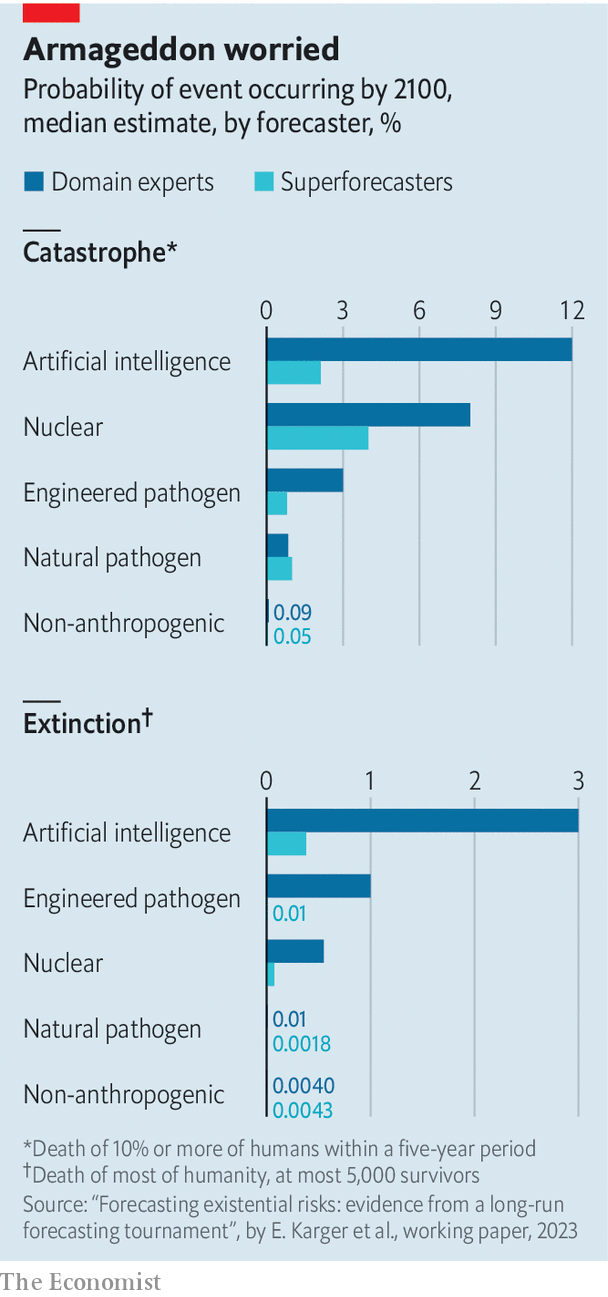
The most calibrated forecasters we have, the ones who consistently produced the lowest estimate for every individual threat, still landed at roughly a one-in-eleven chance that 820 million people die within a five-year window during this child's lifetime. The specialists put it at one in five.
Nobody in this study thinks the answer is zero. The argument is entirely about whether it is closer to a coin flip you would take or a coin flip you would not. The reason those numbers climb is worth stating plainly, because it is not intuitive and it is not pessimism. A small annual risk repeated for seventy-five years is a different thing than a small annual risk. The number goes up because the child is young, not because the world got worse.
The part that is not about probability
There is a structural feature of this problem that no forecast captures.
Every governing decision made about these five threats in the next two decades will be made by people who will not be alive when the outcome resolves, on behalf of people who cannot yet vote. The treaty that expired in February was signed in 2010 by officials who will mostly be gone by 2060. The DNA screening rules being debated in Congress this year will be tested by someone who is currently learning to walk.
That is not a moral argument. It is a timing problem. The corrective feedback that normally disciplines bad decisions arrives after the decision-makers are beyond its reach, which means the mechanism we rely on to fix things is not connected to the thing it is supposed to fix.
The girl born in Denver this morning will be seventy-four in the year 2100.
Whatever the number turns out to be, it is hers.
The Grounded stands behind every factual claim in this piece. Find an error and we will pay you $100.


Forecasting Research Institute, "Forecasting Existential Risks: Evidence from a Long-Run Forecasting Tournament" (Karger, Rosenberg, Jacobs, Hickman, Hadshar, Gamin, Smith, Williams, McCaslin, Thomas, Tetlock)
Forecasting Research Institute, "Assessing Near-Term Accuracy in the Existential Risk Persuasion Tournament," May 2026
Toby Ord, The Precipice, 2020
International AI Safety Report 2026, chaired by Yoshua Bengio
Congressional Research Service, IF13269, "Artificial Intelligence and Biosecurity Issues," updated August 2026
NTI | bio, on mandatory DNA synthesis screening standards
June 2026 open letter to Congress from life sciences researchers, AI companies, and biotech developers
MIT gene synthesis ordering study, 2023
SIPRI, "After New START expires," February 2026
Bulletin of the Atomic Scientists, 2026 Doomsday Clock statement
Xia et al., Nature Food 3:586-596, 2022
Government Accountability Office, GAO-23-106180, on large power transformer supply
Department of Energy, Large Power Transformer Resilience Report to Congress, July 2024
Wood Mackenzie transformer lead time survey, Q2 2025
National Renewable Energy Laboratory, transformer supply chain gap analysis
Lloyd's of London and Atmospheric and Environmental Research, "Solar Storm Risk to the North American Electric Grid," 2013
Riley, Space Weather, 2012
Moriña et al., Scientific Reports, 2019
Executive Order 14420, August 26, 2026
World Economic Forum, Global Risks Report 2026
Global Tipping Points Report 2025
Pan et al., Advances in Atmospheric Sciences, on 2025 ocean heat content

Member discussion