We Plugged In and Turned On Each Other
By Matt Stone
The card reader at the gas station goes down and the line does not move. Nobody has cash. The attendant cannot open the register, because the register is not a drawer with a key, it is a terminal, and the terminal is asking a server in another state whether this transaction is permitted. It is not a complicated failure. Somewhere a piece of equipment stopped receiving current. Twelve people stand in a building full of fuel they cannot buy.
This is the ordinary version. It resolves in twenty minutes and everyone forgets it.
The non-ordinary version is running right now in Gary, Indiana, where a derecho on August 11 took the grid down and parts of the city are still dark two weeks later. As of this morning the utility still had roughly 711 customers out from that storm, with a restoration estimate of tonight, August 25, 2026. Nearly 368,000 have been restored since it started.
The useful thing about the ordinary version is that it shows the shape of the problem. We did not simply add electricity to American life over the last century. We built systems that require it, and then we removed the systems that did not.
1859
In September of 1859 a solar storm hit the Earth with enough force to light auroras far outside the polar latitudes. The only electrical infrastructure of any consequence was the telegraph network. Operators reported shocks. Some lines carried current with the batteries disconnected. Paper caught fire in telegraph offices where the telegraphs had been completely removed from a power source.
That is the entire inventory of what there was to hit. A few thousand miles of wire and the men sitting next to it. An event of the same scale would look very different today.
1989
The objection to Carrington is that it happened to a world made of paper and horses. So take a storm that hit a real grid.
In March of 1989 a geomagnetic storm reached Quebec's transmission system. The collapse took about ninety seconds. Roughly six million people lost power for around nine hours, in a Canadian winter, in the dark. Nobody was attacked. No equipment was sabotaged. The sun did something the sun does, and a modern grid went down faster than a person can read this paragraph.
That was 1989. Consider what a Quebec-scale grid was responsible for then, in a world that was still largely pre-internet, and what it is responsible for now.
Money
Cash is now the fallback that most people do not carry. Physical money has slowly been going the way of the dinosaur. Pennies are not being produced at all anymore as of November 12, 2025. Businesses have been steadily engineered toward card-only operations, and not by an accident of preference, but because cards are cheaper to reconcile, harder to steal from the till, and easier to account for at the end of the day. Every one of those is a real advantage. Each one also removed a way to complete a transaction without a network.
The deeper layer is that the money itself is a record on a machine. Your balance is not stored anywhere you can reach. In a sustained outage, the question is not whether you can pay. It is whether anyone can confirm you have anything. Without access to banking systems and bank accounts, it is nearly indistinguishable from being completely broke. Suddenly the people stashing gold and cash under their mattresses don't look so crazy anymore.
Banks kept paper ledgers within living memory. Ask what happened to them. Most banks transitioned fully to digital core banking systems by the end of the twentieth century.
Movement
Gasoline sits in underground tanks and comes up through electric pumps. Traffic control is powered on electric grids. Modern vehicles will run without a grid, but the systems that fuel them, route them, and let them across a bridge will not. Rail dispatch is electronic. Air traffic is electronic. Our lives now, for the most part, are electronic.
The fallback here was never removed, exactly. It was outgrown. We built the country around distances that only make sense if the fuel keeps coming, and then filled in the gaps with housing. Social media and other innovations in technology helped make these distances feel small and insignificant.
Medicine
This is the one where the clock runs in hours.
Insulin, many vaccines, a range of biologics, and most of what sits in a pharmacy's refrigerated stock have a temperature range and no tolerance for improvisation. Unopened insulin is stored cold. In-use vials hold at room temperature for a limited window, and the window is measured in weeks under decent conditions, less in an Indiana August or a hot house with no air moving through it.
There is no fallback here, and it is worth being precise about why. The redundancy was not dismantled by anyone. It never existed. Refrigeration is not an efficiency layered on top of an older method of keeping insulin viable. It is the only method there has ever been. Before it, the people who now depend on these drugs did not have a worse option. They died. Insulin must be stored between 36 and 46 degrees Fahrenheit. Most insulin, once opened, can remain stable for a maximum 28 days at room temperature.
The same applies to the powered equipment: oxygen concentrators, CPAP machines, home dialysis, anything that runs off a wall. The utility's own guidance during an extended outage is that customers on life-support equipment should follow their emergency plans and arrange backup power. That is an accurate statement of the situation and it is also an admission of what the grid is now responsible for.
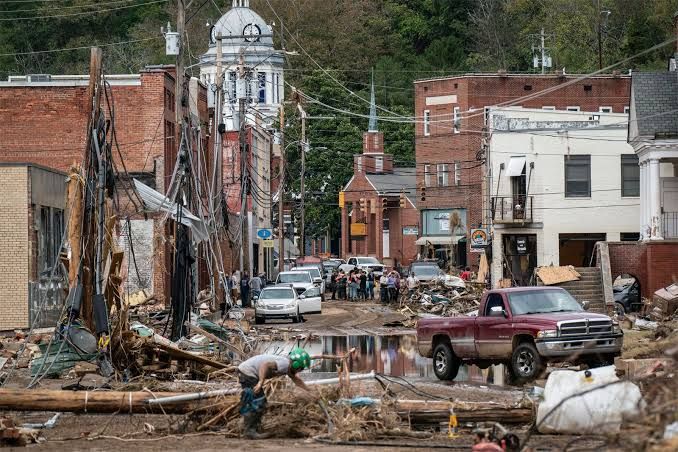
Set that against a real restoration timeline. Helene reached western North Carolina on September 27, 2024. By the following Monday more than 92,000 homes and businesses in Buncombe County were without power. A week after the storm, roughly 78,000 were still out. Duke Energy did not get the county down to a few hundred remaining customers until around October 18, three weeks in, and the water system took longer than the power did.
Three weeks is longer than a vial of insulin lasts on a kitchen counter.
I was in Asheville during that window, running deliveries. I was asked to help with search-and-rescue and cleanup efforts, and I did not think twice. To my surprise, insulin was the number one medication people asked for. Not painkillers, not antibiotics, not anything you would guess. The drug that fails on a clock if not kept at a certain temperature.
Work
For a large share of the workforce, the job is not a place anymore. It is an account. The labor exists on a server, the coordination happens over a network, and the compensation arrives as a record adjustment. Take the power away and the work does not slow down. It ceases to exist as a category. There is nothing to go do.
The rapid expansion of artificial intelligence has created an unprecedented interdependence between the digital labor market and physical electricity-requiring jobs, triggering a massive workforce shift. As AI demands immense computational power, the labor market is experiencing simultaneous white-collar consolidation and a severe blue-collar labor shortage to build out the power grid.
While 2026 has seen the US economy lose approximately 23,000 jobs, the physical trades stay real. Notice how much of the country cannot do them. Many people have not the slightest clue about plumbing, electrical circuits, or even how to swing a hammer. According to data from the U.S. Department of Energy, the industry faces an extreme bottleneck, requiring 80,200 new electricians and 10,700 electrical power-line installers annually.
Talking
The last one is the one people underestimate, because it feels like the softest.
Within two generations we moved from knowing where people live, to knowing how to reach them, to knowing what they are having for dinner every night but never talking to them. Those are different capabilities and only one of them survives a blackout. Phone numbers are stored on devices. Addresses are stored on devices. The mental map that used to sit in a person's head, the one that told you which neighbor had a truck and which one had a well, has been offloaded to something that needs charging.
We did not lose the ability to talk to each other. We lost the ability to find each other. We lost what it means to actually be a neighbor, or to be a part of a community.
Researchers at Oregon State published a study this year on social media and loneliness in adults aged thirty to seventy, a group most of this research skips in favor of teenagers. About thirty-five percent of the study group's social media contacts were people they had never met in person. Connecting online with those strangers was associated with higher loneliness. Connecting online with people they actually knew was not associated with lower loneliness either. It simply did nothing.
While the study shows correlation without necessarily proving causation, it is worth sitting with in the context of an outage. A third of the network is people who cannot come over. The remainder, the ones who could, are reachable through a channel that does not survive the failure, and the connection itself was doing nothing measurable for the loneliness in the first place.
What we built on top of it
This is more than an infrastructure story.
The same continuous power that runs the banking and the fuel and the dispatch also runs a set of systems built specifically to hold human attention. Those systems were tuned by measurement. Whatever kept people engaged was kept. Whatever did not was discarded. Nobody had to design the result, and the internal research at the major platforms documented what the result was well before the public understood it. Internal documents leaked from Facebook in 2018 said explicitly: "Our algorithms exploit the human brain's attraction to divisiveness."
What survived that selection was conflict. Not because anyone chose it, but because it outperformed everything else on the metric that mattered. And whatever kept people interacting on the platform, even if it was manufactured outrage, outweighed everything else.
But rewarding conflict is the surface of it. The deeper effect is what it did to sequence. These systems moved the moment we pick a side ahead of the moment we are actually informed. Not by persuading anyone of anything, just by making the commitment cheap and immediate and the information slow and expensive by comparison. You are asked to have a position on an event before the facts about it exist, and the ask arrives constantly, and eventually having a position that fast stops feeling like a thing you were pressured into.
The word most people reach for here is tribalism, and I am not going to use it. It smuggles in the idea that this is ancient and natural, some deep pull we cannot help. Factionalism is the more honest word. Factions are made. They form around specific grievances at specific moments, they are cultivated by people who benefit from them, and the American founders spent a lot of ink on the problem precisely because they understood it was a political condition rather than a permanent feature of the species.
So: fifteen years of a system that rewarded factional response, running continuously, at national scale.
The relevance to a blackout is not poetic. A sustained outage is a coordination problem. It is answered by neighbors who know each other, local institutions with standing authority, and a shared assumption that the person down the road is working the same problem you are. Those are the exact capacities that fifteen years of optimization have been grinding down.
The Texas grid failed during the week of February 14, 2021. Millions lost power in freezing temperatures and at least 246 people died. By Tuesday, with the outage still underway and no failure analysis in existence, the governor was on national television attributing the collapse to wind and solar and calling the Green New Deal a deadly deal for the country. The state agriculture commissioner posted that Texas should never build another turbine. A senator from Montana used it to argue for gas and coal.
ERCOT held a press conference that same day. Thermal losses, meaning gas and coal and nuclear, were roughly double the losses from renewables. The grid operator's own revised analysis later put the gap far wider: at eight in the morning on February 16, about 4,000 megawatts of wind were offline against roughly 25,000 megawatts of natural gas.
The federal joint inquiry landed in November, nine months later. Fifty-eight percent of generation failures came from gas-fired units. Eighty-seven percent of unplanned outages traced to natural gas production and processing. Protecting four categories of equipment from freezing would have prevented about two thirds of the outages.
Pay attention to the interval. The explanation was assigned in about twenty-four hours. The correction arrived in nine months. By then it did not matter, because the people who absorbed the first version were not waiting on the real cause to be announced, and the first version had already hardened into a position.
That is the mechanism. A physical failure with a mundane engineering cause got sorted into existing camps before anyone knew anything, because the incentive to have an answer immediately is enormous and the incentive to have the right one is not.
It happens at smaller scale too, and it is happening right now. The public argument over Gary has largely become Indiana against Illinois, with officials pointing at the local utility for restoring slower than the one across the state line, while the weather service says the storm intensified as it crossed into Indiana. The comparison driving the blame is not a clean comparison. It did not need to be. Occam's razor is still too dull to cut through the noise on social media.
The audit
None of this requires a solar storm. The failures we have already had were mundane: equipment age, weather, deferred maintenance, a control system doing what it was configured to do.
What has changed is not the likelihood. It is the surface. In 1859 the storm hit a few thousand miles of telegraph wire. In 1989, we got a glimpse of what that would look like in a major populated area. Now it would hit money, movement, work, medicine, water pressure, and the last remaining means by which people locate one another.
And it would land on a population that has spent the better part of two decades being trained, profitably and by measurement, to treat the person across the street as the problem. People they grew up with. People they got along with in 2015. It turns out, they are not the problem after all.
The Grounded stands behind every factual claim it publishes with a $100 accuracy guarantee. Find an error of fact and tell us. If you are right, we pay.
Sources
- Texas Tribune, "No, frozen wind turbines aren't the main culprit for Texas' power outages," Feb 16 2021, https://www.texastribune.org/2021/02/16/texas-wind-turbines-frozen/ — ERCOT's same-day figures, 16 GW renewable offline against 30 GW thermal
- Texas Tribune, Apr 28 2021, https://www.texastribune.org/2021/04/28/texas-power-outage-wind/ — ERCOT's revised analysis, 4,000 MW wind against 25,000 MW gas at 8 a.m. Feb 16, and the death toll above 100
- PBS NewsHour / AP, "Texas blackouts fuel false claims about renewable energy," Feb 17 2021, https://www.pbs.org/newshour/nation/texas-blackouts-fuel-false-claims-about-renewable-energy — Sid Miller and Steve Daines statements, dated Tuesday Feb 16
- Yahoo News aggregation of The Week, https://news.yahoo.com/texas-power-grid-failed-mostly-065217364.html — Abbott's on-air Green New Deal remarks; find the original broadcast or a primary transcript before citing, do not cite the aggregator
- CBS DFW on the FERC/NERC final report, Nov 16 2021, https://www.cbsnews.com/dfw/news/federal-energy-regulatory-commission-final-report-texas-power-grid-failure/ — 58 percent, 87 percent, and the 67 percent winterization figure; pull these from the FERC report itself
- CBS News, https://www.cbsnews.com/news/hurricane-helene-path-florida/ — more than 92,000 Buncombe County customers without power early Monday Sept 30 2024, attributed to Find Energy
- Buncombe County, Helene updates page, https://www.buncombecounty.org/countycenter/news-detail.aspx?id=21749 — 78,000 still out as of 10 a.m. Oct 4 2024
- WLOS, Oct 18 2024, https://wlos.com/news/local/buncombe-county-officials-provide-a-helene-recovery-update-three-weeks-after-the-storm — 469 Duke customers still out at three weeks
- WLOS, Oct 21 2024, https://wlos.com/news/local/buncombe-county-city-of-asheville-officials-provide-hurricane-helene-recovery-progress-updates-curfew-lifted-power-water-service — 129 still out, water system at 95 percent
- National Weather Service GSP, Helene impact narratives, https://www.weather.gov/media/gsp/TropicalEventSummary/PSHGSP_2024AL09_Helene_ImpactNarratives.docx.pdf — primary source for storm severity and Buncombe damage
- https://www.npr.org/2021/09/23/1040081678/what-leaked-internal-documents-reveal-about-the-damage-facebook-has-caused


 Dr.Tony Phillips
 Cleveland Clinic medical professional

Member discussion