Same Fear, New Neighbor

Written and Edited by Matt Stone
North Carolina has spent 250 years afraid of the wrong people. The cure has never changed.
Somewhere in the country right now, someone is sharing a post that says Muslims are taking over and sharia law is coming. The warnings got louder after January 1, 2026, when Zohran Mamdani was sworn in as New York City's first Muslim mayor. A U.S. senator from Alabama posted a picture of the Twin Towers burning next to a picture of Mamdani and wrote that the enemy is inside the gates. A South Carolina congresswoman sent a fundraising email claiming Mamdani is bringing sharia law to America.
So, let's look at the takeover in my home state of North Carolina.
North Carolina has 170 state legislators. One of them is Muslim. Haseeb Fatmi was elected to the Raleigh City Council in 2025 and appointed to fill the District 18 seat in the state Senate in May 2026. Add Durham County Commissioner Nida Allam, the first Muslim woman ever elected to office in this state, and you have most of the invading Islamic army. Muslims make up about one percent of American adults.
Sharia cannot sneak into our courts either. Every law in this state must survive the U.S. Constitution. And in 2013, the General Assembly passed House Bill 522, which bars North Carolina courts from applying any foreign law in divorce, custody, or support cases when it would violate someone's constitutional rights. The door the fear is guarding was locked thirteen years ago.
Many who warn about religious law sneaking into government miss the irony: North Carolina already has religious law written into its constitution, and it is not Islamic. Article VI, Section 8 of the state constitution says that any person "who shall deny the being of Almighty God" is disqualified from holding office. The U.S. Supreme Court made religious tests like that unenforceable in 1961. North Carolina has never taken it out.
The List Keeps Changing
That clause is not an accident. It is the last surviving piece of a list that has been running since the founding, and every name on it was somebody's neighbor.
The 1776 state constitution barred anyone who denied "the truth of the Protestant religion" from public office. On paper, that barred Catholics, Jews, and anyone else who did not fit. In 1809, Jacob Henry, a Jewish merchant from Beaufort, was serving his second term representing Carteret County. On December 5, a lawmaker from Rockingham County named Hugh Mills moved to throw him out of the House because of his faith. Henry got one day to answer. His speech on religious freedom was reprinted for generations, and the House let him keep his seat. One of the men who spoke up for him was John Roberts, the other representative from Carteret County. His neighbor.
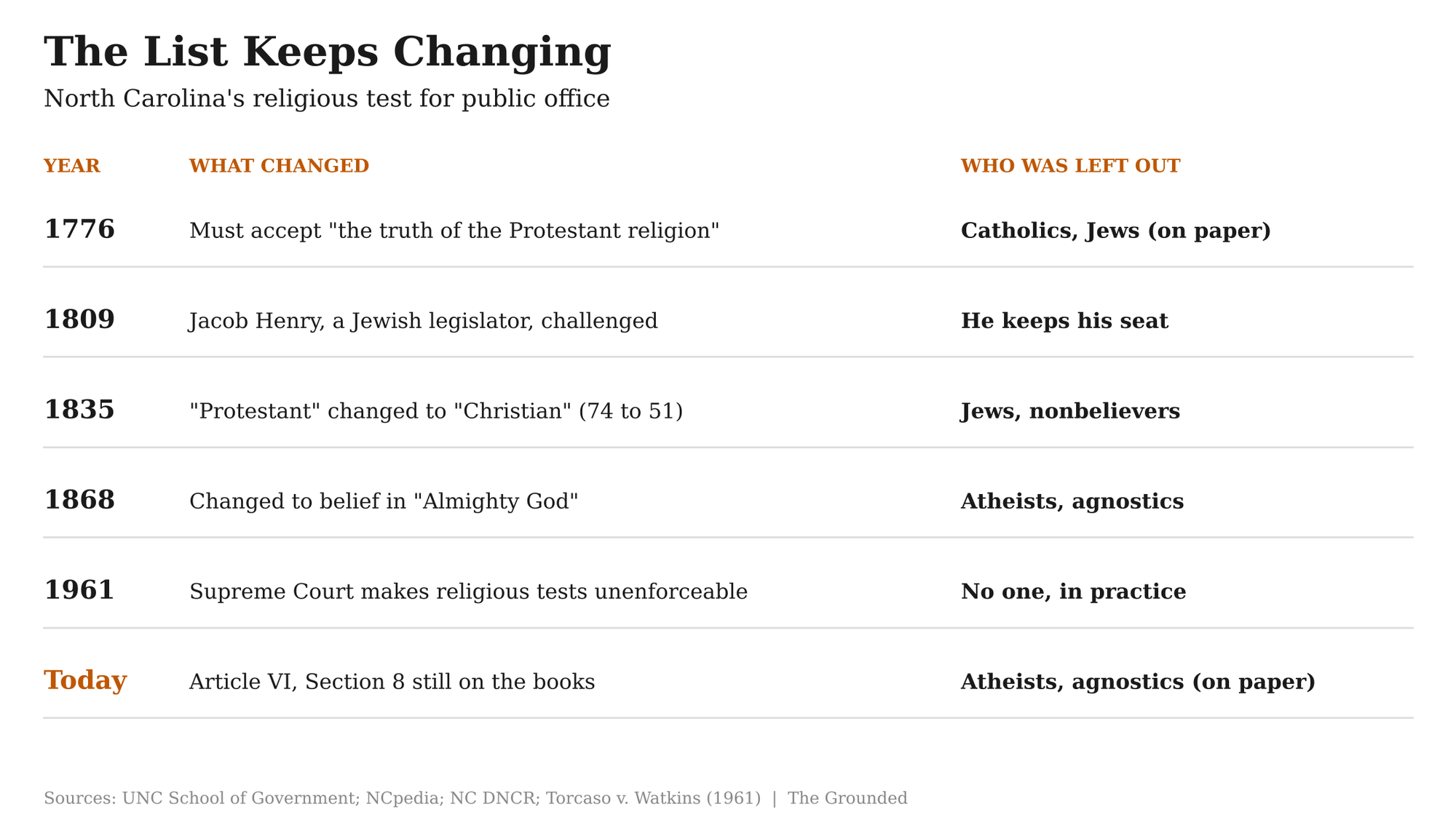
In 1835, a convention argued over the test again. William Gaston, a Catholic who sat on the state supreme court, urged them to drop it entirely. They refused. Instead, by a vote of 74 to 51, they changed "Protestant" to "Christian." Catholics were in. Jews were still out. In 1868 the requirement changed again, to belief in God. Jews were in. Atheists and agnostics were still out, and on paper, they still are.
The list was never only about religion, and the fear was never only words. In 1898, Wilmington was North Carolina's largest city, with a Black majority and an elected government made up of Black and white officials. For months, Josephus Daniels and his Raleigh News & Observer ran racist cartoons, editorials, and invented stories designed to convince white North Carolinians that their Black neighbors were a danger. On November 10, an armed white mob burned the office of the city's Black-owned newspaper and forced the elected government out at gunpoint. The state's official 2006 report put the death toll at as many as 60, and more than 2,100 Black residents fled or were driven from the city. It is the only successful coup in American history. The people who did it did not need an algorithm. They had a newspaper, and they used it to turn neighbors into enemies.
Their rallying cry was 'Negro rule,' the warning that the wrong people were about to take over. Swap in 'sharia' and it could run on Facebook tomorrow.
Twenty-three years later, it happened again in Oklahoma. On May 31, 1921, the Tulsa Tribune ran a front-page story claiming a young Black man named Dick Rowland had attacked a white woman in an elevator. The charge fell apart, and the woman later declined to press it. By the next morning, a white mob had burned the Greenwood district, one of the most prosperous Black communities in America, to the ground. Credible estimates of the dead range from 50 to 300. Before the paper was ever put on microfilm, someone tore the story and the editorial page out of the Tribune's own archived copies. Witnesses remembered that editorial carrying a headline about a lynching that night. The machine was a newspaper again, and once more it worked fast.
Historian Scott Ellsworth has said that within about half an hour of the paper hitting the streets, people were talking about a lynching.
Look at that pattern. In 1776 the danger was Catholics. In 1809 it was a Jewish shopkeeper from the coast. Today it is Muslims. The fear never goes away. It just changes targets, and the people feeling it never notice they are repeating their great-great-grandparents.
Fear Needs Distance
Why does it keep working? Part of the answer is simple. It is easy to fear people you have never met.
Pew Research has measured this for years. In 2017, Americans who personally knew a Muslim rated Muslims at 56 on a 100-point feeling scale. Americans who did not know one rated them at 42. Fewer than half of Americans said they knew a Muslim at all. In 2019, Pew found the same pattern held for Buddhists, Mormons, and evangelical Christians. Knowing one person from a group makes the whole group less frightening.
This is not a polling fluke. It may be the most tested idea in social psychology. In 1954, psychologist Gordon Allport argued that prejudice shrinks when people from different groups actually spend time together. Part of his evidence came from World War II. In the summer of 1945, the Army surveyed white officers and sergeants whose companies had been assigned Black volunteer platoons in the final months of the war. Seventy-seven percent said they had become more favorable toward Black soldiers. Not one said they had become less favorable. Not a single one. Shared danger did what no lecture could.
Shared danger is the oldest glue we have. In 1954, psychologist Muzafer Sherif split a group of boys at Robbers Cave State Park into two rival camps and watched them turn hostile within days. What finally ended it was not lectures or mixing them together. It was a string of shared problems, starting with a broken water supply that every boy needed fixed. The researchers had broken it themselves. Political scientists have a name for the adult version: the rally-round-the-flag effect, first described by John Mueller in 1970, visible after 9/11 when Gallup measured presidential approval at 90 percent. But the mechanism cuts both ways.
If a common threat makes an 'us,' then whoever gets to name the threat gets to draw the line around 'us.' At Nuremberg, Hermann Göring told psychologist Gustave Gilbert that people could always be brought to their leaders' bidding: tell them they are being attacked and denounce anyone who disagrees as unpatriotic. The danger does not have to be real. It only has to be shared.
In 2006, psychologists Thomas Pettigrew and Linda Tropp pulled together every study on the question they could find. It added up to 515 studies covering more than 250,000 people in 38 countries. The result was clear: contact between groups typically reduces prejudice. It worked across race, religion, sexuality, age, and disability. It even worked when the conditions were far from perfect.
The effect spreads further than you would think. Researchers have found that simply knowing that one of your friends has a close friend in the other group lowers prejudice. You do not even have to meet that person yourself. One relationship ripples outward.
And it does not take years. In 2016, political scientists David Broockman and Joshua Kalla studied canvassers who went door to door in Miami to have short, honest conversations with voters about transgender people. A single conversation, about ten minutes long, measurably reduced prejudice, and the change was still there three months later.
But the reverse is also true. Political messaging can push apart even people who already know and love each other. After the 2016 election, economists Keith Chen and Ryne Rohla used anonymous phone location data from about 10 million Americans to measure how long people stayed at Thanksgiving dinner. When guests came from a neighborhood that voted the opposite way from their host's, dinners ran 30 to 50 minutes shorter than when everyone came from same-party areas.
The drop was three times larger for people who lived in places flooded with political TV and radio ads, and it did not show up at all the year before the election. In Orlando, which saw more than 26,000 campaign ads, the researchers estimated mixed-politics families lost more than an hour at the table. These were not strangers. They were the people sitting across the Thanksgiving table, and the messaging still won.
Knowing someone is not a shield on its own. Somebody must stand up. Jacob Henry kept his seat because the men in that room had to look at him. They knew him. A name on a list is easy to hate. A man you have worked beside is not.
Where Did Everybody Go?
For most of American history, people who disagreed with each other were still forced into the same rooms. Churches, union halls, bowling leagues, the VFW, the Friday night game. A farmer and a schoolteacher with opposite politics sat in the same pew every Sunday. Anyone who has served knows the strongest version of this. You do not pick who sleeps in the bunk next to you, and by the end of training you would bleed for people you would never have chosen.
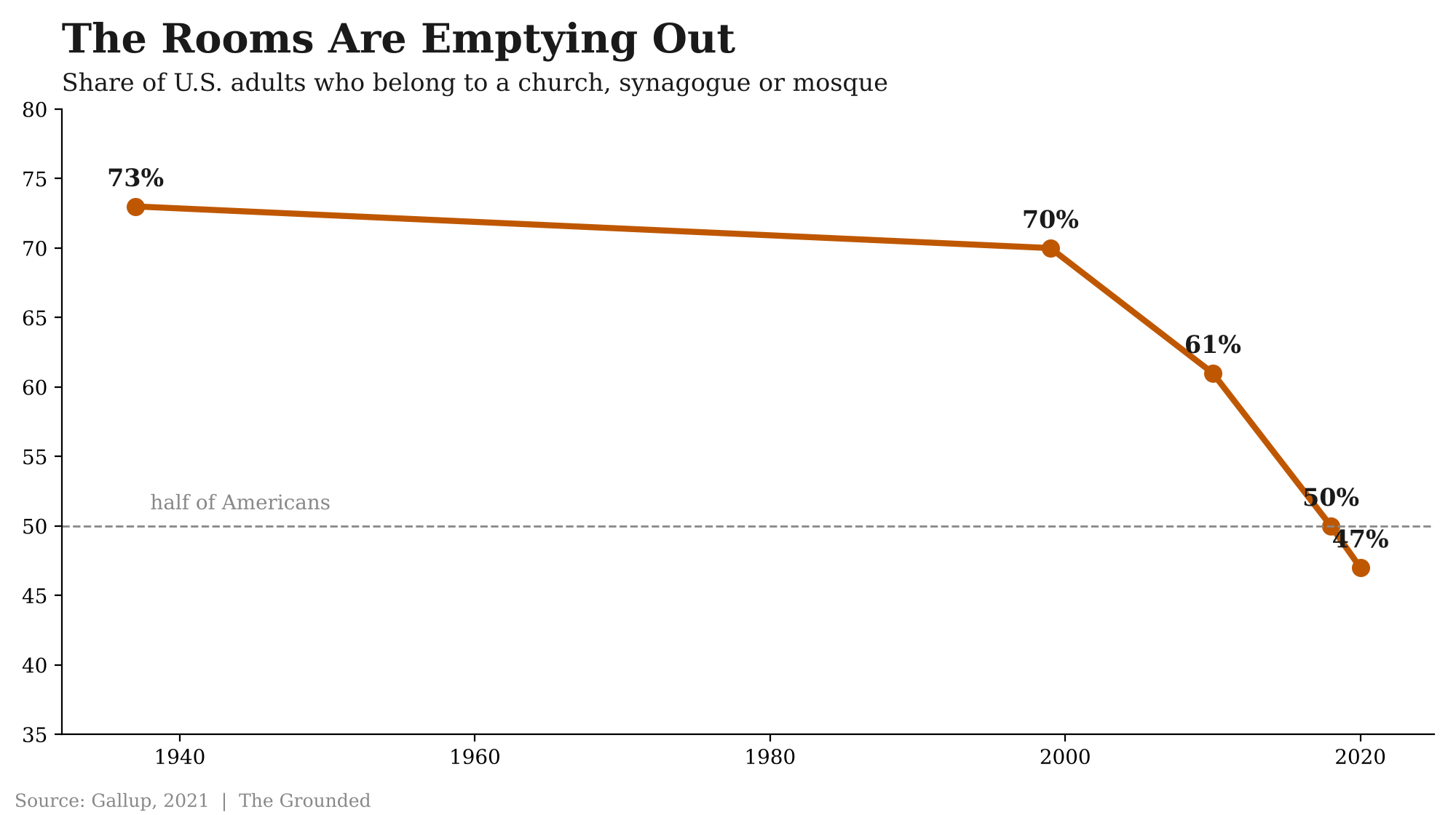
Those rooms are emptying out. When Gallup first asked in 1937, 73 percent of Americans belonged to a church, synagogue, or mosque. It stayed near 70 percent for six decades. By 2020 it had fallen to 47 percent, the first time ever below half. In 1983, one in five American workers belonged to a union. Today it is about one in ten. In 2024, North Carolina's rate was 2.4 percent, the lowest in the entire country.
We are not just leaving institutions. We are leaving each other. Census time-use data shows Americans spent 47 minutes a day with friends in 2003. By 2023 it was 34. UNC sociologist Neal Caren looked at the same survey and found that the Friday night out has nearly disappeared. Friday now looks like any other weeknight. In 2023 the U.S. Surgeon General warned that lacking social connection can raise the risk of early death as much as smoking up to 15 cigarettes a day.
We talk about the good old days like we had nothing to do with the fact that we choose to trust a screen over our neighbors, repeatedly, every day.
The Algorithmic Jail Cell
Something filled that empty time. We moved from the bowling alley to the feed. And the feed is not a neutral room. It is a machine built to keep you scrolling, and nothing keeps you scrolling like fear and anger.
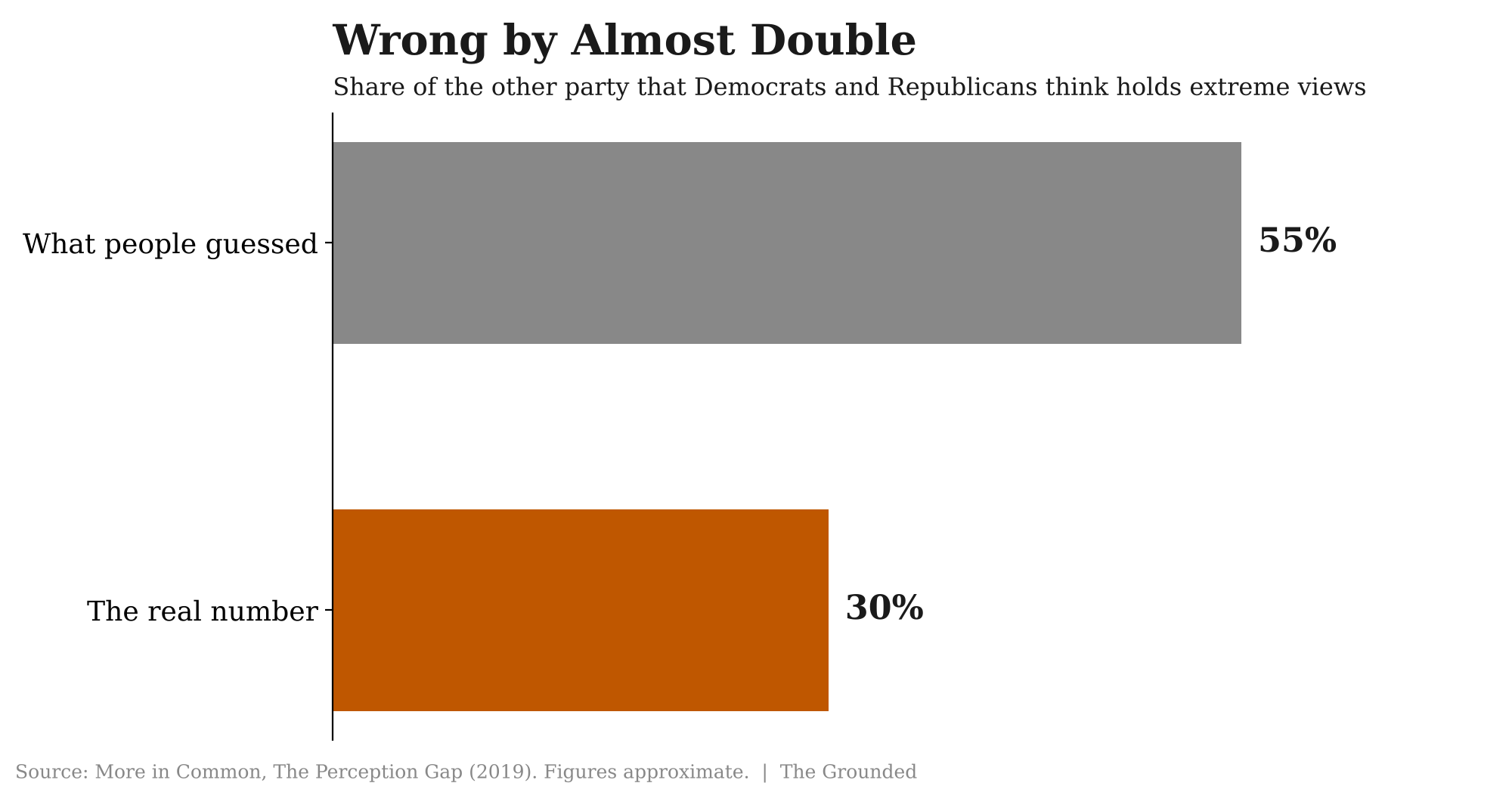
In 2019, the research group More in Common asked thousands of Democrats and Republicans what they believed and what they thought the other side believed. Both sides guessed that about 55 percent of the other party held extreme views. The real number was closer to 30 percent. People were wrong by almost double. The kicker: the more news people consumed, the worse their guesses got. Political scientist Lilliana Mason has shown how party has swallowed religion, race, and region into one giant identity. The letter beside a name now stands in for an entire moral character.
The people who think they are the most informed are often the most wrong about their neighbors. That is not because they are stupid. It is because they are being shown the worst one percent of a group every day and told it is the whole. The people with the widest gaps were also the most likely to call the other side hateful or brainwashed. Nobody inside the cell can see the bars. That is what makes it a good cell.
Nextdoor
It does not have to work this way, and one company proved it. Nextdoor, an app built for actual neighbors, became known around 2015 for posts reporting "suspicious" Black men who were doing nothing but walking down the street. Working with Oakland groups including Neighbors for Racial Justice and 100 Black Men, the company redesigned its crime and safety posts. If a post mentioned race, users had to describe actual behavior and clothing, not just skin color. Nextdoor reported that the best version cut posts with racial profiling by 75 percent in its test markets. A few extra questions before hitting "post" changed how neighbors saw each other. The machine is a design choice, and so far most companies have chosen anger.
Anatomy of a Post
Social media is very good at giving you a headline and very bad at giving you a story. A post has room for an accusation but not for the context that would explain it. A vote gets reduced to yes or no with no word about what was buried in the bill. A quote gets clipped right before the sentence that changes its meaning. Nuance does not survive the trip, because nuance does not fit in a caption and does not make anyone angry enough to share.
The trouble is that it still feels like the whole story. The feed hands you a screenshot, a few confident lines, and a hundred comments agreeing, and your brain files it as settled. Most people never check. A 2016 study from Columbia University and the French research institute Inria found that 59 percent of links shared on Twitter were never clicked at all. People were passing along stories they had never read. And when MIT researchers studied years of Twitter data in 2018, they found false news was 70 percent more likely to be retweeted than the truth. The algorithm does not care which is which. It cares what keeps you on the app, and a lie built to make you mad will beat a careful truth almost every time.
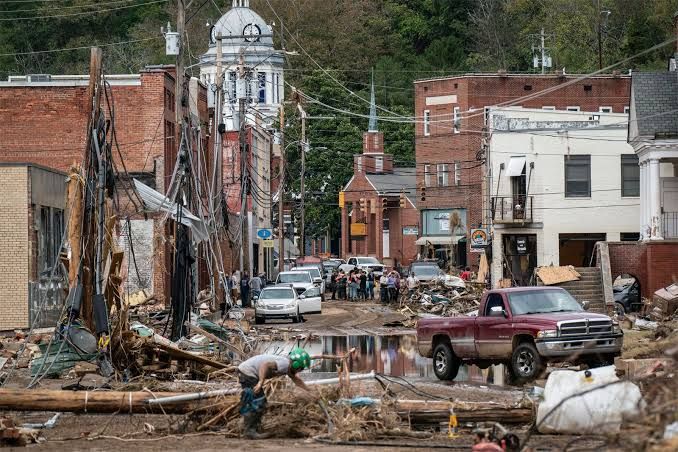
A disaster is supposed to be the broken water supply, the shared danger that turns strangers into neighbors. Helene should have been that. In October 2024, two weeks after the storm tore through western North Carolina, FEMA crews in Rutherford County were pulled off the job. Word had spread that National Guard troops had seen an armed militia threatening relief workers near Lake Lure. Deputies arrested one man with a rifle and two handguns who had talked about going after FEMA workers. Then the sheriff's office set the record straight: he acted alone, and no truckloads of militia were headed anywhere. Even the story about the threat had a rumor built into it. The county's own spokesperson said that chasing down false rumors that fall used up time and people that should have gone to recovery. Mountain families who had lost everything were being taught to fear the people sent to help them.
Once you know what to look for, the misleading posts start to look alike. They lean on borrowed authority, like "public records show" or "studies prove," with nothing linked. They use loaded labels that only allow one answer. They take a single issue and turn it into a verdict on someone's whole character. And the sharpest ones tell you to distrust what you have seen with your own eyes. You think you know that person? You don't. Trust this post instead. Believe this podcast instead. This podcaster and that one poster are the only ones telling you the whole truth. Laid out plainly, it sounds insane. In a feed, at midnight, from someone you follow, it sounds like the truth. The truth is not a well-kept secret.
The feed does not have to convince you your neighbor is evil. It only has to convince you that knowing him does not count, that your own eyes and ears are not enough. All it must create is a shadow of a doubt. Once your own experience stops being evidence, the only thing left to believe is the screenshot.
I have always hated being categorized, crammed into a neat little box. I joined the Army as a cook and ended up jumping out of airplanes, because I hated people thinking they knew what I was capable of. I've refused to wear a party label for the same reason. Most of us learn early that life is not black and white, yet we fail to extend that understanding to others.
Swap the party letters and you will find the same tricks on the other side by lunchtime. Learn to spot them, and the bars of the cell start to show. Scroll social media without a clear political affiliation, and the entire prison reveals itself.
The Cure Is Old
The fix for this is not a new app or a better fact-check. It is the same thing that saved Jacob Henry's seat in 1809. Somebody who knew him stood up.
Go to the thing. The fish fry, the high school game, the open house at the mosque down the road, the city council meeting where nobody shows up. Sit next to somebody whose bumper sticker you hate and talk about anything else. The fear has changed names for 250 years. It has never once survived a neighbor.
The Grounded stands behind every factual claim it publishes with a $100 accuracy guarantee. Find an error of fact and tell us. If you are right, we pay.
Sources
ABC News, "Man arrested for allegedly threatening FEMA workers in North Carolina" (Oct. 15, 2024), and CNN's report on FEMA's Rutherford County pause (Oct. 14, 2024).
Allport, The Nature of Prejudice (1954)
Army Research Branch, "The Utilization of Negro Infantry Platoons in White Companies" (1945), published in Stouffer et al., The American Soldier (1949); Sherif et al., Intergroup Conflict and Cooperation: The Robbers Cave Experiment (1961).
Mueller, "Presidential Popularity from Truman to Johnson," APSR (1970); Gallup poll, Sept. 21-22, 2001; Gilbert, Nuremberg Diary (1947); Pettigrew and Tropp, Journal of Personality and Social Psychology 90(5) (2006); Wright et al., "The Extended Contact Effect," JPSP (1997);
Broockman and Kalla, Science 352 (2016); Chen and Rohla, Science 360 (2018); Nextdoor, "Reducing Racial Profiling on Nextdoor" (Aug. 24, 2016); Gabielkov et al., "Social Clicks" (2016); Vosoughi, Roy, and Aral, Science 359 (2018)
North Carolina Constitution, Article VI, Section 8 (current text): https://www.ncleg.gov/Laws/Constitution/Article6
UNC School of Government, Additional Information on the North Carolina Constitutional Provisions Regarding Religion: https://www.sog.unc.edu/resources/legal-summaries/additional-information-north-carolina-constitutional-provisions-regarding-religion
NCpedia, Constitution of 1835: https://northcarolinahistory.org/encyclopedia/constitution-of-1835/
NC DNCR, Jacob Henry historical marker (C-83): https://www.dncr.nc.gov/blog/2023/12/08/jacob-henry-ca-1775-1847-c-83
NCpedia, Henry, Jacob: https://www.ncpedia.org/biography/henry-jacob
NCpedia, Roberts, John: https://www.ncpedia.org/biography/roberts-john
Seth Barrett Tillman, A Religious Test in America? The 1809 Motion to Vacate Jacob Henry's Seat, North Carolina Historical Review 98(1): https://papers.ssrn.com/sol3/papers.cfm?abstract_id=3498217
Torcaso v. Watkins, 367 U.S. 488 (1961)
NC General Assembly, House Bill 522 (2013), Session Law 2013-416: https://webservices.ncleg.gov/BillDigests/2013/H522
PolitiFact, No, North Carolina did not ban Sharia law: https://www.politifact.com/factchecks/2019/may/23/facebook-posts/no-north-carolina-did-not-ban-sharia-law-or-make-p
Haseeb Fatmi, NC Senate District 18: https://en.wikipedia.org/wiki/Haseeb_Fatmi
Nida Allam, Durham County Board of Commissioners: https://en.wikipedia.org/wiki/Nida_Allam
PolitiFact, Mamdani is not bringing Sharia law to America: https://politifact.com/factchecks/2025/nov/07/nancy-mace/mamdani-mayor-new-york-shariah-law/
Fox News, GOP senator's 'enemy inside the gates' comment about Mamdani: https://www.foxnews.com/politics/gop-senator-earns-dem-backlash-enemy-inside-gates-comment-about-nyc-mayor-zohran-mamdani
Pew Research Center, How the U.S. General Public Views Muslims and Islam (2017): https://www.pewresearch.org/religion/2017/07/26/how-the-u-s-general-public-views-muslims-and-islam/
Lifeway Research summary of Pew 2017 feeling thermometer data: https://research.lifeway.com/?p=3873
Pew Research Center, Familiarity with religious groups is associated with warmer feelings (2019): https://www.pewresearch.org/short-reads/2019/10/31/in-u-s-familiarity-with-religious-groups-is-associated-with-warmer-feelings-toward-them/
Gallup, U.S. Church Membership Falls Below Majority for First Time (2021): https://news.gallup.com/poll/341963/church-membership-falls-below-majority-first-time.aspx
Bureau of Labor Statistics, Union membership rates lowest in North Carolina in 2024: https://www.bls.gov/opub/ted/2025/union-membership-rates-highest-in-hawaii-and-new-york-lowest-in-north-carolina-in-2024.htm
American Time Use Survey friend-time figures, via Audacy/CBS: https://www.audacy.com/wccoradio/news/national/americans-arent-interacting-face-to-face-and-its-costing-more-than-we-know
Neal Caren, The End of Friday Nights with Friends (2026), via Marginal Revolution: https://marginalrevolution.com/marginalrevolution/2026/08/the-end-of-friday-nights-with-friends.html
U.S. Surgeon General, Our Epidemic of Loneliness and Isolation (2023): https://www.hhs.gov/sites/default/files/surgeon-general-social-connection-advisory.pdf
More in Common, The Perception Gap (2019): https://perceptiongap.us/
Lilliana Mason, Uncivil Agreement: How Politics Became Our Identity (University of Chicago Press, 2018)
Robert Putnam, Bowling Alone (Simon & Schuster, 2000)

Member discussion