A Great Time To Be A Gang Member
The legislature claimed Jaleeyah’s Law would put gangs on notice. But when you strip away the press releases, look at what they actually built: no prevention funding, no specialized prosecutors, no required tracking, and an expiring executive task force with zero statutory permanence.
By Matt Stone
Updated August 12, 2026 with a response from the Department of Public Safety. See the bottom.
The word gang appears exactly once in the 634 pages of North Carolina's state budget. It appears in a heading on page 468, above a sentence eleven words long.
REPEAL OUTDATED REPORT ON GANG PREVENTION RECOMMENDATIONS.
Section 20.5. G.S. 143B-1730 is repealed. That is the entire treatment of gang prevention in the state's spending plan for the year. One heading, one sentence, one adjective. The adjective is the part worth a second look.
What was repealed
G.S. 143B-1730 required the State Highway Patrol, working with the State Bureau of Investigation and the Governor's Crime Commission, to develop recommendations on priorities and needed improvements in gang prevention, and to deliver them every year by March 1 to the chairs of the House and Senate Appropriations Committees on Justice and Public Safety and to the chairs of the Joint Legislative Oversight Committee on Justice and Public Safety.
It was a standing instruction from the legislature to its own law enforcement agencies. Once a year, tell us what you are seeing and what you think should change.
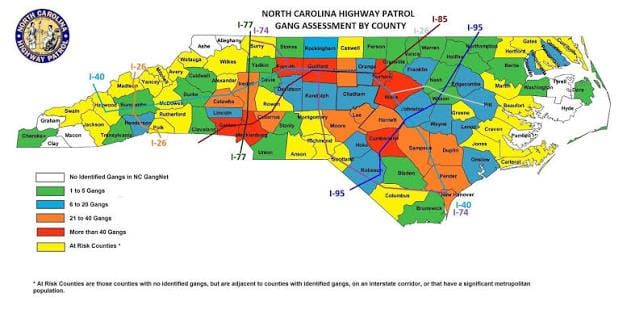
On March 1, 2025, the agencies filed that report. Its findings are not ambiguous. Suspected juvenile gang offenses in North Carolina rose from 397 in 2020 to 587 in 2024, an increase of 47.9 percent, while adult gang offenses fell from 884 to 336 over the same period. Juvenile gang crime had overtaken adult gang crime. Roughly 4,000 people are validated as gang members statewide.

The report went further into why. Drawing on the state's own juvenile risk assessments, it found that 44 percent of gang-affiliated at-risk youth had mental health problems compared to 33 percent of other at-risk youth, that they were twice as likely to have negative peer relationships, and that 40 percent came from families with criminal histories against 22 percent for other at-risk youth. Of the youth assessed in 2024, 86 percent had experienced trauma.
It made recommendations in three categories, and one of them matters more than the rest for what happened next.
Under Leadership, recommendation four reads: expand the number of offenses for which gang activity elements are collected. The report explained that the FBI's reporting system captures gang involvement for only a limited list of crimes, so most offenses never record it at all. It noted that the state's own gang data, in GangNet and in the national incident reporting system, is inconsistently entered across North Carolina.
The report asked the legislature for more data collection.
The legislature repealed the report.
What it produced before it was called outdated
In August 2025, Governor Josh Stein issued Executive Order No. 21.
The order cites the report by name. It recites the finding on juvenile gang crime rising nearly 50 percent in five years, the 4,000 validated members, and the mental health and family history figures. It states that the report recommended creating a task force focused on gang prevention. Then it creates one.
The Gang Prevention and Intervention Task Force is housed in the Governor's Crime Commission, co-chaired by the Secretary of the Department of Adult Correction and the Director of the Office of Violence Prevention. More than 100 people applied for twenty seats. Its membership includes the Attorney General, the Superintendent of Public Instruction, a police chief, a sheriff, a district attorney, a pediatric hospitalist, and people who left gangs.
It exists because of a document filed under the statute the General Assembly has now called outdated.
The replacement has not started
In March 2026, the task force submitted its first annual report to the Governor, as Executive Order No. 21 requires. It is worth reading before accepting that the statutory report was redundant.
The task force report contains no recommendations. It describes its own Phase 1 as Infrastructure, the work of ensuring all members share a baseline understanding of key concepts. Phase 2, developing and prioritizing actual recommendations, is scheduled for Spring through Winter 2027. Phase 3, implementation, runs Winter through Summer 2027.
Sections 2 and 3 of Executive Order No. 21 expire on August 31, 2027.
The body that is supposed to have replaced the statutory report plans to produce its recommendations in 2027 and implement them in 2027, and its authorizing order expires in August of that year. Its March 2026 report reproduces the 2025 legislative report as an appendix, because that document still contains the only substantive gang prevention recommendations the state has.
The same week
On July 2, 2026, the General Assembly ratified two bills.
One was the budget. The other was House Bill 1173, known as Jaleeyah's Law.
Jaleeyah Tune was thirteen years old, a seventh grader in Goldsboro, shot and killed on December 21, 2025 while walking home with her sister. Three teenagers with alleged gang ties were charged. In the months after, her mother, Whitney Brown-Tune, went to the legislature and asked for a stronger law. She got one. Nothing that follows is a criticism of her, of her daughter, or of what that family did with the worst thing that ever happened to them.
It is a description of what the General Assembly did around them.
Session Law 2026-37 runs seven sections. It raises court costs. It broadens the definitions of criminal gang and criminal gang activity. It lowers the standard for classifying someone as a criminal gang leader or organizer from meeting two or more criteria to meeting at least one. It raises the age in the solicitation statutes from 16 to 18 and elevates those felonies from Class H to Class F and from Class F to Class D. It creates new firearm offenses for gang members. It creates a rule of evidence allowing proof of gang activity to establish any element of a charged offense. It expands venue to any county where any act occurred. It raises the gang sentencing enhancement from one felony class to two, and for leaders and organizers from two classes to three.
That is the whole act. Every section expands classification, prosecution, evidence, or punishment. There is no prevention provision in it and no reporting requirement of any kind.
The House deserves credit for what it took out. The First Edition would have created a new felony for any court-identified gang member to possess any firearm at all, and that section was dropped. The First Edition's evidence rule would have made a defendant's other crimes, wrongs and acts admissible for any relevant purpose, close to a wholesale override of existing limits, and the enacted version narrows it to proving an element. The First Edition flatly lowered gang member classification from three criteria to two, and the enacted version keeps three unless one of the two is an admission, a reliable-source identification, or physical evidence.
That is what public legislating looks like. A bill gets filed, gets read, gets narrowed, and gets voted on 110 to 3 with a sponsor's name on it.
What came out of Section 1
The First Edition of Jaleeyah's Law opened with money.
Section 1 appropriated $397,014 in recurring funds and $7,504 nonrecurring to the Conference of District Attorneys to hire two resource prosecutors focused on gang prosecutions, and $136,298 recurring and $4,198 nonrecurring for a district attorney investigator. Roughly $545,000, effective July 1, 2026. The bill's title said so: an act to make certain modifications related to the criminal laws of North Carolina and to appropriate certain funds.
None of that is in the enacted law. The appropriation clause was struck from the title. The Conference of District Attorneys received funding in the budget for administrative positions, software subscriptions, information technology, utilities, eighteen assistant district attorneys and support staff, but nothing for gang prosecution.
What occupies Section 1 in the law that passed is an increase in court costs, from $147.50 to $177.50 in district court and from $154.50 to $184.50 in superior court.
The slot that held a half million dollars for prosecuting gang cases now holds a fee increase on convicted defendants.
The other version of the budget
The Sixth Edition of Senate Bill 257, dated May 22, 2025, is the last version of the budget the public was permitted to see before the bill went into a conference committee for a year. Section 20.9 of that edition carries this heading:
AMEND REPORT ON GANG PREVENTION RECOMMENDATIONS.
Not repeal. Amend. That section recodified G.S. 143B-1730 as G.S. 143B-1208.11A and rewrote the list of agencies responsible for producing it. Read the strikethrough and the change is specific. The State Highway Patrol comes out as lead. The State Bureau of Investigation takes its place. The Governor's Crime Commission stays. And the Division of Juvenile Justice of the Department of Public Safety is added.
Added. To a report about children joining gangs, in the year the report showed juvenile gang crime overtaking adult gang crime, the last public draft of the budget was adding the state's juvenile justice agency to the list of authors.
The March 1 deadline stayed. The recipients stayed. The requirement stayed.
The last public draft expanded the report. The version that became law deleted it.
To break this down more simply: when state law enforcement warned North Carolina lawmakers that juvenile gang crime had jumped nearly 50%, they asked for better data. Instead of helping, the legislature went into a private conference room, labeled the warning 'outdated,' and deleted the reporting requirement entirely. The same week, they passed a 'tough on gang crime' bill—after stripping out every dollar meant to actually fund gang prosecutions.
Virtue signaling does not even begin to cover the level of ignorance and disregard for the facts displayed here. We traded prevention and funding for pure theater. Lawmakers took a grieving family's pain and converted it into political cover. By standing beside the mother of 13-year-old Jaleeyah Tune, they gave the public the illusion of aggressive action, passing a law wrapped in a victim's name while secretly stripping away the state's only mandated gang-prevention report the very same week.
They didn't honor a family's tragedy; they used it. They put a murdered child’s name on a bill for public applause, then retreated to a closed room to kill the data that could have helped prevent the next one.
This is the second one
The Grounded has now traced two reporting requirements that went into that conference committee alive and came out repealed.
In the Sixth Edition, five statutes were recodified as a block under the SBI reorganization. G.S. 143B-901 became 143B-1208.15. G.S. 143B-902 became 143B-1208.16. G.S. 143B-903, the traffic stop reporting requirement, became 143B-1208.17. G.S. 143B-904, the requirement to report on law enforcement use of deadly force, became 143B-1208.18. G.S. 143B-905 became 143B-1208.19.
In the law that passed, 143B-1208.15A, .16, .18 and .19 all exist. 143B-1208.17 does not. 143B-903 was pulled out and repealed on its own, twenty pages after Section 20.5.
143B-1208.11A does not exist either. 143B-1730 was pulled out and repealed on its own.
Two requirements, both governing what law enforcement reports to the legislature, both preserved in the last public draft, both deleted in a room that keeps no record. Everything around them survived.
Nobody was defunded
North Carolina's budget comes in two binding parts. The bill, and the Joint Conference Committee Report that carries the line-item numbers. Section 45.2(a) of the act states that the Committee Report shall be used to construe the act, shall be considered a part of it, and shall be printed as part of the Session Laws. It is not a summary. It is law.
The Committee Report runs 716 pages. It contains no appropriation tied to this repeal, no savings figure, no reduction, and no explanation. The word gang appears in it once, incidentally, inside the description of a grant to the Boys and Girls Clubs.
What it does contain is page E 34, the Summary of General Fund Appropriations for Public Safety, fiscal year 2026-27, budget code 14550. The table runs three sets of columns: Enacted Budget, Legislative Changes, Revised Budget.
Budget fund 102606 is the Governor's Crime Commission. Requirements, $52,710,089. Receipts, $51,515,340. Net appropriation, $1,194,749.
The Legislative Changes columns are dashes straight across. The revised figures match the enacted figures to the dollar. Page E 36 shows the same for positions: 43.000 enacted, no change, 43.000 revised.
Three rows down on both pages sits the Samarcand Training Academy, with a legislative change of negative $7,360,192 and negative 54 positions.
This budget was fully capable of cutting things when it meant to. It did not cut the Governor's Crime Commission, the Highway Patrol or the Bureau of Investigation. Every agency that produced the gang prevention report is funded and staffed exactly as before.
The state did not decide the work was unnecessary. It kept paying for the work and removed the obligation to say what the work found.
What outdated has to mean
There is one honest argument left. The task force exists now, the Office of Violence Prevention coordinates the effort, and a statutory report might duplicate what the task force produces.
That argument has three problems, and none of them are matters of opinion.
The task force has not produced recommendations and does not plan to until 2027.
An executive order is not a statute. Executive Order No. 21 expires on August 31, 2027 unless a governor renews it, and any governor can rescind it before then. G.S. 143B-1730 could be ended only by an act of the General Assembly, which is exactly what happened, in a conference committee, without a vote on it.
And the two documents go to different places. The task force reports to the Governor. The statute reported to the legislature, specifically to the appropriations committees that fund gang prevention and the oversight committee that reviews it. Those are the people who stopped receiving it, and they are the people who passed the bill that stopped it coming.
Headings in a session law are labels, not operative text. This one is a label a reader would have to check against a signed executive order, a standing task force, a 47.9 percent rise in juvenile gang crime and a second bill ratified the same day to find wanting.
Want to learn more about holding the government accountable? Download a free public records request kit with a guide for getting information the government does not want to give: https://store.thegrounded.org/