Where She Went, What She Did
By Matt Stone
A fifty-year fight over abortion ended in the Supreme Court. The enforcement moved somewhere nobody votes.
Where the Enforcement Went
Marci Bakely found out the way most of them find out. Not from an internal affairs investigation, not from a call from a police department, but by typing her own license plate into a website.
Bakely is a single mother in Jefferson, Georgia, an Air Force veteran who had moved back to be near her parents. She met Michael Steffman on Tinder in 2022. He had twenty years in law enforcement, coached Little League, and made her feel safe. Within months, by her account to the Washington Post, he was combing through more than a decade of her Facebook history, demanding access to her Ring doorbell, and going through the contacts in her phone.
They broke up in late 2023. The texts did not stop. When she went for groceries, or on a date, or to the doctor, he would message her about it, sometimes within minutes, from a job fifteen miles away. Once, wrongly convinced she had gone to see a man, he told her he hadn’t expected her to slip up.
She started behaving like someone under surveillance, because she was. She put three cameras around her house and patio to see if he was sitting on her cul-de-sac. She bought a hidden-camera detector and swept her walls with it. Three times she drove her Kia to a mechanic and asked them to check the car for trackers.
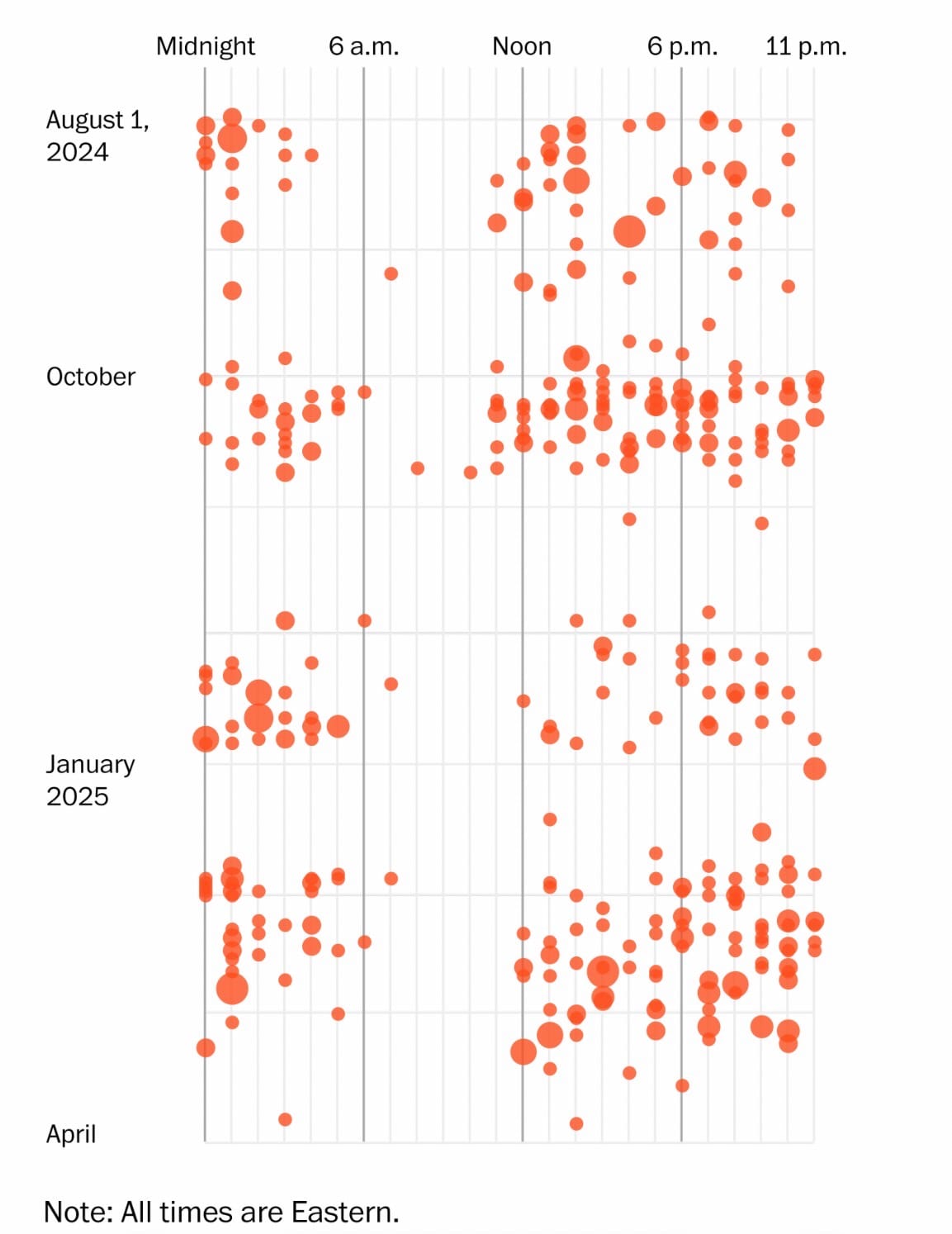
On July 29, 2024, he searched her plate 21 times. Seventeen of those searches ran in a single hour, between five and six in the evening.
Two days later she confronted him. She asked how he knew she had driven to Cleveland, because she hadn’t told him. He said he had looked it up. She asked where. He answered: Flock camera. He said he had been in a spiral that day and promised, “I won’t ever look again.”
Over the next seven months he searched her plate more than 500 more times.
She believed him at first. Months later she heard about a website called Have I Been Flocked on the local news and ran her own plate. By the time she understood what had happened, he had looked up her tag and her teenage daughter’s roughly 600 times. Many of the searches were logged between midnight and four in the morning. Steffman was the chief of police in Braselton, the next town over.
She filed for a restraining order in August 2025, writing that he was using the traffic cameras to track her. A judge called the conduct concerning and denied the petition, finding she had not shown evidence of ongoing stalking. The searches stopped that month. Three months later the Georgia Bureau of Investigation arrested him and said he had misused the system to harass and stalk multiple people. He was found dead in his home in April. Officials said it was suicide.
Five days before the GBI announced the arrest, Braselton’s Facebook page had posted a photo of Steffman with the mayor and town council, honoring twenty years of dedicated service.
The scale
Bakely is one of a set that nobody in law enforcement had counted until this month.
The Post reviewed police and court records and identified at least 50 officers across the country charged with or accused of using license plate readers for unauthorized purposes. Flock’s system was involved in 46 of those cases. In 26 of them, investigators or prosecutors said the officer was surveilling a wife, a girlfriend, an ex, an ex’s new partner, or a woman he wanted to meet. The overwhelming majority of the identified targets are women.
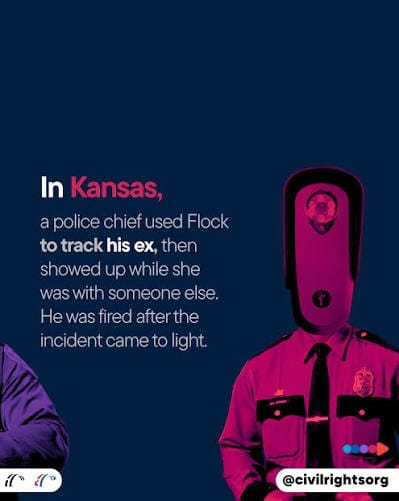
The specifics repeat with a monotony that is itself the point. In Kechi, Kansas, Lieutenant Victor Heiar texted his ex-wife demanding to know where she had taken their children, and later described to her the restaurant where she had celebrated her birthday and the day care she had deliberately kept hidden from him. He was fired, lost his certification, pleaded guilty to computer crime and stalking, and got eighteen months of probation.
In Orange City, Florida, officer Jarmarus Brown called his girlfriend on FaceTime to show her video of herself driving. He later came to her apartment, grabbed her, and reminded her he was carrying a gun. When she said she would call the police, according to an investigator’s report, he told her the police were already there. He pleaded no contest to unauthorized use of computers and was sentenced this month to five years of probation and a fine of a few hundred dollars.
In Niceville, Florida, officer Coty Wayne Hall ran 192 improper searches, including on a fellow officer he had been involved with, and once texted her a description of what she was wearing at the park with her kids. He was fired and pleaded no contest. He told the Post it was unfair to be made out to be a monster, and said essentially everyone in the department used the system that way and that nobody audited it.

The heaviest sentence went to a former California deputy. Prosecutors said Alexander Vanny used Flock as one piece of a months-long campaign against his former fiancée that also involved following her around town and installing a hidden camera in her roommate’s bathroom. A jury convicted him on ten counts, including stalking and unauthorized access of electronic data, and he was sentenced in February to six years. His attorney told the Post the case centered on Vanny photographing the plate of a man who drove off with her after a night at a bar, and that he did it because he was worried about her.
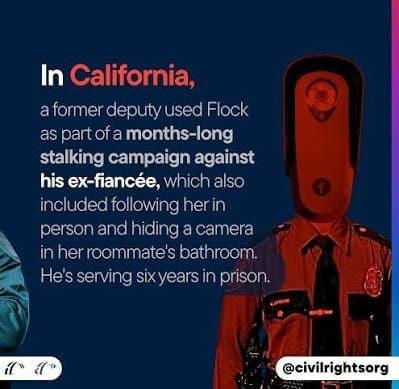
Infrastructure is not a local database. Flock runs more than 120,000 cameras in more than 6,000 communities and records on the order of 20 billion plate scans a month. The company says it passed $300 million in annual revenue last year and was valued at $7.5 billion. Departments lease cameras for roughly $3,000 each per year, and can choose to pool their data with agencies across city and state lines. Homeowners associations, apartment complexes, and strip malls buy in too.
Eva Galperin of the Electronic Frontier Foundation put the mechanism plainly to the Post. An abuser’s goal is to seem omniscient. He does not have to watch you all the time. You just have to believe he could be.
North Carolina got its own case this week. Mooresville police audit their license plate reader logs every thirty days. That audit turned up 31 personal searches by officer Elizabeth Snowman, hired in January 2025, who Chief Ron Campurciani said had used the system to track her boyfriend’s ex-wife. Two of the searches were run while she was off duty. She was arrested at the start of her shift on August 5, charged with accessing computers, and held on a $5,000 secured bond in Iredell County. She was still employed as of the chief’s press conference. He said the department is reviewing at least ten other officers’ Flock use, that three of those look problematic, and that he doesn’t think they’re done yet.
Twenty-nine of Snowman’s 31 searches were logged as motor vehicle infractions. The other two were logged as burglary or robbery. The department said she was untruthful about why she had accessed the system.
One more thing about North Carolina, because it explains how far this reaches. Charlotte- Mecklenburg owns no Flock cameras at all. Its officers can still search the network, through a memorandum of understanding that grants access to cameras belonging to other agencies and private entities. The number of cameras in a jurisdiction tells you nothing about who can run a plate there.
Menasha
In Menasha, Wisconsin, officer Cristian Morales used Flock to check whether his then- girlfriend had gone to a clinic to seek a possible termination of a pregnancy. That description comes from an affidavit sworn by an investigating officer at a different police department, who was seeking to subpoena Flock for the search records.
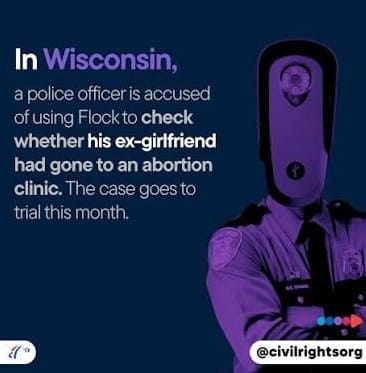
He then texted her to say he had verified she did not go, and accused her of lying. He contacted the clinic trying to obtain her medical records. He confronted her at her home. He called her as many as nineteen times a day.
Morales was charged in January with misconduct in public office and has pleaded not guilty. According to the criminal complaint, he admitted running the searches on her vehicle, and blamed bad judgment, desperation, and lack of sleep.
He had labeled the searches in the system as welfare checks.
Read that sequence in order. He suspected. He queried a national surveillance network. He got an answer about her medical care. He typed a word into a box, and the system accepted it.
A Poisoned Tree, Not Bad Apples
Here is what should end the bad-apples defense.
An officer with credentials logs in, types a plate, types a reason, and receives a location history. No warrant. Flock’s training materials say officers should give a reason, but the field takes anything, including one word. The Post found that vague one-word entries are common enough to make internal review nearly useless.
The numbers from Joplin, Missouri, are the clearest picture anyone has. After the advocacy group DeFlock Joplin obtained the police department’s audit logs, it found that 85 percent of searches carried a one-word justification, things like suspicious or drugs, and that fewer than 3 percent were tied to a criminal case at all.
Flock will let a department require a criminal case number for every search. It is an optional setting. The company also rolled out an automated audit-assistance feature in April that flags patterns like repeated queries on the same vehicle or searches run off the clock. A Flock spokesman told the Post that roughly one in four agencies had turned it on.
Joplin shows one failure mode, which is a field so vague it means nothing. Mooresville shows the other. Snowman did not type a single word. She typed motor vehicle infraction twenty-nine times and burglary or robbery twice, and the entries looked entirely ordinary until somebody matched them against a name. A field that accepts a plausible lie is not an audit trail. It is a formality with a paper record attached.
The accountability is optional at the state level too. According to the Policing Project at NYU Law, thirteen states require departments to audit license plate reader use, and eight have criminalized misuse outright: Georgia, Kentucky, Maine, Maryland, North Carolina, Utah, Virginia, and Washington. That leaves most of the country with neither.
North Carolina is on both lists, which is why the Mooresville case produced an audit and an arrest instead of a resignation. Idaho is on the first list and not the second, and that gap has a name. A sheriff in Jerome County searched for his wife’s car several times a day in the weeks after a prosecutor complained about him to the state attorney general. He resigned more than two years before his term was up and faced no charges, because the attorney general concluded that license plate reader misuse is not a standalone crime in Idaho. He has said he was checking the system’s reliability.
Flock’s chief executive, Garrett Langley, has said misuse is "inevitable" and that the company’s job is to make sure officers know they can be caught afterward. He has also said, more bluntly, that nobody elected him police chief of America and that policing the police is not his job. An investor at Andreessen Horowitz told the Post the forty-odd misuse cases were an infinitesimally small number and, in his words, a nonissue. A nonissue. Trusted public servants abusing their position for personal use, stalking, and abuse, is a "non-issue."
In Milwaukee, the internal affairs detective assigned to investigate an officer’s Flock misuse was himself charged last month with misusing Flock to surveil someone, and with putting a GPS tracker on her car. The audit trail everyone points to as the "safeguard" is a text box that nobody reads until a woman files a complaint.
The paperwork
Charlotte-Mecklenburg’s memorandum of understanding with Flock, which The Grounded obtained through a public records request, is four pages of ordinary vendor language that quietly explains the whole arrangement.
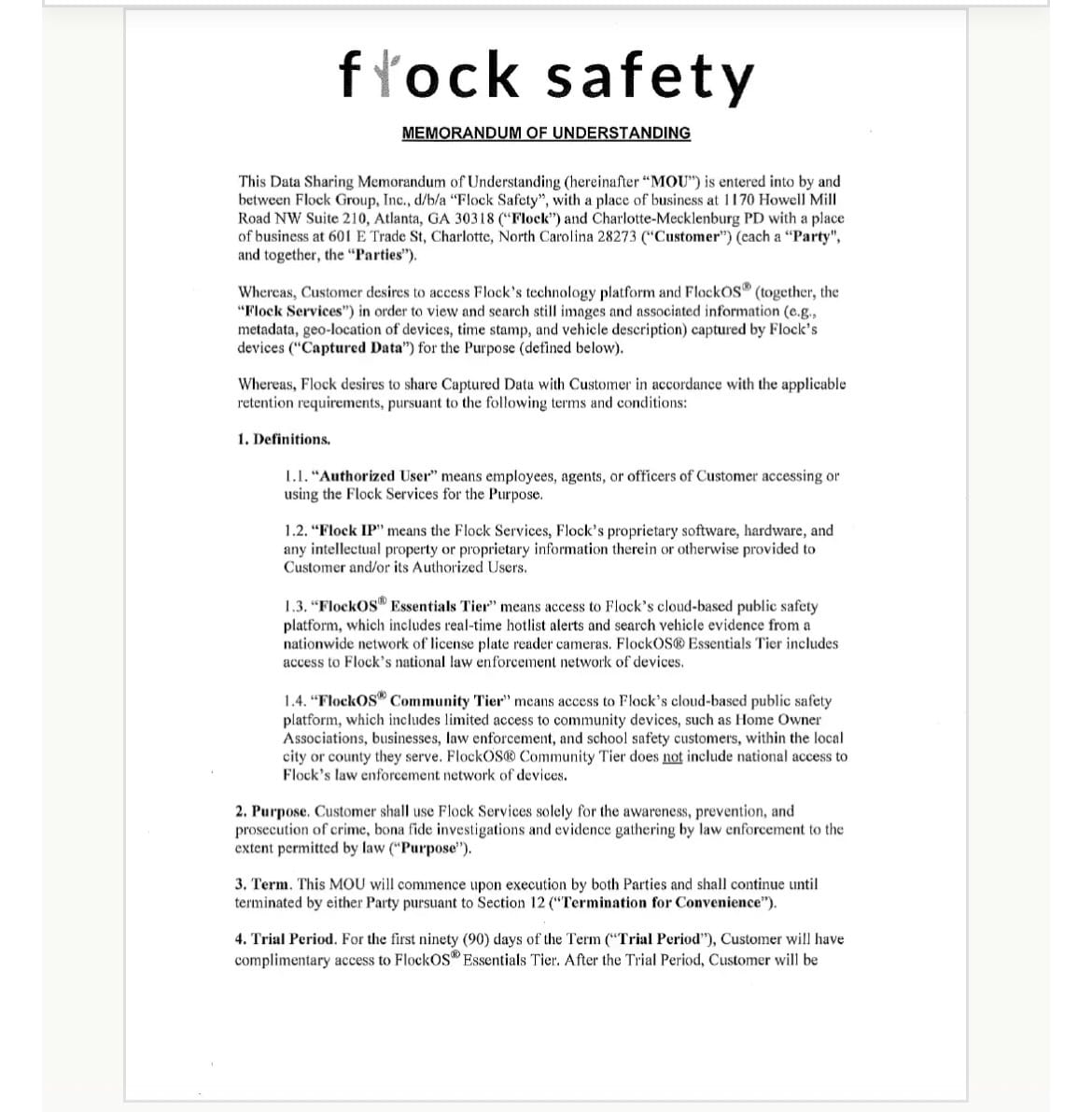
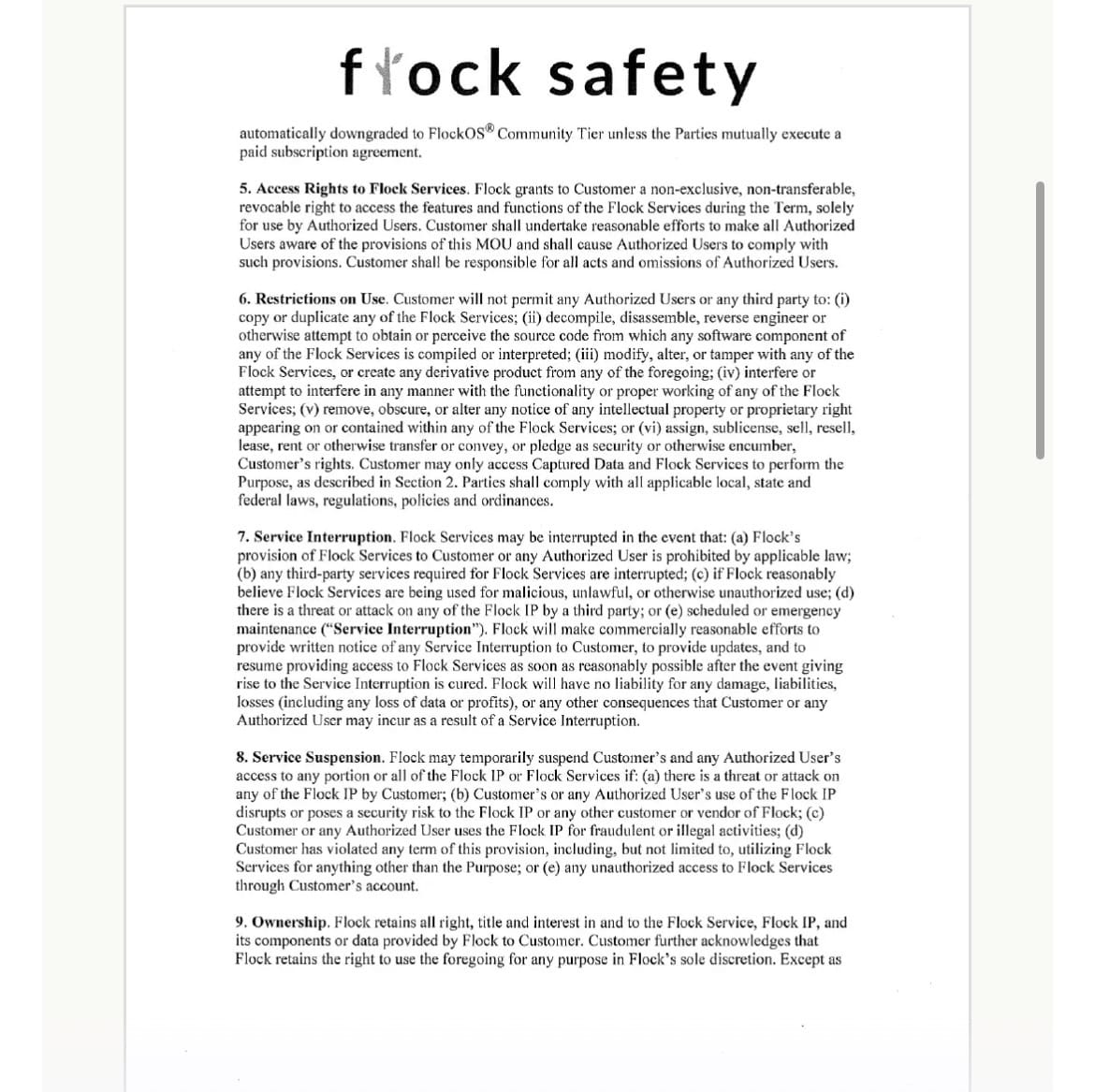
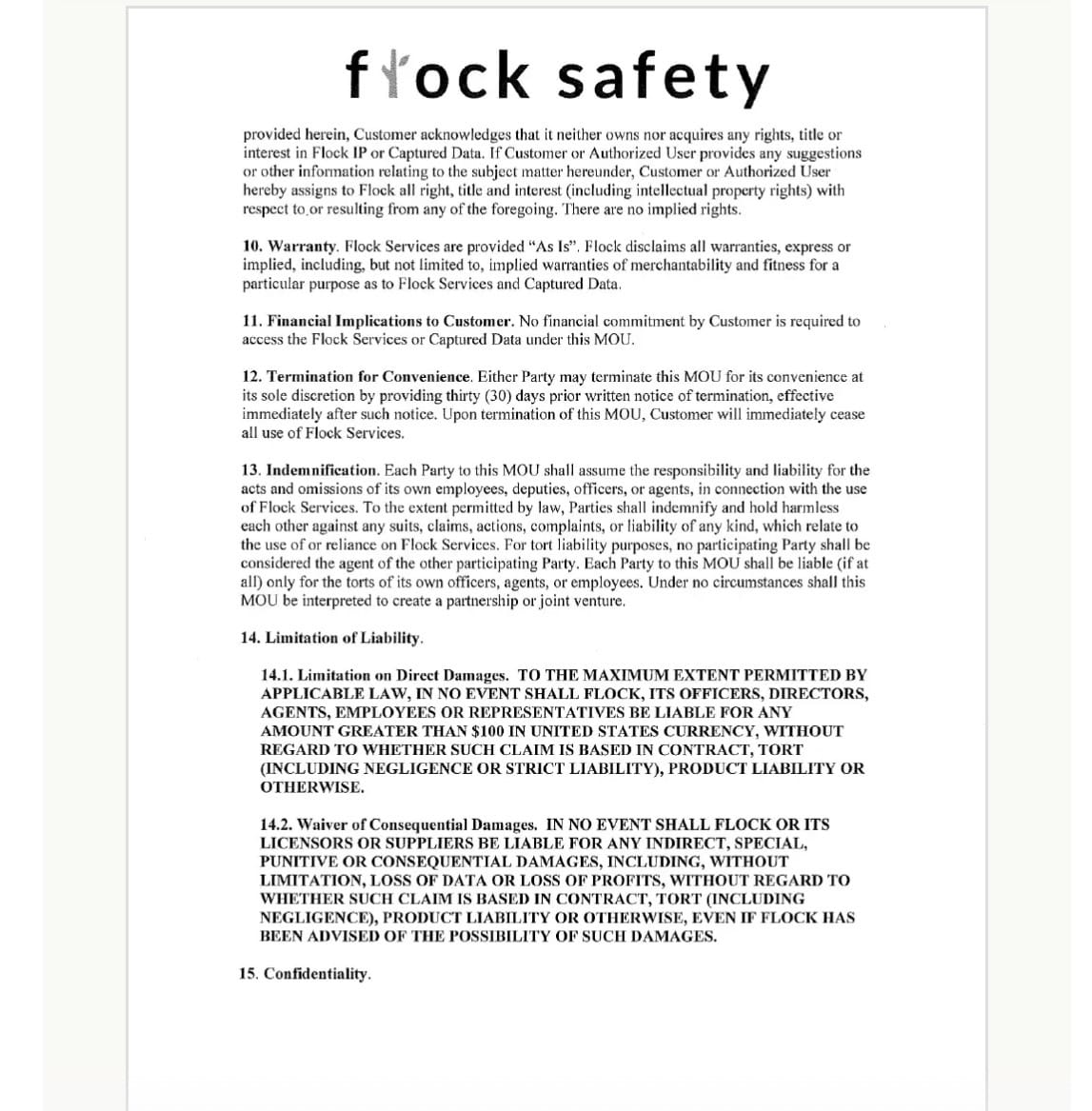
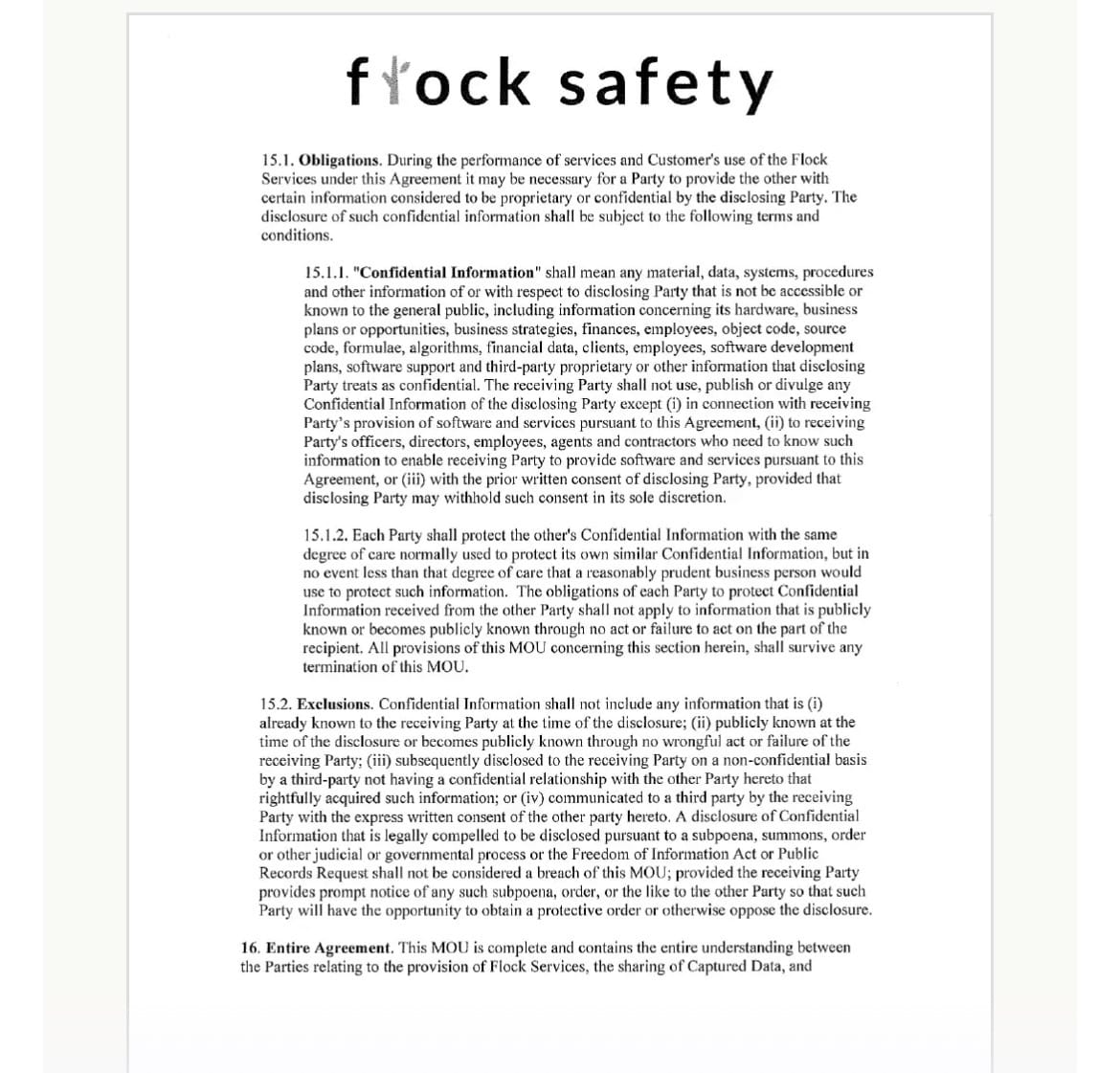
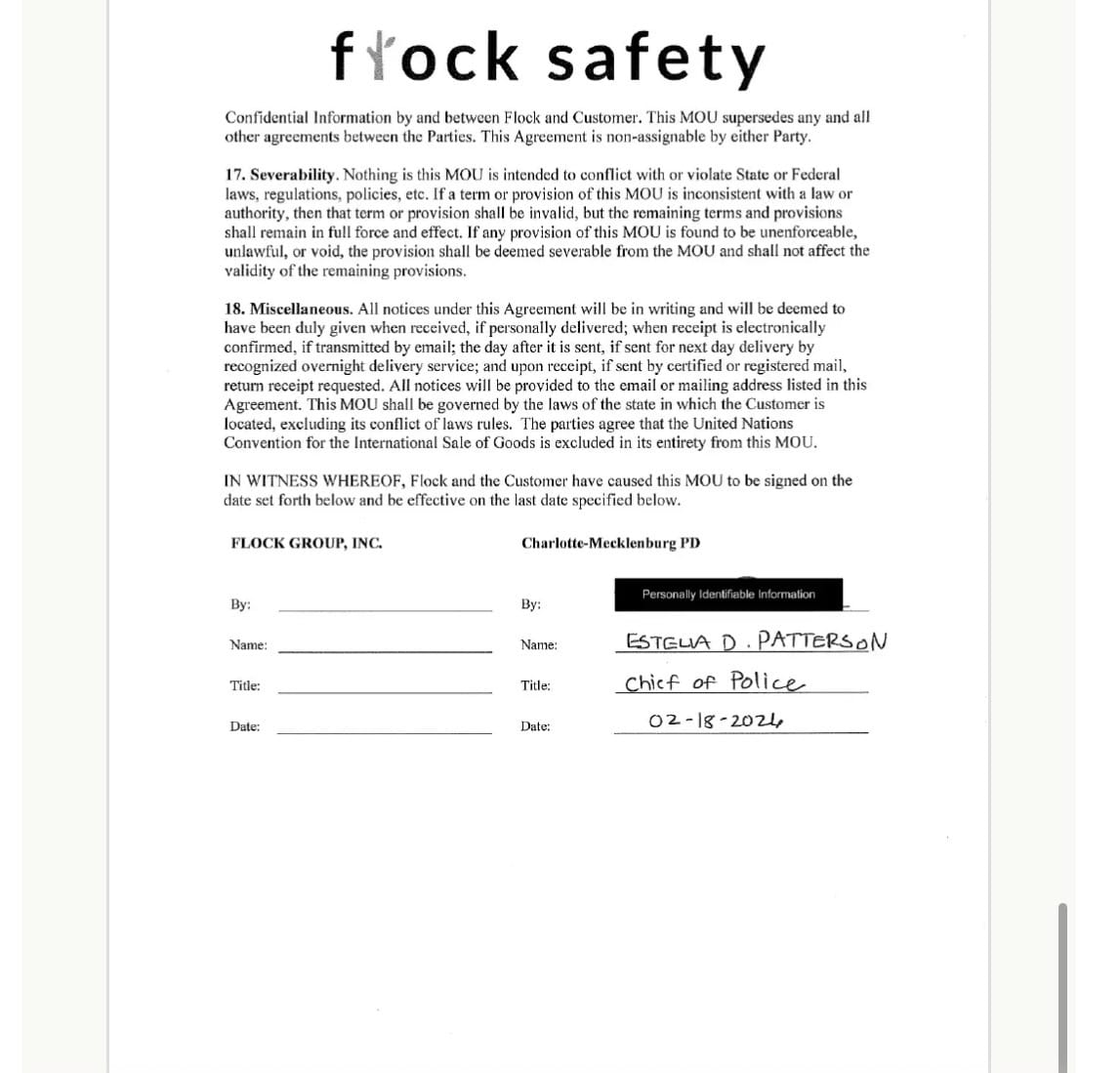
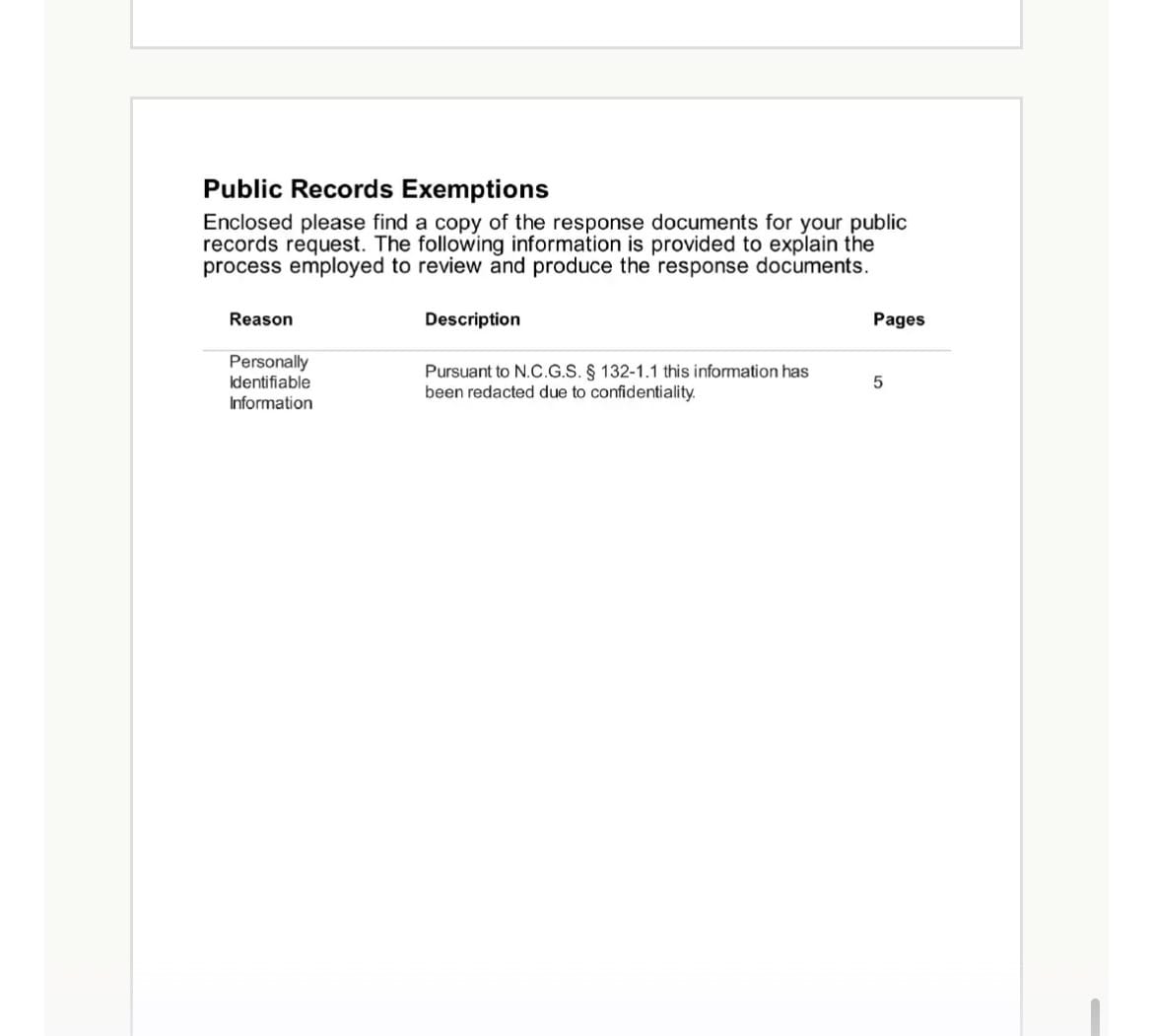
CMPD’s memo of understanding with Flock.
The department pays nothing. Section 11 states that no financial commitment is required to access the service or the captured data. For the first ninety days the agency gets the Essentials tier, which includes real-time hotlist alerts and search across Flock’s national law enforcement network. After ninety days it drops to a local-only tier unless somebody signs a paid subscription. Nationwide search is the free sample.
Use is restricted, on paper, to crime prevention and prosecution and to “bona fide investigations.” Enforcing that restriction is the department’s problem: the agreement makes the customer responsible for all acts and omissions of its authorized users, and makes each party liable only for its own people. Flock’s own exposure is capped. Under section 14.1, the company’s maximum liability to the agency, for anything, in contract or in tort, is one hundred dollars.
Flock keeps the data. The agreement states that the company retains all right, title, and interest in the captured data, that the customer acquires none, and that Flock may use it for any purpose at its sole discretion.
And there is a provision worth sitting with, given how every woman in this story found out what had happened to her. The confidentiality section carves out disclosures compelled by a public records request, so responding to one is not a breach. But the party receiving the request has to give Flock prompt notice, so that Flock has the opportunity to seek a protective order or otherwise oppose the disclosure.
The audit logs are the safeguard. The company that owns them gets advance warning when someone asks to see them.
The copy Charlotte-Mecklenburg produced was signed by Chief Estella Patterson on February 18, 2026. Flock’s signature block is blank.
Johnson County, Texas
On May 9, 2025, a deputy with the Johnson County Sheriff’s Office in Texas ran two searches through Flock’s network. The reason typed into the log, according to records obtained by 404 Media and later by the Electronic Frontier Foundation, was that the subject had an abortion, search for female.
The first search covered 1,295 networks made up of 17,684 cameras, going back a week. The second went back a month and reached 6,809 networks and 83,345 cameras, including cameras in Washington and Illinois, states where the thing she was suspected of doing is legal.
Sheriff Adam King told 404 Media the office feared she was bleeding to death and wanted to find her. Flock called the reporting clickbait.
The records tell a different story. Deputies opened a death investigation. They treated the home as a potential crime scene, put up tape, filled out a scene log, and photographed a stainless steel tumbler that the woman’s partner said contained the fetus, which they placed in a small body bag. They consulted the district attorney about charging her. The DA said they could not. A supplemental report filed a month later, after 404 Media’s story ran, described a large amount of blood at the scene. The on-scene detective’s own sworn affidavit does not mention it.
Nothing here was a rogue query. The reason went in the box. The search ran through official channels across two-thirds of the country. The tool did what it was built to do, and the only thing standing between that woman and a prosecution was a district attorney reading a statute.
The fallout came after: a House Oversight probe, a commitment Senator Ron Wyden extracted to shield Oregon residents’ data from abortion and immigration queries, a referral to the Illinois attorney general, legislation in California. All of it jurisdiction by jurisdiction, all of it responding to a search that had already happened.
How the question moved
It is worth asking how a license plate query became an abortion investigation without a single new law being passed.
Roe created the right. Casey, in 1992, is what actually governed for the next thirty years, and Casey is where the disclosure question got settled. The Court upheld Pennsylvania’s recordkeeping and reporting requirements. The one provision it struck was spousal notification, and Justice O’Connor’s reasoning was that a husband could use the requirement to find out, and that for a woman in a violent marriage the knowledge itself was the danger.
Hold that against Menasha. The Court held in 1992 that the state may know and the husband may not. Thirty-four years later a man who is both gets the answer off a pole-mounted camera, with no statute, no notice, and no judge.
The forty years between those points were a political project, and it did not begin with abortion. The Southern Baptist Convention passed resolutions in 1971 and again in 1974 supporting broad access. Paul Weyrich and the organizers who built what became the Moral Majority were mobilizing against federal action on the tax exemptions of segregation academies and Bob Jones University. Abortion was selected afterward, as the issue that would sell nationally. It worked. It elected Reagan, reorganized a party, and took four decades to reach a Court willing to finish it.
The pipeline
Which brings us to Wednesday, when the Senate confirmed Dr. Erica Schwartz as director of the Centers for Disease Control and Prevention, 51 to 44.
At her July confirmation hearing, Senator Josh Hawley pressed her on the CDC’s abortion reporting system, noting that it is voluntary and that several large states decline to participate. Schwartz answered that abortion surveillance is a critical component of what the CDC currently does. She added that she wanted to be sure states were not hiding abortions inside emergency services case definitions, so the data would be accurate.
There is no evidence that any state is doing that. What there is, in states with bans, is a growing record of physicians afraid to cross exactly that line, and women hurt while they waited.
Nothing Schwartz said announced an enforcement program. That is not the point. The point is the direction of travel. A federal data pipeline is being tightened at the same moment local police are already treating plate data as an abortion investigation tool, and neither development required a vote.
What this is
Safety over freedom is the trade we have spent a century telling ourselves other countries make. Every surveillance state in history was sold to its citizens as protection, and most of the buyers were sincere.
The argument for all of this is the same argument governments we do not admire have always made, which is that you will be safer if we can see you. We will keep you safe, all you have to do is sacrifice your privacy.
Put the pieces beside each other and the same shape shows up in all of them.
An ex-boyfriend with a badge, a sheriff’s deputy in Texas, and a federal agency under new management are not doing the same thing for the same reasons. But they are asking the same question, about the same class of people, through systems sold to the public as something else. Where did she go? Who was she with? What did she do? And every one of them was already holding the credential. Steffman had a department login. The Johnson County deputy had reach into 83,000 cameras in states where the thing he was investigating is legal.
One case in the Post’s tally is why this story is not only about jealous men with credentials. Snowman had the same access her department gives everyone, and used it the same way. Nobody had to pass anything. The authority was issued in advance, for other stated reasons, and it turns out to point wherever the person holding it decides to point it.
That is why the sex of the officer running the query is not the variable, but the sex of the victim is overwhelmingly female. Snowman is a woman who tracked a woman. The badge is the structure. Take away the credential and she is a person with a suspicion and no way to act on it.
The fight over abortion was won in court and lost in court, and while everyone watched the court, the enforcement moved. It moved to a camera on a light pole, a search box, a voluntary audit, and a reporting requirement a new director would like to make less voluntary. None of it is on a ballot. None of it required a legislature. It required somebody to already have the login.
Marci Bakely only found out because she went looking herself. When she tried to report it, she ran into the problem she later put to the Post as a question: to whom do you turn in the chief of police? This is a question that is becoming increasingly difficult to answer.
The Grounded stands behind every factual claim it publishes with a $100 accuracy guarantee. Find an error of fact and tell us. If you are right, we pay.
Sources
Washington Post, “How police officers used a vast network of cameras to spy on their exes,” August 2, 2026
Affidavit and criminal complaint in the Cristian Morales case, Menasha, WI (pull from the Winnebago County clerk)
DeFlock Joplin audit log analysis, Joplin, MO police department Institute for Justice, tally of ALPR stalking cases
Flock Group, Inc. and Charlotte-Mecklenburg PD, Data Sharing Memorandum of Understanding, signed February 18, 2026 (obtained by The Grounded via public records request; five pages withheld as PII under N.C.G.S. 132-1.1)
WBTV, Mooresville PD press conference on Officer Elizabeth Snowman, August 5, 2026
ABC News, Mooresville, NC arrest of Officer Elizabeth Snowman, August 2026
404 Media, “A Texas Cop Searched License Plate Cameras Nationwide for a Woman Who Got an Abortion,” May 2025, and follow-up October 2025
Electronic Frontier Foundation, records obtained from Johnson County Sheriff’s Office
Snopes, review of the Johnson County records, August 4, 2026
Planned Parenthood v. Casey, 505 U.S. 833 (1992)
Senate HELP Committee confirmation hearing of Dr. Erica Schwartz, July 15, 2026
HuffPost and News From The States, coverage of the Schwartz hearing and confirmation
Randall Balmer on the origins of the religious right; Southern Baptist Convention resolutions, 1971 and 1974





Member discussion