The Call Is Coming From Inside The House
By Matt Stone
In 1993, the entire world knew who Michael Jordan was. He had just led the Chicago Bulls on a "three-peat" in securing their third championship title in as many years. I wore his signature red Bulls jersey to every spelling bee I won as a child. I considered it my lucky jersey. When Michael Jordan's dad was killed and he stepped away from the sport, I was devastated. I had no idea those events transpired right in my backyard, or that anyone in my family had any involvement.
I watched The Last Dance like everybody else. In the middle of Covid lockdown, there weren't many places to go or things to do. When the Michael Jordan documentary came on, it seemed as if everyone were talking about it. Somewhere in the back half, the documentary slows down for the murder of James Jordan, Michael’s father, killed in the summer of 1993 on the side of a highway in Robeson County, North Carolina. That’s my county, and Lumberton, where James Jordan was killed, the very town I was born in. I grew up there and so I did what anyone from home would do: I looked it up.
Three clicks. That’s all it took.Wikipedia itself led me to the investigation. The investigation led me to a cocaine dealer who’d taken a call from James Jordan’s car phone. That dealer, Hubert Deese, turned out to be the illegitimate son of the sheriff running the case, my great-uncle, Hubert Stone.
The jury that convicted Daniel Green never learned that. Neither did I, until a documentary and a Google search put it in front of me. This is the story of what the record actually shows, what it doesn’t, and what it’s like to find your family name tied to one of the most famous murders in American sports.
The Murder
The public facts are settled. James Jordan left a funeral in Wilmington in late July 1993, driving his red Lexus back toward Charlotte. Investigators later concluded he was shot in the early morning hours of July 23 while resting at a pull-off along US 74 in Robeson County. His body was found on August 3 in a swamp across the state line in South Carolina. His car turned up stripped near Fayetteville.
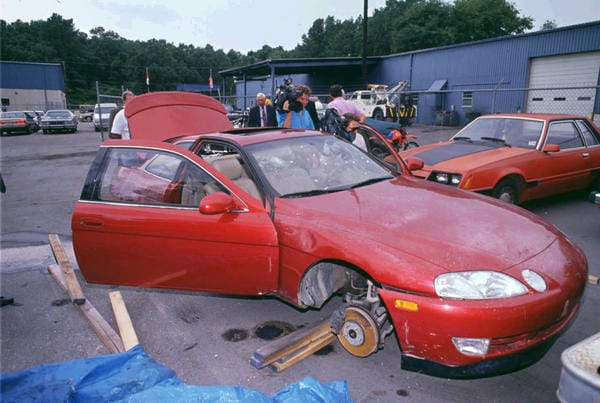
Two local men, Daniel Green and Larry Demery, both 18 at the time, were arrested after investigators traced calls made from Jordan’s car phone and found video of the men with Jordan’s belongings, including his NBA championship ring. Both were sentenced in 1996. Demery testified against Green in exchange for a lesser sentence. Green has maintained for three decades that he helped dispose of the body but was not present for the killing.
That’s the version the jury heard. What the jury didn’t hear is where this story turns.
What the Jury Did Not Know
In February 1994, seven months after James Jordan's murder, the DEA finally arrested Hubert Deese on cocaine trafficking charges. This is all in the court filings. Deese became a federal informant. The deputies who debriefed him were Robeson County's own, including Thomas "C.T." Strickland and Steve Lovin, two names that would surface again years later. The man whose phone number sat in a murder victim's call records was now supplying information to an agency staffed, in part, by the department his father ran. Deese received a "substantial assistance" reduction and was sentenced to ten years. He was in federal custody, cooperating, while Daniel Green stood trial. The jury heard not one word of it.
Don't Tell The Prosecutor
The strangest detail in the filings may be this one. Assistant U.S. Attorney Robert E. Skiver, who prosecuted Deese's federal drug case, said he never knew Deese was Sheriff Stone's son. Nobody told the federal prosecutor handling the sheriff's son's case who the defendant's father was. Skiver said something else, too: that toward the end of Stone's tenure, Stone himself was "being looked at."
Former SBI Director Jim Coman confirmed it, saying Stone was under investigation at some point in the 1990s. Stone retired in 1994 but appeared as a state's expert witness at Daniel Green's 1996 trial, called by DA Johnson Britt, whose office had been copied on the Deese drug reports. Here you had a recently retired sheriff who had himself drawn the attention of state and federal investigators. The jury heard him as an expert. It never heard the rest.
The Phone Call
Among the calls made from James Jordan’s car phone in the hours after his death, one call went to one Hubert Larry Deese.
According to court filings by Green’s legal team, including a 2015 motion supported by the Southern Coalition for Social Justice and later supplements to his Motion for Appropriate Relief, Deese was a trafficker operating in Robeson County. He worked alongside Larry Demery at Crestline Mobile Homes, a factory near where Jordan’s body was found. And he was the biological son of Sheriff Hubert Stone, the man running the murder investigation.
Investigators believed the Deese organization was moving 10 to 20 kilos of cocaine into Robeson County every six weeks. This wasn't a corner dealer whose number happened to be in a dead man's phone. It was, per federal investigators, one of the county's major pipelines, run by the sheriff's son.
The Informant Turn
Seven months after the murder, on February 28, 1994, the DEA arrested Deese. He was debriefed by DEA Agent Michael E. Grimes and Robeson County deputies Thomas Strickland and Steve Lovin. Both deputies were later among the first arrested in Operation Tarnished Badge, the largest police corruption scandal in North Carolina history, and both went to federal prison. Deese pled guilty on July 21, 1994 and was released on unsecured bond. He kept spending time with Lovin and Strickland after his arrest, setting up undercover operations for the joint task force until his January 1995 sentencing. The government moved for downward departure for "substantial assistance," he got 10 years, and continued cooperation cut it to 54 months by 1997.
After Deese got out of federal prison, Hubert Stone deeded 3.11 acres at 10702 Deep Branch Road in Maxton to Deese and his wife Diana. The land went to Deese through Stone's company, H & K Stone Enterprises, rather than in Stone's own name, and only the signature line, Hubert Stone, President, connects him to it. I tracked down the deeds, posted below, to see for myself. Nobody in my family ever showed me a deed, period. I suppose I got into the wrong business.
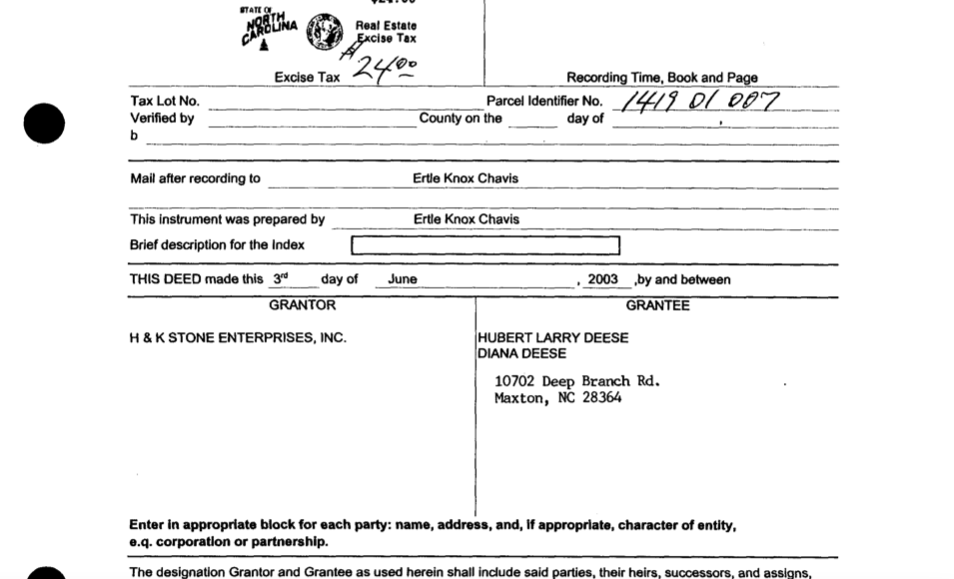
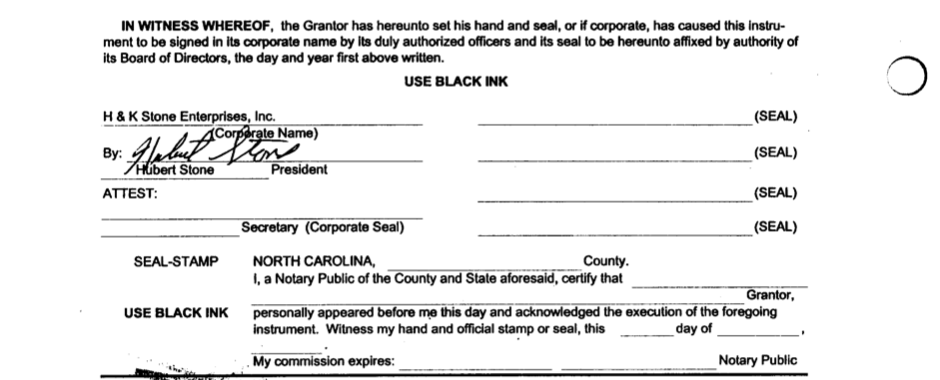
The deed for H & K Stone Enterprises transferring land to Hubert Deese and his wife, Diana.
Law enforcement interviewed Deese multiple times during the investigation and trial of Daniel Green, he was an active informant for the DEA and the sheriff's department during that exact period, and none of those statements were ever disclosed to the defense. So the official story that Deese was "never questioned" has a darker truth: he was talking to law enforcement constantly, just never about James Jordan, the call, and never where a jury could hear it.
DA Johnson Britt knew. He admitted to defense counsel in January 2015 that at the time of the 1996 trial he knew Deese was Sheriff Stone's biological son and knew he was a drug trafficker. He knew the call from Jordan's phone went to the trafficking son of the sheriff, and never disclosed it. Deese was never questioned about the call during the investigation at all.
The filings go even further. SBI documents cited in Green’s fourth MAR supplement show Deese was already under DEA and SBI drug suspicion as of 1992, the year before the murder. On the very day James Jordan was killed, the SBI wrote a memo on its Deese drug-conspiracy investigation. Robeson County deputies were present at most interviews in that investigation, and the District Attorney's office was copied on the reports. At trial, DA Johnson Britt called Sheriff Stone to testify as an expert witness, with Stone’s son sitting in the phone records the whole time.
Green’s lawyers have argued the murder may have been a drug deal gone wrong rather than a random robbery, and that the investigation was steered away from anyone whose involvement would have implicated the sheriff’s office. That is an allegation, not a finding. No court has ruled that Stone protected his son. Deese has denied any connection to the murder.
But the structure and the timing, the sheriff’s son in the phone records, never interviewed, his paternity hidden from the jury, is court record. The fact is the jury was never made aware of the connection between Stone and Deese. And a phone call from James Jordan's Lexus went to Deese's phone number.
Walking Tall
To understand why Green’s lawyers thought the allegation was plausible, you have to understand what Robeson County law enforcement was in that era.
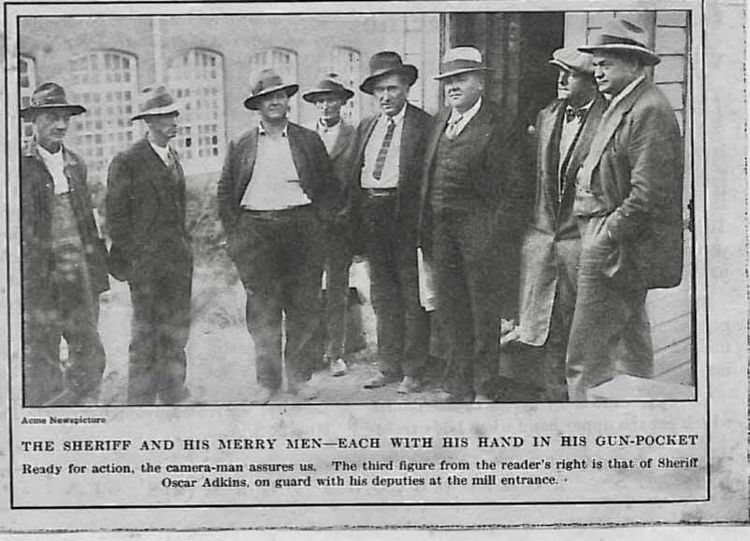
In 1994, Sheriff Stone gave an interview to GQ for Scott Raab’s piece “Reasonable Doubt.” Stone was quoted as saying: "Cocaine, we still have a problem with, especially among the Indians. We have it in all three races, but most of the drug dealers that are arrested are one race—Indian. The blacks are on crack."
That was not the only controversial quote to come out of that GQ interview: "Anytime you look down the street and you see a black and an Indian guy, you've got crime." These quotes belong side-by-side. Once may be a slip of the tongue, a mistake. Twice begins a pattern.
The pattern had been visible for a while. In the 1980s, a deputy that was later acquitted testified under oath about a protection racket in which one dealer paid $300 per ounce of cocaine directly to Hubert Stone in order to move product through the county. In the 2000s, a federal and state investigation of the Robeson County Sheriff’s Office, years after Stone left, ended with 22 officers pleading guilty to charges including drug trafficking. Among them was Stone’s successor, Glenn Maynor. Some of the convicted deputies had served under Stone.
None of that proves anything about James Jordan’s murder. It proves that when Green’s lawyers described a sheriff’s office entangled in the county drug trade, they were describing an institution that would later plead guilty, twenty-two times over, to being exactly that.
The Evidence that Disappeared
There is one more thread. A 2010 SBI audit found that additional blood testing favorable to Green’s defense had never been disclosed at trial. The evidence was later destroyed. Whatever it would have shown, no one will ever test it again.
This is a pattern in Robeson County cases from that era, and it’s one I’ve written about before. When Julian Pierce was murdered in 1988, his briefcase and the sheriff’s office dispatch tapes from that night went missing too. Different case, same custodians, same result: the material that could have answered the question ceased to exist while in the care of the people the question was about.
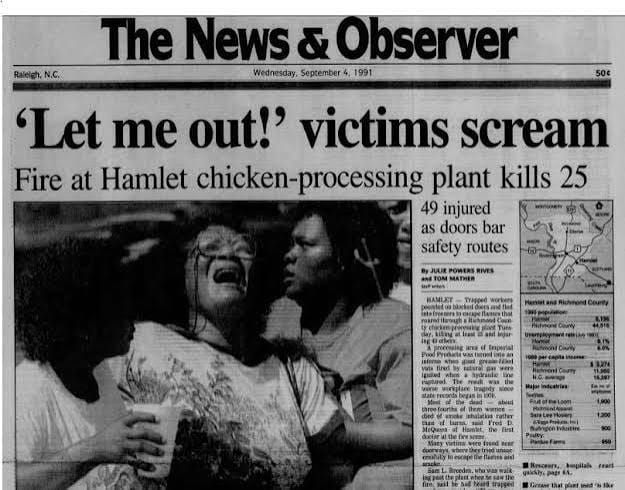
When Eddie Hatcher and Timothy Jacobs occupied the offices of the Robesonian Newspaper, it was in response to fear of retaliation for Hatcher obtaining maps and documentation from a Federal Informer who had assisted the FBI and DEA in major drug convictions. Hatcher claimed to have maps outlining the drug distribution network, and evidence that 34 major business people and law enforcement officers, including Sheriff Hubert Stone, were behind the major cocaine trafficking in the county and eastern North Carolina.
The Hatcher story usually gets told as a closed chapter, two Tuscarora men, a newspaper office, twenty hostages, an acquittal, a legend. But the people who were in that story are still alive, and some of them are still talking.
The evidence Hatcher claimed to have was never investigated. And the whole world took notice. From Germany to Australia to Sweden to Canada, and countless other countries, groups and organizations spoke out about the "case of Eddie Hatcher" and how "the United States does have Political Prisoners." Even though the world took notice, taking over a newspaper at gunpoint was not the right methodology. Armed standoffs were already a subject that had people on edge. The fact remains though, what they were demanding was for the state to do its job. No cash, no prisoner releases, no immunity, just an investigation of the Robeson County Sheriff's Department and the disproportionate incarcerations and murders of black and brown men.
The occupation was thirty-eight years ago. The claims Hatcher carried into that newsroom, that the county's cocaine trade ran through its businessmen and its badges, stopped being deniable in 2006, when the first badge pled guilty. When it was all said and done, 22 officers had pled guilty.
Operation Tarnished Badge
Tarnished Badge didn't come from outside. In 2003, DA Johnson Britt ordered an investigation into the sheriff's drug unit, which patrolled a stretch of I-95, the drug corridor between Florida and the Northeast, and it grew into a federal case. The same Johnson Britt who, per the MAR, knew in 1996 that Deese was Stone's son and said nothing. The man who eventually turned the lights on is also the man who sat on the Deese fact at trial.
What was uncovered was that deputies at the Robeson County Sheriff's Department were stealing tens of thousands of dollars during traffic stops and paying informants with drugs. Britt called it something out of a Hollywood script and said the number of people involved became shocking. The indictment alleged that deputies Roger Taylor, Thomas "C.T." Strickland, and Steven Lovin burned two homes and a business, assaulted people, paid informants with drugs, and stole and laundered public money, with investigators saying the corruption went back to at least 1997. Several deputies were separately convicted of stealing federal equitable sharing money, funds earmarked for combating drug trafficking in Robeson County.
The tally, per the DOJ's own release: 22 convictions on federal violations including RICO conspiracy, money laundering conspiracy, defrauding the government, satellite piracy, kidnapping conspiracy, cocaine distribution conspiracy, and use of a firearm during a crime of violence, including former Sheriff Glenn Maynor, with charges ranging from kidnapping and money laundering to burning houses during drug raids. The heaviest individual sentences: deputy Patrick Ferguson got 250 months for conspiring to kidnap two people and discharging a firearm, and Vincent Sinclair got 34 years and five months for kidnapping two Virginia drug dealers, then spit at an SBI agent on his way out of the courtroom.
The deputies who debriefed Deese as an informant, Strickland and Lovin, weren't peripheral figures in Tarnished Badge. They're named in the arson and racketeering core of the indictment. So the sheriff's son's federal cooperation ran through two officers later imprisoned for running the county exactly the way Hatcher's maps and the 1987 deputy testimony described. The 1988 claims, the 1993 phone call, and the 2006 guilty pleas are one continuous story.
For sixteen years under Hubert Stone, the accusations piled up without consequence. A deputy's sworn 1987 testimony about protection payments. Hatcher's maps. A federal prosecutor who later said Stone was "being looked at" toward the end of his tenure. Nothing came of any of it. Then in 1994, Glenn Maynor became Robeson County's first Lumbee sheriff. Less than a decade into his tenure, his office became the subject of Operation Tarnished Badge, the largest police corruption investigation in North Carolina history, and every one of the 22 convictions was for conduct committed after Stone left.
To be fair, the probe wasn't some kind of racist federal payback for an Indian winning the office. It began in 2003 when DA Johnson Britt referred his own county's drug unit, and the corruption it found was real, deputies burning houses, kidnapping dealers, stealing drug money. Maynor's office earned its indictments. But the county had been accused of running exactly this kind of operation for decades before he took the badge. The difference wasn't the behavior. The difference was that this time, somebody made the decision to prosecute it.
What We Have In Common
Hubert Stone was my great-uncle. I never chose that, the same way nobody chooses their family. I found out from Wikipedia, thirty-some years into my life, three clicks from a basketball documentary.
I’ve thought about what I owe here. The easy version of this piece would gesture at the allegations, soften the family material, and let readers connect dots I wasn’t willing to draw. I’m not writing the easy version. My publication carries a $100 accuracy guarantee, and the standard doesn’t bend because the name in the documents is mine. If anything, it tightens.
So here is what the record supports, stated plainly. My great-uncle ran the investigation into James Jordan’s murder. My cousin’s phone number was in the victim’s car phone records. My cousin was never questioned. The jury never learned my cousin was the sheriff’s son. The DA knew, and put the sheriff on the stand anyway. Favorable evidence went undisclosed and was destroyed. And a decade later, the institution my great-uncle built pled guilty to running drugs.
What actually happened on that pull-off on US 74 in the early hours of July 23, 1993, I don’t know. Daniel Green says he wasn’t there. Larry Demery, who testified he was, says Green was the shooter. Green denies to this day that he was present for the shooting, but helped Demery dispose of the body after Demery showed up to his house saying he needed help. Larry Demery was initially granted parole in 2020 with a release date of 8/6/2023, which was then pushed back to 2024 before being canceled by the state entirely. Daniel Green remains in prison, but still insists he is innocent and passes most of his time by working on, and researching his case. Nobody can know for sure what happened on that night. What I do know is that the machinery that investigated the murder had every incentive to look away from one man, and it looked away. That man is my family. This piece is what looking directly at it looks like. It is not comfortable. It is costing me relationships with family members. But the truth matters, and any attempts to subvert or ignore it are nothing short of cowardice.
 Josh Rudis
 Alex Belth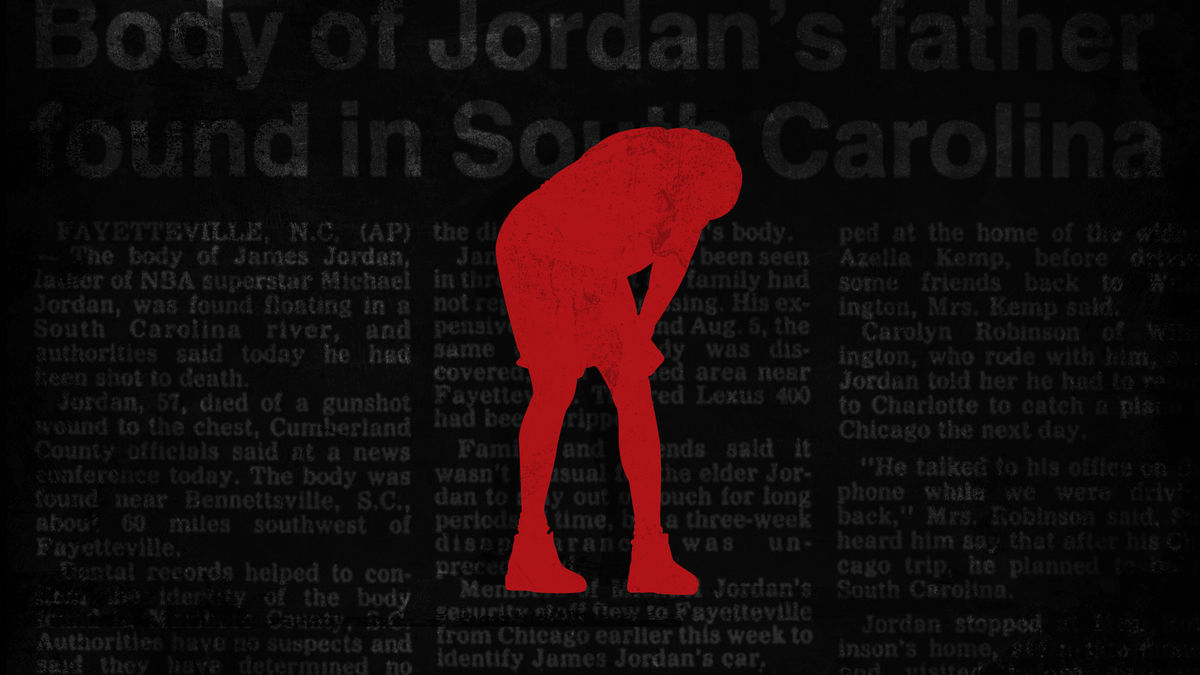

https://www.jstor.org/content/oa_chapter_monograph/10.5149/9781469646398_lowery.11?seq=11
Sources: Daniel Green’s Motion for Appropriate Relief and supplements (2015-2017, including SBI memoranda cited therein); Southern Coalition for Social Justice motion (2015); trial record, State v. Green (1996); Scott Raab, “Reasonable Doubt,” GQ (1994); News & Observer; The Robesonian; NBC Chicago.
Member discussion