9 min read

The Doors Were Locked From the Outside

The people who died at Imperial were not killed by fire. Fire was the mechanism. They were killed by a padlock, a vacant inspector's job, and a state philosophy that said prosperity would trickle down to the people standing in the water on the kill floor.
The Doors Were Locked From the Outside
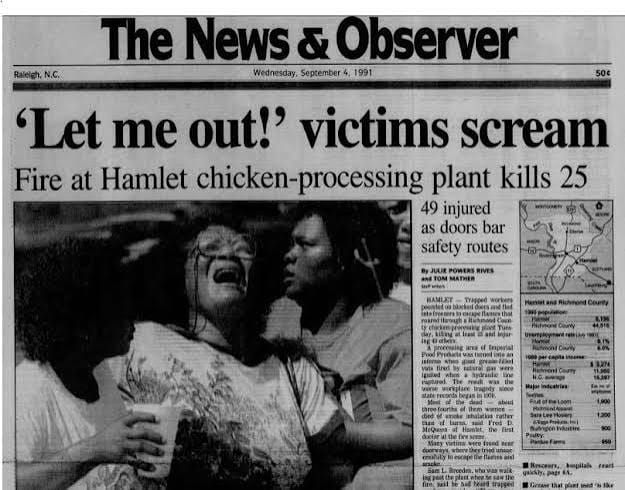
Newspaper clipping covering the Hamlet chicken plant fire.
Buried Bodies: The Hamlet Fire, 1991

The footprints were on the door.

Not beside it. On it. When investigators walked through what was left of the Imperial Food Products plant in Hamlet, North Carolina, they found the marks where workers had kicked and beaten against an exit that would not open, because the man who owned the building had ordered it locked from the outside. He was worried, his employees said, that they were stealing chicken.

Twenty-five people died on September 3, 1991, the day after Labor Day. Fifty-four more were injured. Eighteen of the dead were women. Most were Black. One was a vending machine deliveryman who had the bad luck to be inside when a hydraulic line above a deep fat fryer let go. Forty-nine children lost a parent that morning.

Thirty-five years later, the state that let it happen is quietly rebuilding and allowing the same work conditions to go unchecked.

Eleven Years, Zero Inspections

The fire itself took minutes. A hydraulic line feeding a conveyor had been patched with an improvised repair. It failed, sprayed fluid near the fryer's gas flames, and the vapor ignited. Fire and thick smoke rolled through a single-story cinder block building with no fire alarm, no working sprinkler system, and no evacuation plan.

Workers ran for the exits and found some of them locked or blocked. A group crammed into the walk-in freezer to escape the smoke. Others huddled at a locked door and prayed while they beat on the walls. Survivor Annette Zimmerman, who was trampled in the crush and lived, would later describe the decades that followed as thirty years of tears.

The number that turns a tragedy into an indictment: in eleven years of operation, no state safety inspector ever set foot in the building. Not once. Not after the first fire. Not after the second. Not after the third. Not once.

This was not because nobody from the government was around. Federal inspectors were in that plant every single day. They worked for the U.S. Department of Agriculture, and they were there to inspect the chicken. The meat leaving the building was subject to daily federal oversight. The human beings inside it were subject to none. The product was the priority, not the employees producing it.

North Carolina ran its own state OSHA program, and it ran it the way it ran everything else in those years: cheap, half-assed, and only when it benefitted someone with a higher pay grade. The state had one of the worst inspector-to-worker ratios in the country. This was policy, not accident. North Carolina was selling itself to industry as a low-wage, low-regulation, non-union haven, and a toothless safety agency was part of the pitch. Governor Jim Hunt captured the operating philosophy in seven words: "If business prospers, so will workers." While he may have been trying to allude to trickle down economics, the statement does not hold true in any sense. The theory said wealth would find its way down to them. The only thing that found them was fire, a door that was locked, and an agonizing death.

The workers at Imperial saw that prosperity trickle down at roughly minimum wage, standing in water, cutting and frying chicken parts in a town where the mill jobs had already left and there was nothing else. They knew the plant was dangerous. They stayed because the alternative was nothing.The alternative was starving and watching their families starve. That is not a labor market. That is the appearance of a solution dangling over a trap door.

The Owner Got Four Years

Emmett Roe, the owner, had bought the Hamlet facility in 1980. His company already had a poor safety record elsewhere. After the fire, he pleaded guilty to 25 counts of involuntary manslaughter and was sentenced to just under 20 years, which sounds like accountability until you learn he was paroled after about four. The plea deal spared his son and the plant manager from trial. Many of the families were furious. Twenty-five dead came out to roughly two months of prison time per person.

He was, for whatever it is worth, the first employer in North Carolina history to be imprisoned for the deaths of his workers. In a state that had been industrializing for a century, that fact is its own indictment.

The Lessons, Briefly Learned

For a moment, the state was ashamed enough to act. Federal OSHA moved against North Carolina's failed state program, and under that pressure the legislature did something. House Speaker Dan Blue convened a special commission, and in 1992 the General Assembly passed a package of workplace safety reforms over the objections of business lobbies that considered more inspectors too onerous a burden. The inspection force grew. Fire codes tightened. A memorial went up in Hamlet with twenty-five names on it.

Hamlet chicken plant after the fire.

If the story ended there, it would be a grim but familiar American arc: preventable disaster, public outrage, reform. It does not end there.

In 2021, on the thirtieth anniversary, veteran North Carolina journalist John Drescher went back through the data for The Assembly and found the reforms dissolving in real time. Inspections of non-construction worksites in the state had fallen by more than half over the previous decade. A quarter of the state's 114 workplace inspector positions sat vacant. Workplace fatalities had climbed for six straight years to their highest level in nearly two decades. Wayne Goodwin, a Hamlet native who served as the state's insurance commissioner and fire marshal, put it plainly: the lessons were briefly learned and are now being unlearned.

The state's answer, as of last year, is a plan from the new labor commissioner to fill inspector vacancies and raise starting salaries. Whether that plan has produced actual inspectors walking through actual plants, or whether it joins the long tradition of promises made at anniversary ceremonies, is a question the state's own vacancy data will answer.

Because this is the pattern, and it is the pattern this series exists to document. North Carolina remembers its dead exactly as long as the cameras are present. Wilmington in 1898, Marion in 1929, Greensboro in 1979, Hamlet in 1991. The state holds the ceremony, lowers the flag, and then goes back to the arrangement that produced the bodies, confident that memory fades faster than policy.

Eighty Years, Same Door

In 1911, the Triangle Shirtwaist Factory burned in New York City. One hundred forty-six garment workers died, most of them immigrant women, many of them trapped behind doors that management had locked to prevent theft. The outrage that followed built much of modern American workplace safety law.

Hamlet happened eighty years later, almost to the season. Same locked doors. Same justification. Same class of worker considered cheap enough to gamble with. The distance between Triangle and Hamlet is the distance between a lesson learned and a lesson recited.

The people who died at Imperial were not killed by fire. Fire was the mechanism. They were killed by a padlock, a vacant inspector's job, a legislature that priced their lives against the cost of a sprinkler system, and a state philosophy that said prosperity would trickle down to the people standing in the water on the kill floor. Twenty-five of them found out exactly how much they were worth.

Overhead view of the Hamlet chicken plant fire.

The Experiment Runs Again

The tempting way to end a story like this is to call it history. A cautionary tale. Something we learned from. That ending is not available, because the conditions that produced Hamlet are being rebuilt right now, and this time at the federal level.

In July 2025, OSHA published a sweeping package of proposed rules under a presidential executive order titled "Unleashing Prosperity Through Deregulation." Read that title again with the footprints in mind. It is Jim Hunt's seven words with a federal letterhead. The agency put more than two dozen rules into the Federal Register at once, part of a roadmap targeting over 40 workplace safety standards for narrowing or removal, on the stated grounds that they slow economic development.

One of those proposals would restrict how OSHA enforces its General Duty Clause, the provision requiring workplaces to be free from recognized hazards likely to cause death or serious harm. That clause is the exact legal instrument a locked fire exit falls under. It is the catch-all that exists precisely for the hazard nobody wrote a specific rule against yet. Narrowing it does not remove a piece of red tape. It removes the tool you would use on the next Imperial.

Another finalized rule strips the requirement that large employers electronically report their injuries and illnesses to the government. Fewer reports mean fewer recorded incidents, which mean a cleaner-looking safety record for the same body count. This is the Buried Bodies principle in its purest form: death hidden twice, once in the ground and once in the data. You cannot investigate a pattern the state has stopped writing down.

And the enforcement muscle is thinning the way North Carolina's did before 1991. Federal inspector ranks fell roughly ten percent during the previous administration, and current budget cuts point the same direction, paired with a push toward employer self-auditing, companies grading their own safety homework. Self-policing is not a reform. It is the arrangement Imperial already enjoyed for eleven unvisited years.

There is even a bill in Congress to abolish OSHA outright and hand the whole question back to states and employers. It is unlikely to pass. It did not need to. The dismantling is happening through the quieter machinery of rule making, where nobody has to cast a vote next to the word "fire."

This is what institutional decay looks like when it stops being passive. Hamlet's lessons did not merely fade. They are being deliberately reversed, under a banner promising the same prosperity that reached the kill floor as smoke.

The footprints were on the door. The door is still the question, and the country is unlocking it from the other side.

The Grounded stands behind every fact in this piece with our $100 accuracy guarantee. If you find a factual error, you get paid.

Sources