7 min read

The Woman in the Photograph

A tiny, untrained school teacher turned 110 men, with 3 American rifles between them, into a terrifying unconventional insurgency, lurking in the jungle brush with bolos, gas pipe guns, and handmade bombs with gunpowder and old nails. American units later named the unit the Gas Pipe Gang.
The Woman in the Photograph
Nieves Fernandez--School teacher, Community Organizer, One-Woman Death Squad.

Written by Matt Stone

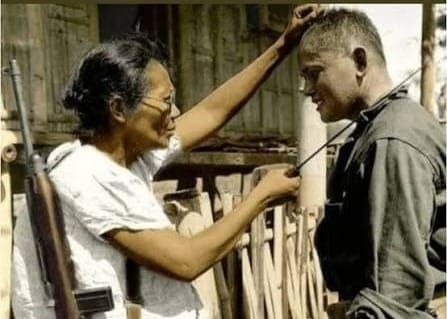
The photograph is why you know her, even if you don't know her name. A small woman in a plain dress, glasses, hair pinned back, holding a bolo to the neck of an American private while her other hand steadies his head. A rifle slung across her back. She is teaching him something, and he is listening the way you listen to someone who knows.

The picture was taken by war photographer Stanley Troutman on Leyte in November 1944, days after American forces returned to the Philippines. The soldier is Private Andrew Lupiba. The woman is Nieves Fernandez, a schoolteacher from Tacloban, and the technique she is demonstrating is the one she used on Japanese soldiers for the previous two and a half years.

The photograph went out on the wires and has been circulating ever since, usually attached to a story that grows a little with each retelling. She personally killed 200 men. She was a lone assassin. She shot soldiers who came for her students. Some of it traces to the record. Some of it traces to nothing at all.

The Grounded went looking for the parts that trace, and found a paper trail thread that nobody has pulled.

The Root Source

Nearly everything the internet knows about Nieves Fernandez descends from a single Associated Press dispatch, published in early November 1944 under headlines like "School-Ma'am Led Guerillas on Leyte." The reporting was done in Tacloban just after liberation, when Fernandez, then 38, told an American correspondent what the occupation had been: the Japanese confiscating everything, torturing business owners with alternating scalding and freezing baths. "They took everything they wanted," she said.

Before the war she taught school in Tacloban and ran a small wholesale business. When the Japanese occupied Leyte in May 1942, she went south of the city and organized. The dispatch's details are specific in the way real logistics are specific: she raised roughly 110 men who began with exactly three American rifles. The rest of the arsenal they manufactured, shotguns fashioned from sections of gas pipe, loaded with gunpowder and old nails, plus handmade grenades, bolos, and whatever Japanese weapons they could capture. American troops later nicknamed the unit the Gas Pipe Gang.

The dispatch credits her force with killing more than 200 Japanese soldiers. U.S. intelligence officers, in the same reporting, said the Japanese had put a 10,000-peso bounty on her head. She was wounded once, and the bullet scar on her right forearm is visible in Troutman's photographs.

That is the root source. It is vivid, it is contemporaneous, and it is one article. For eighty years, most of what has been written about Fernandez has been that article wearing different clothes. The consensus remains that Captain Fernandez was not only real, but she was essentially the female equivalent of Simo Hayha, the Finnish sniper that had the invading Red Army terrified by his kill count and sheer determination alone. The difference is that Captain Fernandez was not a trained soldier. She was just a schoolteacher, as if John Wick happened to be a five-foot-nothing Filipino woman.

The Paper Trail

Here is what makes Fernandez unusual among viral history subjects: the independent record, the part that doesn't descend from the wire story, holds up.

The Philippine Veterans Affairs Office confirms her service record: honorably discharged on May 31, 1945, from Headquarters & Service Company, 95th Infantry, Leyte Area Command, with the rank of Sergeant. Her unit operated within the guerrilla structure organized under Colonel Ruperto Kangleon, whose Leyte resistance fed intelligence to MacArthur's returning forces and is credited with helping make Leyte the first Philippine island liberated.

Her unit file sits in the Philippine Archive Collection at the U.S. National Archives in College Park, Maryland, under the Leyte Area Command records. The Grounded has identified the folder and is pursuing its contents. To our knowledge, no published account of Fernandez has ever cited it directly.

A second American eyewitness account also exists, independent of the AP dispatch. Captain Edward Odrowski, a U.S. Army officer with the 44th General Hospital on Leyte, described encountering a slight, tough-looking female guerrilla with a bolo on her belt who explained her method of approaching from behind and killing with a single stroke. His son, historian James Odrowski, later concluded the woman was Fernandez. It is a secondhand identification, but it is a separate chain of custody, and it corroborates the technique, the weapon, and the woman. And it meets the Grounded's standard for triangulating sources.

She survived the war by more than half a century, dying in 1997. In 2017, the Philippine Army named a base in Ormoc City, home of the 78th Infantry Battalion, Camp Captain Nieves Fernandez.

The Myth and the Legacy

Now the corrections, because the legend has accumulated barnacles.

The rank. She was never officially a captain. "Captain Fernandez" was what her men called her; the official record says Sergeant. The Philippine Army's own base naming preserves the honorific, which tells you something about which version the institution prefers. A tiny, untrained school teacher turned 110 men, with 3 American rifles between them, into a terrifying unconventional insurgency, lurking in the jungle brush with bolos, gas pipe guns, and handmade bombs with gunpowder and old nails.

The kill count. The 200 figure comes from the 1944 dispatch, which attributed it to her force, not to her personally, and which rested on her own account with no battle ledger behind it. Wartime guerrilla numbers are estimates at best. The later internet version, in which she personally killed 200 men as a lone assassin, is an inflation the original reporting never claimed. Whatever she did though, it earned the respect of 110 rugged men, warriors who were no stranger to wartime violence and Japanese savagery.

The embellishments. The story that she shot Japanese soldiers who came to take her students appears nowhere in the contemporaneous record. It surfaces decades later, unsourced, and spreads because it is a better story. It may even be true. Nothing currently supports it. But nobody is angry about a good underdog story, especially one as prolific as hers. The story stuck for a reason.

Strip everything away and look at what the documents leave standing: a 36-year-old schoolteacher with no military training, under occupation, organized 110 men into a fighting unit. She solved the armament problem with a hardware store's worth of gas pipe. She ran combat operations in the Tacloban sector for two and a half years, integrated into the island's formal resistance command, took a bullet, carried a price on her head that no one in her community ever collected, and mustered out with an honorable discharge and a sergeant's stripes.

None of that requires myth-making, or the embellishment of someone who already led a legendary life. The verified woman is enough.

The part history forgot

What the record does not contain is almost as striking as what it does. Between her discharge in 1945 and her death in 1997 lie fifty-two years of near-total silence. No memoir, no postwar interviews that have surfaced, no known photographs beyond the war. A woman credited with one of the most effective small-unit resistance operations on Leyte walked back into civilian life and history simply stopped looking. She brought hope to a people facing a savage enemy that even battle-hardened Marines and Soldiers feared.

Look at the photograph again. Her hand on his head, his eyes down, the patience of someone who has explained things to beginners her whole life. She is not showing off a kill. She is teaching, which is the only thing she ever did. For years the classroom was in Tacloban, then for two and a half years the classroom was the jungle south of it, and in November 1944 the student was an American private who needed to know what she knew. The photograph survives because an American photographer was there for one week. Everything else survived because the teacher did. A tiny teacher with a big heart, and giant metaphorical balls.

That silence is the real story of Nieves Fernandez, and of the thousands of Filipino guerrillas like her. The United States promised benefits to Filipinos who fought under American command, then stripped most of them away with the Rescission Act of 1946. Recognition, where it came at all, came late: a congressional gold medal in 2016, a camp named in 2017, twenty years after she died. The woman in the photograph spent two and a half years at war for an ally that spent the next seventy debating what her service was worth.

She was a badass. History needs to remember Nieves Fernandez.

Sourcing note, per The Grounded's accuracy guarantee: This story rests on the November 1944 Associated Press dispatch (Lewiston Daily Sun, Nov. 3, 1944, viewable in the Google News Archive); Philippine Veterans Affairs Office service records; the Philippine Archive Collection, Leyte Area Command files, U.S. National Archives, College Park; the Odrowski account as published by historian James Odrowski; and Matt Fratus's 2020 reporting for Coffee or Die. Claims sourced solely to the 1944 dispatch are identified as such in the text. The College Park unit file has been identified but not yet obtained; this story will be updated when it is. If you find an error, our standing $100 guarantee applies.