
God is Red
By Matt Stone
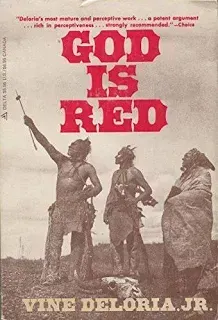
Vine Deloria Jr.'s God Is Red: A Native View of Religion, first published in 1973 and substantially revised in 1992, advances a sustained and structurally coherent argument that the deepest conflict between Native American tribal religions and Christianity is not doctrinal but ontological. The disagreement is not primarily about the content of belief -- about which deity is real or which cosmology is correct -- but about the basic framework through which religious experience is organized, validated, and transmitted. Deloria's central claim is that Western Christianity has made time the fundamental category of religious meaning, while Native American tribal religions have grounded meaning in space. This distinction is not merely a cultural or philosophical curiosity. It functions as a diagnostic tool for explaining the failures of Western religious thought to account for its own history, its ecological consequences, and its systematic exclusion of non-Western religious forms. Read carefully, God Is Red argues that the privileging of time over space does not simply produce a different religion -- it produces a religion structurally incapable of accountability to the world it actually inhabits.
The distinction between temporal and spatial orientations to religious experience structures the analytical work of the entire book. Western European identity is organized around the assumption that time proceeds linearly and that a particular people -- first the Hebrews, then Christians, then Western Europeans -- have been appointed as the guardians of that temporal unfolding. This is not simply a theological claim; it is, as Deloria demonstrates, the ideological scaffolding for the Crusades, the Age of Exploration, imperialism, and Cold War containment doctrine. The temporal framework gives Western civilization its sense of direction, its claim to universal relevance, and -- critically -- its capacity to abstract moral consequence away from any specific place. When history is the primary category, particular lands and the particular communities that inhabit them become secondary to the forward movement of a divinely sanctioned narrative. For tribal religions, by contrast, the sacred is always somewhere: a mountain, a river, a plateau that concentrates the community's religious experience and orients all of its ethical and ceremonial life. Deloria writes that "the vast majority of Indian tribal religions have a sacred center at a particular place" and that this center "enables the people to look out along the four dimensions and locate their lands, to relate all historical events within the confines of this particular land, and to accept responsibility for it." The language of responsibility here is precise. Spatial grounding is not merely aesthetic or sentimental; it is the structural basis for a form of accountability that temporal religion cannot generate.
The question of what kind of deity a spatially or temporally oriented religion produces is not incidental to this argument. Deloria observes that the Judeo-Christian God exhibits what can only be described as a distinctly human personality structure -- not in the sense of anthropomorphic projection that comparative religion typically diagnoses, but in the more troubling sense of emotional instability and moral inconsistency. This deity monitors behavior, keeps records of transgressions, throws fits of anger over real or perceived slights, and -- as Deloria notes in response to Oral Roberts's televised threat that God would "call him home" if he failed to raise ten million dollars -- eventually resorts to extortion as a motivational strategy. The point is not comic, though Deloria allows it its humor. The point is diagnostic: a deity modeled on an immature human personality produces a religion oriented around fear and compliance rather than around reciprocal relationship with the world. The contrast with tribal conceptions of Wakan Tanka -- where, as the Sioux Shooter described it, the creator taught each species its specific purpose, making diversity not a problem to be overcome but the deliberate design of a genuinely ordering intelligence -- is structural rather than sentimental. Tribal religions, by treating the sacred as present and distributed across the natural world rather than as a sovereign personality administering a linear historical project, generate a different kind of moral relationship to creation.
Christianity's treatment of creation as a specific past event -- the stage-setting for the drama of sin and redemption -- has consequences that flow directly from the logic of the temporal framework rather than from any particular bad intention. If creation is primarily an event that happened, then the natural world is primarily a backdrop. It has no ongoing sacred status of its own; its significance derives from its role as the theater of human moral history. The Genesis mandate to subdue the earth, as Harvey Cox articulates it, expresses this logic clearly: the earth is an object of human dominion, not a community of relatives with whom one stands in reciprocal obligation. Deloria contrasts this sharply with the tribal understanding as expressed by figures including Young Chief of the Cayuse, who refused to sign the Treaty of Walla Walla on the grounds that the land itself had not been represented in the transaction. The difference is not merely one of sentiment. Tribal religions, by treating creation as an ongoing ecosystem rather than a past event, generate a structural framework in which accountability to the natural world is not optional but constitutive of religious identity.
Christianity's commitment to linear history has also produced an interpretive framework that systematically distorts both its own sacred record and the records of others. Tribal religions generally did not organize their validity around specific historical events requiring uncritical belief. Ceremonies and the powers they conveyed were what mattered; whether a culture hero existed at a precisely dateable moment was irrelevant to whether the ceremony worked for the community in the present. Christianity, by contrast, has staked its entire theological structure on the historical accuracy of a linear sequence running from creation through the fall of Adam to the crucifixion and resurrection of Jesus. The problem, as Deloria documents through reference to theologians including Rudolf Bultmann, Harvey Cox, Theodor Gaster, and Johannes Pedersen, is that Christian scholars have progressively retreated from the historical claims that their theology requires. Gaster characterizes the Exodus account as more romantic saga than accurate record; Pedersen argues it is a cultic legend meant to glorify the Jewish people rather than a description of actual events; Cox, attempting to ground God's activity in history through social change, relies on the Exodus and Easter as interpretive lenses while his own footnotes disclaim commitment to their historical reality. Deloria's diagnosis is precise: "This dilemma over the nature of history occurs and will occur whenever a religion is divorced from space and made an exclusive agent of time." When events lose their spatial particularity -- when the Red Sea is no longer a specific body of water at a specific place where something specific happened -- they become symbolic teaching devices, and the religion that depends on them loses its capacity to make any claim that could be falsified, confirmed, or held accountable to the material world.
The institutional consequences of this commitment to temporal uniformitarianism are visible not only in Christian theology but in the Western scientific establishment. Deloria's extended engagement with the work of Immanuel Velikovsky functions as a case study in what happens when spatial and multi-perspectival evidence is taken seriously as a source of knowledge. Velikovsky's central claim – that global catastrophes of planetary scale occurred within historical memory and that the legends of peoples around the world record these events from different geographical positions – is significant for Deloria not primarily because it vindicates biblical narrative but because it illustrates what the temporal framework systematically excludes. The rock paintings in the American Southwest that record the 1054 supernova, the Makah legend of the sea withdrawing and returning as a tidal wave, the Hopi accounts of world destructions corresponding to changes in the earth's rotational axis – these are spatially specific observations by communities rooted in particular places, preserved because those communities had no ideological investment in the uniformitarian assumption that the world has always operated as it does today. The institutional suppression of Velikovsky – the boycott of his publisher, the theft of his predictions without credit, the silence of theologians who might have found in his work a vindication of biblical historical claims – parallels the institutional suppression of tribal religious knowledge. Both are excluded not because they are demonstrably false but because they do not conform to the reigning interpretive framework.
What Western interpreters have habitually called creation myths may not be creation stories at all -- they may be collective memories of catastrophic historical events, preserved by communities that survived them and whose spatial rootedness allowed them to encode the memory with geographical precision. The Hopi account of four successive world destructions, each associated with a specific direction and a specific form of catastrophe, is not, in Deloria's reading, a primitive cosmogony. It is a longer and more comprehensive record of planetary history than anything preserved in Near Eastern religious traditions, which appear to reach back only as far as what Deloria suggestively identifies as the third Hopi world. The implication is radical: tribal religions may be not only equally valid but empirically richer than Western religious traditions, preserving memories of events that the Western uniformitarian assumption has rendered invisible.
The treatment of human personality within each framework reinforces this structural divergence. Western Christianity has become accustomed to defining religious experience as involving a radical change in personality -- the conversion event that reconstitutes the self at its foundations. This assumption reaches its greatest intensity in American evangelical culture, where becoming a Christian is understood to involve a fundamental transformation of the human being's constitution. Tribal religions do not operate this way. Rather than demanding personality reconstitution, they encompass within the tribal cultural context many of the same behavioral patterns that Christianity claims as distinctively Christian. The distinction matters because the Christian emphasis on individual conversion generates a religion oriented around the interior state of the individual believer, while tribal practice remains oriented around the community's collective relationship to its specific place. The early Christian expectation of imminent world-ending judgment -- which drove the urgency of the conversion message through Paul's articulation of cosmic redemption -- has never been fully abandoned, even as its timeline has been repeatedly deferred, and this expectation continues to shape the individualist and anti-ecological character of much American Christianity.
The communal dimensions of religious life that tribal traditions preserve are precisely what American Christianity has progressively eroded. The present tendency in Christian religion is to interpret religious experience as a wholly individual phenomenon -- to focus on getting right with God on a personal basis while largely neglecting the social conditions of the nations and communities in which believers live. This individualism is opposed to another tradition within Christianity that has always placed heavy emphasis on the church as a community of the saved, but in its American expression the individualist trajectory has largely prevailed. The consequence is a religious form that generates intense private conviction while remaining structurally unable to produce the kind of collective accountability to specific places and communities that tribal religious life has always maintained. When the tribal chief and warrior refused to treat land as a commodity to be sold, this was not mere stubbornness -- it was the expression of a religious framework in which land cannot be alienated because the community's religious identity is constituted by its relationship to it.
The trauma of European contact with the New World exposed the internal contradictions of the Christian temporal framework with particular force. The theological question was genuine and acute: what were devout thinkers to make of the existence of millions of people living on lands larger than Europe? Did God have a purpose for these peoples? Could Jesus return until all nations had heard the gospel? The Christian reaction to these questions, as Deloria documents, was one of unmitigated greed reframed as theological obligation. Having been blocked by Muslim forces in their attempts to reach the Near East and facing the financial pressures of newly established monarchies, the kings of Europe saw in the New World an inexhaustible revenue source. The Christian church, its political power waning against strong European rulers, saw the invasion of new lands as a means of maintaining itself through the imprimatur of exploitation. The Doctrine of Discovery, which granted Christian nations the right to claim lands occupied by non-Christian peoples, was not a perversion of Christian theology applied to an exceptional situation. It was the direct and logical expression of a temporal framework that had already decided, in advance, who was participating in the meaningful movement of sacred history and who was not.
The practical consequences of this framework for the management of tribal religious life have been sustained and systematic. Following forced removal to reservations in the 1870s and 1880s, the Bureau of Indian Affairs -- staffed in large measure by Christian zealots serving as Indian agents -- prohibited many of the traditional religious rituals by which tribal communities maintained their relationship to their sacred places. Tribes adapted with considerable ingenuity, shifting ceremonial calendars to coincide with national holidays and Christian feast days, explaining to curious whites that they were simply celebrating Christmas or honoring George Washington while conducting ceremonies that had nothing to do with either. Sacred sites that had been displaced from reservation homelands remained accessible because settlers had not yet found them economically useful. That buffer has steadily eroded. The post-World War II expansion of corporate farming, mining, timber extraction, and the recreation industry has placed formerly marginal lands under multiple competing uses, and the new generation of federal and state bureaucrats -- oriented toward developers and recreation interests rather than toward the informal arrangements that tribal religious leaders had worked out with their predecessors -- has established increasingly restrictive rules for managing public lands that systematically disadvantage ceremonial access to sacred sites. The dispossession is ongoing, and it operates through the logic of the temporal framework: the land's significance is understood through its economic productivity and recreational utility, not through the community relationships to specific places that constitute tribal religious identity.
The comparison between American Christianity and tribal religions in their contemporary forms is not, in the end, a competition between functional equivalents. American Christianity in particular appears to be a willing captive of American culture, functioning primarily as a buttress of official folklore and patriotism rather than as a source of critical perspective on the society it inhabits. The Jesus Movement, which Deloria addresses as the most publicized Christian development of recent decades, emerged not from any theological renewal but from the need of young people exhausted by drugs to find a substitute high. Whether these young people were tired of drugs or whether drugs were simply in short supply may be, as Deloria observes, a thesis for a future sociologist. What is clear is that the movement had no theological basis of any depth, and that its characteristic complete fanaticism -- modeled on the earlier flower children and Civil Rights and antiwar movements -- was celebrated by evangelists as the greatest development in religion in recent years without any apparent awareness of what it revealed about the relationship between the religion and the culture it was supposedly transforming. Tribal religions, facing the same modern pressures, confront a more fundamental question: whether the very existence of an Indian community in the modern electronic world requires a massive effort of translation between traditional religious values and the phenomena those values must now address. The cold milk dilemma -- where children accustomed to cold milk from school require the pueblo to install electricity, which will violate the religious life of the community -- is not trivial. It illustrates the depth at which the question of continuity operates, and the extent to which tribal religious life has always been constituted by the specific material conditions of specific places rather than by portable doctrines that can be transported across any environment.
Deloria makes explicit at the book's conclusion what the preceding analysis has established structurally. The comparison between tribal and Christian religious concepts does not imply that tribal religions are necessarily correct simply because Christianity is inadequate. The question is diagnostic: given that Western civilization faces simultaneously an ecological crisis, a crisis of cultural meaning, and a crisis of institutional religious credibility, which interpretive frameworks offer genuine resources for reorientation? Deloria's answer is that any framework adequate to the present situation must shift from time to space as its primary category -- from the abstraction of historical progress to the concreteness of particular places and the communities that hold responsibility for them. This is not nostalgia; Deloria is explicit that the old tribal religions may not survive prolonged exposure to modern conditions. The point is structural. The problem of contemporary people is the problem of piercing the veil of unreality to recover a sense of genuine existence in specific places. That recovery, if it is possible at all, requires abandoning the assumption that time and its forward movement exhaust the possibilities of religious meaning. God Is Red is, at its core, an argument that a religion incapable of staying in one place long enough to be accountable to it is a religion that has already evacuated the conditions of its own validity.



Member discussion