11 min read

Nothing To See Here

Twenty weeks of training to get the badge. After that, no obligation to record what you do with it, and no external mechanism that will notice a pattern unless someone already knows which pattern to look for.
Nothing To See Here
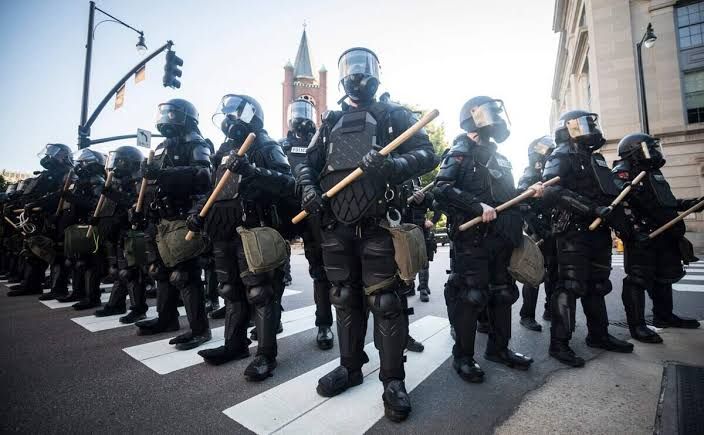
Wilmington, NC Police LARPing as stormtroopers.
North Carolina: where it takes longer to become a barber than it does a police officer. And one of them gets a gun.

By Matt Stone

To cut hair for money in this state, you complete roughly 1,528 hours of classroom instruction and then serve an apprenticeship. North Carolina wants to be sure about you before it lets you near somebody with scissors.

To carry a gun, stop a car, order a citizen out of it, search the vehicle, put hands on the driver and take that person to jail, you complete Basic Law Enforcement Training. The Commission mandated course runs 868 hours, about twenty weeks. Until recently the requirement was 640.

That comparison usually gets made and then dropped, as though the point were about training. It isn't. The front end of this system was never the safeguard. The back end was, and on July 1 the back end was deleted.

Not weakened. Not reformed. Lifted out of a list of five statutes, one at a time, and killed.

What the statute did

For twenty six years, every traffic stop in North Carolina generated a record separate from any citation. G.S. 143B-903 required it: the alleged violation, whether a search followed, whether an arrest followed, whether property was seized, whether force was used.

The mechanics mattered as much as the categories. Every officer covered by the law was assigned an anonymous identification number by his own agency. That number was a public record. The link between the number and the officer's name was not, and could only be pried loose by court order in a case where it was actually at issue. Agencies had sixty days after the close of each month to submit. An agency that failed to submit became ineligible for any state law enforcement grant until it complied. Every December, the state published the list of officers who would be covered the following year.

That is not a paperwork requirement. That is an accountability architecture, with a privacy protection for officers built into it and a funding penalty behind it.

North Carolina was the first state in the country to build one. It ran continuously from January 2000, expanded two years later to every sheriff's office and nearly every municipal department.

Follow the bill

Here is the part that has not been reported, and it is available to anyone willing to open two PDFs.

Senate Bill 257 was filed in March 2025 as the 2025 Appropriations Act, sponsored by Senators Brent Jackson, Ralph Hise and Michael Lee, with Norman Sanderson as cosponsor. It passed the Senate in April, passed the House in May, and the Senate refused to concur on June 3. Conference committees were appointed in both chambers by June 5, 2025.

Then the record stops. The next public text is the ratified bill, a year later.

The Sixth Edition, dated May 22, 2025, is the last version anyone outside that room got to read. It contains a reorganization moving a cluster of criminal justice reporting statutes from the Department of Public Safety to the State Bureau of Investigation. Section 20.3(p) of that edition recodifies five statutes:

143B-901 becomes 143B-1208.15. 143B-902 becomes 143B-1208.16. 143B-903 becomes 143B-1208.17. 143B-904 becomes 143B-1208.18. 143B-905 becomes 143B-1208.19.

Section 20.3(s) then rewrites the traffic statistics statute in its new home, swapping "Department of Public Safety" for "State Bureau of Investigation" and leaving every operative requirement standing. The anonymous officer numbers. The sixty day submission window. The grant ineligibility penalty. The annual published list.

As of May 22, 2025, the General Assembly was not eliminating this requirement. It was carefully maintaining it and handing it to a new agency.

Now open the ratified bill and read the same table.

143B-901 becomes 143B-1208.15A. 143B-902 becomes 143B-1208.16. 143B-904 becomes 143B-1208.18. 143B-905 becomes 143B-1208.19.

One entry is gone.

143B-903 does not appear anywhere in the reorganization. It appears on page 448, under its own heading, in language nobody could mistake:

REPEAL LAW ENFORCEMENT TRAFFIC STATISTICS REPORT. Section 19.4(a). G.S. 143B-903 is repealed.

Every statute that sat beside it in that list survived and got a new number. That includes 143B-904, the requirement that agencies report on law enforcement use of deadly force, which is alive today at 143B-1208.18.

Somebody went into a working reorganization of five reporting statutes and removed exactly one. In conference. With no public draft, no committee vote, no amendment, and no name attached.

The repeal section carries no effective date of its own, so it falls under Section 45.8 at the end of the act: except as otherwise provided, the act becomes effective July 1, 2026. The General Assembly ratified the bill on July 2 and the Governor signed it on July 7. The requirement was already gone by the time either of them touched it.

State Representative Marcia Morey, a Durham Democrat and former District Court judge, learned about it from a reporter. So did colleagues of Congresswoman Alma Adams, who was serving in the North Carolina House when the original law passed in 1999. Adams asked the only question that matters: "Why was it secretly done?"

What is actually left

Strip the database out and inventory what remains as a check on the most common encounter between an ordinary person and the armed power of the state.

Body worn and dash camera footage. Orange County Sheriff Charles Blackwood, who wanted the reporting requirement gone, points to exactly this, and he is right that it is a good tool. But that footage is not a public record in North Carolina, release generally requires a court order, and it can only answer a question about one stop, on one day, involving one person.

Internal affairs. A complaint process run by the agency being complained about, with no external reporting obligation attached.

Civil litigation. Available in theory to everyone, in practice to people who can retain counsel, and only after the harm has already happened.

Criminal court. Where a defendant can challenge a stop, one stop at a time.

Every one of those requires you to already know which stop to ask about.

The database was the only mechanism in the structure that held officers accountable to the public. It is how anyone learned that a deputy in one county spent two years searching mostly Hispanic drivers in a place where Hispanic residents were under ten percent of the population. It is how anyone learned that an officer in a western North Carolina city searched close to half of every driver he stopped, many times the state average. Civil rights attorney Ian Mance found both patterns in the numbers, put them in affidavits, and defendants saw charges dismissed or reduced.

Nobody filed a complaint that started those inquiries. The data started them. Mance's assessment of the repeal is that showing a court a pattern of disparate enforcement becomes close to impossible without the statistics.

Frank Baumgartner, the UNC Chapel Hill political scientist who built a 2018 book from this data, says eliminating it makes it hard to document whether a problem exists at all.

The blank slate

Twenty weeks of training to get the badge. After that, no obligation to record what you do with it, and no external mechanism that will notice a pattern unless someone already knows which pattern to look for.

An officer inclined to run a bad pattern in North Carolina has a structural advantage today that he did not have in June. Not because anyone granted permission. Because the one instrument that could have caught him without a tip is switched off, and every remaining instrument needs a tip it can no longer generate.

The same is true in reverse, and this is the cost to the good ones. A department that wants to prove it is clean has lost the ability to prove it. An officer accused of profiling could once point at his own distribution and walk. Footage answers what happened in one stop. Only data answers how often.


The argument for the repeal, taken seriously

It is not frivolous and it deserves a fair hearing.

Blackwood says the system was badly built from the start, with no guidelines, no training and no oversight of how agencies filled it out, producing inconsistent and incomplete data. He says the paperwork could run fifteen minutes per stop on top of the standard report, and that it made deputies reluctant to stop anyone. The North Carolina Sheriffs' Association requested the repeal. The Association of Chiefs of Police supported it. Senate leader Phil Berger says law enforcement told him they were not using the information.

Grant all of it. The conclusion still does not follow, and the bill itself proves why. The Sixth Edition shows that the General Assembly was fully capable of opening this statute up and rewriting it. It did rewrite it. It moved the duty, updated the agency, kept the substance. A poorly built measurement was sitting right there in a form that could have been fixed with standards, training and auditing, which is what critics of the data quality have asked for since at least 2015.

Instead, between May 2025 and July 2026, in a room with no record, it was taken off the list.

And follow the chilling effect claim all the way down. If the paperwork suppressed stops, removing it produces more stops, for everyone, starting now. There is no longer any way to measure whether that happens. The state deleted the instrument that would have tested the state's own argument.

The money question, and why it has the wrong answer

In most of the country the cynical explanation is revenue. Departments write tickets, towns cash them, and anyone questioning enforcement patterns gets pointed at a budget line. That explanation is not available in North Carolina, and it never has been.

Article IX, Section 7 of the state constitution sends the clear proceeds of all fines, penalties and forfeitures for breach of the penal laws to the county school fund, to be used exclusively for public schools. Clear proceeds means the full amount collected, reduced only by actual costs of collection, capped by statute at ten percent. A city cannot keep the money. Neither can a sheriff's office. The state Supreme Court has enforced this hard enough to litigate a municipal red light camera program over it.

That single sentence is the reason North Carolina has no speed trap towns while its neighbors are full of them. Court costs are a separate matter, currently about $193 for a misdemeanor traffic offense, but those are set by the legislature and flow to state funds and the court system, not to the agency that made the stop.

The budget did not change any of this and could not have. Article IX is in the constitution, which takes a three-fifths vote of both chambers plus a statewide referendum to amend. S257 touches the Civil Penalty and Forfeiture Fund only to set allocations out of it.

So nobody in North Carolina law enforcement profits from writing more tickets, and that was true for the entire twenty six years this data was collected. Whatever explains the repeal, it is not revenue.

What money there was ran the other direction. G.S. 143B-903 said that an agency failing to submit its data became ineligible for any state law enforcement grant until it complied. That was the only enforcement mechanism the statute had, and repealing the statute repealed the penalty along with it.

Which way the camera faces

Sixteen pages later in the same document, something else happened.

Page 604 rewrites G.S. 20-183.34 to authorize the State Bureau of Investigation to place and operate automatic license plate reader systems in Department of Transportation rights of way, and requires an annual report on that use to a standing legislative committee.

Read the two provisions together.

Records of what police do to drivers: repealed, on page 448, with no reporting obligation to anyone. Records of where drivers go: authorized, on page 604, with an annual report to the General Assembly.

The legislature did not decide this category of information is unimportant. It decided which direction it should point.

The SBI is the common thread. It inherits the surviving reporting statutes. It gets the plate reader authority. And under Section 41.3, on page 537, it administers a $1,750 bonus to every sworn local law enforcement officer employed on June 30, 2026. Rank and file state employees got a bonus too, tiered down to $1,000 for anyone earning above $65,000. Sworn local officers got the full amount flat.

What happens to twenty six years of records

Nobody in Raleigh has said. Republican leadership did not respond to reporters asking what becomes of the collected data, whether the public portal stays online, or how the state plans to monitor disparities without it.

Jeff Welty of the UNC School of Government notes that nothing in the repeal prevents agencies or the Department of Public Safety from continuing to collect voluntarily, and that some departments intend to. Henry King, a deputy chief at Winston Salem State University and a former Edenton police chief, says forward thinking departments will keep collecting because the numbers tell leadership what their own enforcement actually looks like, including when it clears them.

That is a real consolation and a small one. Voluntary participation is self selected. The agencies that opt in will skew toward the ones already confident in their numbers, and the statewide comparison that made this dataset worth anything cannot be built from volunteers.

The archive is the open question, and it is the one The Grounded is pursuing. No retention schedule is attached to the repeal. No commitment exists that twenty six years of records stay public and searchable. A database nobody is required to maintain is a database that can quietly stop existing.

The people with the answer

A conference committee is a small room. The provision was not in the Sixth Edition. It was in the ratified bill. That happened in the room, and the room had names on the door.

The Senate conferees on Senate Bill 257 were Brent Jackson of Sampson County as chair, Ralph Hise of Mitchell County, Michael Lee of New Hanover County, Buck Newton of Wilson County, Tom McInnis of Moore County and David Craven of Randolph County. Jackson, Hise and Lee were also the bill's primary sponsors, which means the three men who filed the version that preserved this statute sat on the committee that deleted it.

Not one of them has explained it. Not one of them has been asked in public.

Senate leader Phil Berger has said law enforcement requested the change and that they were not using the information. The North Carolina Sheriffs' Association says it asked for the repeal. The Association of Chiefs of Police says it supported it. So three parties have confirmed a request was made, and none of them has said who carried it into conference, when, or in writing.

These are the questions, and they are not rhetorical. The Grounded has put them to all six conferees in this story.

Which conferee brought the repeal of G.S. 143B-903 into the conference report?

Why did the same bill that rewrote and preserved the statute in May 2025, suddenly delete it instead?

Why did the deadly force reporting requirement in 143B-904 survive the identical reorganization and the traffic stop requirement did not?

What happens to twenty six years of collected records; will the public portal stay online? And whether anything obligates the state to keep either.

How does North Carolina intend to detect patterns of disparate enforcement now that it has eliminated the only mechanism capable of finding one without a complaint?

Every one of those has an answer. Six senators and one Senate leader are in a position to give it.

We will print what they say. We will also print their silence.

The Grounded stands behind every factual claim it publishes with a $100 accuracy guarantee. Find an error of fact and tell us. If you are right, we pay.

Sources