Stand Your Ground
Written by Matt Stone
A Reflection on Kelly Brown Douglas’ Stand Your Ground
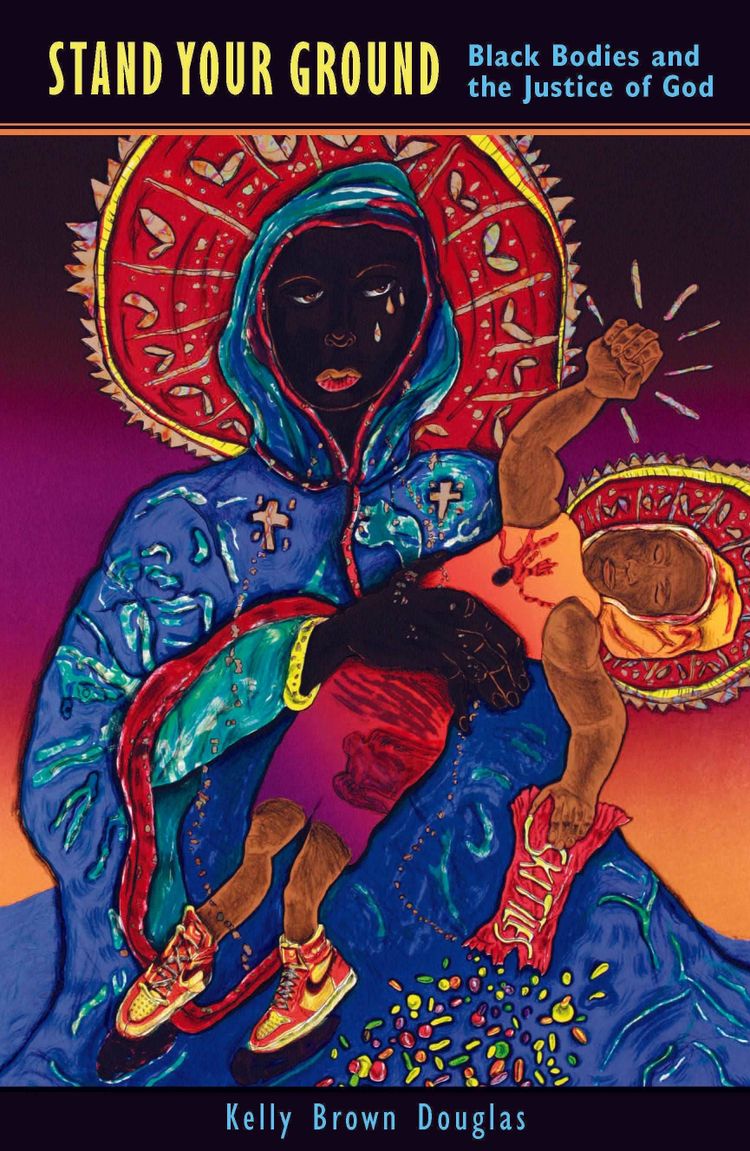
In Stand Your Ground: Black Bodies and the Justice of God, Kelly Brown Douglas constructs a sweeping theological and historical argument: that the killings of Trayvon Martin, Jordan Davis, Renisha McBride, and Jonathan Ferrell were not isolated incidents of individual racism, but the predictable, recurring product of a deep narrative woven into the fabric of American identity. The chapters selected here, covering the construction of the guilty black body, the meaning of the exodus for stand-your-ground culture, an unshattered black faith, Jesus in the face of Trayvon, stand-your-ground culture as a culture of sin, and the call to go beyond stand your ground, together form Douglas’s most essential case. Her central thesis is this: America’s narrative of Anglo-Saxon exceptionalism, religiously legitimated and historically adaptive, produces a stand-your-ground culture that marks the black body as inherently guilty, and only a God of radical freedom, encountered in the cross and the exodus, can name this culture as sin and point toward its dismantling. Reading these chapters together, one encounters not simply a work of academic theology but a sustained act of prophetic witness in the tradition Douglas herself describes.
The chapter on the guilty black body is the intellectual foundation of the entire book, and it deserves sustained attention. Douglas traces how the black body came to be constructed as chattel, hypersexual, and dangerous through an interlocking system of natural law theo-ideology, religio-scientific discourse, and what Michel Foucault calls discursive power. Douglas shows that the construction of black guilt was never accidental. It was willed into existence by power in order to sustain white supremacy.
The argument is devastating in its precision: because natural law theory identifies “the way things are” with “the way God intends things to be,” a social order built on black subjugation became, in the hands of proslavery advocates, nothing less than divine ordinance. Vice President of the Confederacy Alexander Stephens stated plainly that “slavery, subordination to the superior race, is his natural and moral condition,” and that any arrangement otherwise was a violation of God’s creative design. A free black body was therefore not merely a legal or social threat: it was, within this theo-ideological framework, a theological affront to eternal law itself.
This is why, Douglas writes, “free black bodies have to be guilty of something.” The transformation from chattel to criminal—accomplished through Black Codes, vagrancy laws, the War on Drugs, and the Prison Industrial Complex—is Douglas’s most chilling demonstration of what Michelle Alexander calls racism’s adaptability. The Georgia vagrancy law she cites, which effectively criminalized black existence by punishing anyone “without visible and known means of a fair, honest, and respectable livelihood,” illustrates precisely how a legal code can be race-neutral in language and wholly racial in function. When Douglas describes this as “preservation through transformation,” she is naming something that every subsequent generation of stand-your-ground culture has relied upon: the capacity to maintain the structural subordination of black bodies while retiring the explicit vocabulary of white supremacy.
The media’s role in forging the link between blackness and criminality, from the darkened O. J. Simpson Time cover to the treatment of Rachel Jeantel during the Trayvon Martin trial, represents the twenty-first-century version of the religio-scientific discourse that Agassiz and his contemporaries provided in the nineteenth. The machinery of guilty-body construction has not stopped; it has simply changed its instruments. What gives this historical analysis its theological urgency is Douglas’s insistence that the black faith tradition has always offered a counternarrative. The chapter on the meaning of the exodus brings this into sharpest relief.
The enslaved did not read the exodus story as an exclusivist claim on divine favor. They read it as a universal declaration: God acts first, on behalf of those in bondage, because bondage is contrary to the freedom that is God’s own essence. As Douglas explains through the testimony of ex-slave Reverend Reed, what moved God in the exodus was not the ethnicity of the Israelites but their condition. The God who says “I am who I am” refuses to be captured by any particular people’s self-serving narrative. God’s identity is not a static noun but a verb, an ongoing movement in history that is always in the direction of freedom.
This reading has direct consequences for the national faith claims Douglas critiques throughout the book. If Anglo-Saxon exceptionalism rests on the premise that God chose a particular racial-national people to establish a righteous civilization, the exodus story, read on its own terms, demolishes that claim. God chose the Israelites not because of their blood but because they were in bondage. The enslaved understood this universality with clarity, singing that if God delivered Daniel, then “why not-a every man.”
Douglas is also careful here not to romanticize the exodus uncritically. Following womanist theologian Delores Williams, she acknowledges the troubling dimensions of a God who later sanctions the destruction of the Canaanites, and she argues that a black faith tradition committed to the freedom of God cannot grant theological authority to biblical stories that contradict that freedom. This is one of the most intellectually honest moves in the book: the norm of black faith, God’s preferential option for freedom, is not simply applied to critique America’s exceptionalism but turned inward as self-critique.
The black faith community, Douglas argues, must be held accountable to its own central claim, which means refusing to replicate the logic of Manifest Destiny that victimized Native Americans, even when biblical texts might seem to sanction such violence. The Jesus story serves as the “new exodus” that corrects these distortions: in Jesus, God’s solidarity with the marginalized is confirmed without the violent exclusions that shadow the original Israelite narrative.
The chapter on unshattered faith is, in some respects, the most personally immediate in the book. Douglas’s account of the Sunday morning after the acquittal of Trayvon Martin’s killer, when her congregation gathered in grief and anger but also in an unbroken proclamation of faith, captures something that pure historical or theological argument cannot: the lived texture of black faith as a paradoxical force. Black faith, Douglas argues, does not promise to protect black bodies from stand-your-ground violence.
It does not resolve the contradiction between the God of freedom and the reality of a world that murders children. What it does is refuse to let that contradiction be the final word. There is an inherent absurdity in black faith, Douglas admits: it speaks of freedom in the midst of bondage, of life in the midst of death. But this absurdity, she argues, is precisely what makes it indispensable. Christianity itself centers on a cross, which is nothing if not absurd. The cross is the symbol of state-sanctioned execution, and yet it is also the site where God’s love for creation is most fully revealed.
Douglas’s account of Ida B. Wells is particularly powerful here. Wells’s insistence that black people must fight for their freedom rather than wait passively for divine intervention is the activist corollary of the theological claim: if God’s freedom is the core of black faith, then the black faithful must enact that freedom in history. When Wells told twelve black men awaiting execution to stop praying about dying and start praying to live and be freed, she was not contradicting black faith, she was expressing its most demanding implication. Faith is not a quietist retreat from the world. It is a radicalizing force that refuses to accept the world’s terms as final. Tracy Martin’s declaration after his son’s killer was acquitted—“even though I am broken hearted my faith is unshattered”—is, in Douglas’s reading, a contemporary expression of the same tradition. It is not resignation. It is the courage to continue fighting for justice while holding onto the conviction that justice is ultimately God’s own nature.
Douglas’s Christological argument brings together everything that precedes it. By reading Jesus’s crucifixion through James Cone’s identification of it with lynching, Douglas establishes that Christ’s solidarity with the “crucified class” was not accidental or symbolic. It was the defining shape of his ministry. The story of Jesus and the Samaritan woman at the well is read as a paradigmatic “new exodus”: Jesus crosses into demonized space, initiates relationship with the most marginalized body in the encounter, a woman who was Samaritan, female, and ritually impure, representing the intersection of every devalued identity in her world, and restores her to sacred dignity. Douglas draws a deliberate parallel between the Jewish-Samaritan boundary and the white-black divide in a context of Anglo-Saxon exceptionalism: both are systems in which certain bodies are constructed as threatening, unclean, and unworthy of occupying certain spaces. Jesus’s decision to enter Samaritan space, to initiate conversation with the most “worthless” of all Samaritans, is a direct repudiation of every social-religious narrative that constructs bodies as inherently dangerous or inferior. On the cross, Jesus empties himself of all pretensions to privilege or exceptionalism, and in so doing identifies completely with those whom stand-your-ground culture would place on the wrong side of the gun.
The implication for the church is direct and uncomfortable. A church that remains silent in the face of stand-your-ground murders—as Pastor Michael Bledsoe told the white churches of Florida with his repeated “Shame. Shame. Shame.”—is not simply failing in social justice. It is betraying the memory of the one it claims to bear. Remembering Jesus is not a mental recollection but a reenactment, a living-into his solidarity with the crucified in one’s own time and context. The cross, in this framework, is simultaneously a judgment on stand-your-ground culture, exposing it as a culture of death antithetical to everything God stands for, and a call to the church to cross over into the space of those who don’t know “whether to walk slow or walk fast in order to stay alive.” The question “Where was God when Trayvon was slain?” receives Douglas’s answer in the form of a rewritten Matthean passage: on a Florida sidewalk, on a Michigan porch, on a street in North Carolina. As it was done to these young black bodies, it was done to Christ.
Stand-your-ground culture, Douglas argues, is precisely that: a culture of sin. She highlighted America’s culture of unsympathetic understanding—the inability to places oneself in someone else’s shoes. When Matt Lauer asked Trayvon Martin’s parents whether they thought their son’s death might have been God’s plan, or whether they had considered his killer a victim, he exemplified exactly this unsympathetic understanding. It is not merely a personal moral failure; it is the product of a culture that systematically denies the humanity of certain bodies.
Sin, in Douglas’s theological framework, is that which alienates humans from the ways and will of God, from the life-giving freedom that is God’s essence. Stand-your-ground culture fosters both individual sin and structural sin. The laws Douglas names—Stand Your Ground, Stop and Frisk, Conceal and Carry, mandatory drug sentencing—are not simply unjust policies. They are structures of sin, systems that deny life and thrive on the subordination of certain bodies. America’s original sin, she argues, is not slavery itself but the narrative of Anglo-Saxon exceptionalism that produced slavery, and that will continue to produce new expressions of stand-your-ground culture until it is confronted at its root. Lincoln was right to name slavery as a sin in his Second Inaugural Address, but he could not see that the deeper sin was the exceptionalist narrative that made slavery possible—and that would survive slavery’s abolition in transformed but recognizable forms. Artificial intelligence is now automating these systems that were far from perfect in the first place. Facial recognition, recommended sentencing guidelines, and humans being removed from the decision-making process risks the continuation of an unjust system, only now there is no ability to mediate.
Douglas’ chapter in which she moves beyond stand your ground toward moral memory, moral identity, moral participation, and moral imagination, is the most forward-looking in the collection. Douglas’s grandmother’s story—a woman with a sixth-grade education who worked as an elevator operator in Columbus, Ohio, and saved from every paycheck so her grandchildren could finish high school—is offered as a parable of the black prophetic tradition: dreaming and working toward a world that does not yet exist, shaped not by the limitations of stand-your-ground culture but by the history of black witness. The concept of moral imagination, which Douglas develops through the resources of black faith, is the capacity to act and hope in ways that defy the power of stand-your-ground culture—to insist, with King, that the arc of the universe bends toward justice even when nothing immediate confirms it. This imagination is not naive optimism. It is grounded in the cross and the resurrection, in the conviction that the stand-your-ground verdict over Trayvon’s life is not the final verdict. The mothers dreaming of their children becoming Marines, aviation mechanics, or pilots are not deluded; they are exercising a prophetic moral imagination that refuses to let the narrative of Anglo-Saxon exceptionalism define what their children are worth or what they can become.
Reading these chapters together, what strikes me most is the coherence of Douglas’s method. She moves fluidly between historical analysis, theological argument, womanist critique, personal testimony, and pastoral reflection without any of these registers losing its integrity. The personal anecdotes, her son at the park, the sermon after the verdict, her daily assurances to her child that he was a child of God, are not decorative. They are epistemologically essential. They demonstrate that the theological stakes of this argument are not abstract. They are measured in the fear a mother carries for her son’s body every day he leaves the house. When Douglas describes telling her son from birth, “You are a child of God. God loves you. There is no one greater than you but God,” she is doing theology, constructing, through the resources of black faith, a counternarrative to the Anglo-Saxon exceptionalist story that would tell him otherwise.
Douglas’ work sits in a rich tradition that includes Cone, Gutiérrez, and Delores Williams, but it extends that tradition in important ways. Her genealogy of the Anglo-Saxon myth, her use of Foucault’s theory of discursive power, her engagement with Michelle Alexander’s analysis of mass incarceration, and her insistence on the adaptive, “preservation through transformation” quality of stand-your-ground culture give the argument a specificity and contemporary lens that pure theology alone could not achieve. At the same time, her theological claims are not merely instrumental. The God of freedom she describes is not simply a rhetorical resource for liberation politics. She is making a genuine claim about the nature of God: that God’s essence is freedom, that God’s movement in history is always toward the liberation of those in bondage, and that any theology that contradicts this is in breach with God.
Stand Your Ground is, finally, a work of prophetic theology in the tradition it describes: it speaks of freedom in the midst of bondage, of life in the midst of death, and it refuses to grant stand-your-ground culture the authority to define what is real or what is possible. Douglas’s grandmother worked an elevator with a hand crank and saved money from every paycheck because she believed the world would be better for her grandchildren. That belief, sustained in the teeth of Jim Crow, in the shadow of lynching, in the heart of a stand-your-ground culture that was trying at every turn to return black bodies to an unfree space, is what Douglas means by moral imagination. It is what she calls us, as readers, to embody in our own time. The Trayvons and Jordans of the present moment are waiting for a church, a nation, and a culture capable of the same.
Works Cited
Alexander, Michelle. The New Jim Crow: Mass Incarceration in the Age of Colorblindness. Rev. ed., New Press, 2012.
Agassiz, Louis. "The Diversity of Origins of the Human Races." Christian Examiner, July 1850, pp. 10–45.
Baldwin, James. The Price of the Ticket: Collected Nonfiction, 1948–1985. St. Martin's/Marek, 1985.
Berger, Peter. The Sacred Canopy: Elements of a Sociological Theory of Religion. Doubleday, 1967.
Cone, James H. The Cross and the Lynching Tree. Orbis Books, 2011.
Douglas, Kelly Brown. Stand Your Ground: Black Bodies and the Justice of God. Orbis Books, 2015.
Du Bois, W. E. B. Black Reconstruction in America, 1860–1880. The Free Press, 1935.
Foucault, Michel. The History of Sexuality. Translated by Robert Hurley, vol. 1, Vintage Books, 1990.
Gutiérrez, Gustavo. A Theology of Liberation. Translated by Sister Caridad Inda and John Eagleson, Orbis Books, 1973.
Tillich, Paul. The Courage to Be. 2nd ed., Yale University Press, 2000.
Wells, Ida B. Crusade for Justice: The Autobiography of Ida B. Wells. Edited by Alfreda M. Duster, University of Chicago Press, 1970.
Williams, Delores S. Sisters in the Wilderness: The Challenge of Womanist God-Talk. Orbis Books, 1993.
Member discussion