
What the Trump-Xi Summit Should Make Us Think About
By Matt Stone
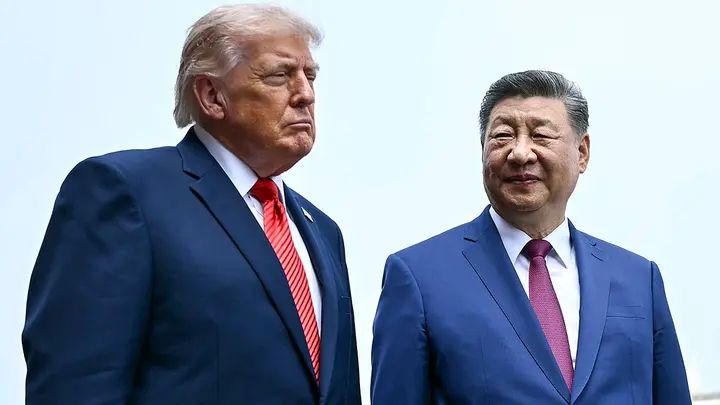
On May 13, 2026, Air Force One touched down in Beijing carrying not just a president, but a delegation that reads like a roll call of American technological power: Elon Musk of Tesla and SpaceX, Jensen Huang of Nvidia, Tim Cook of Apple, Larry Fink of BlackRock, Jane Fraser of Citigroup, and representatives from Meta, Visa, Cisco, Qualcomm, Micron, and Mastercard, among others. It was the first visit by a sitting U.S. president to China in nearly a decade.
On the surface, it looked like progress. Two superpowers, long locked in a grinding trade war that pushed tariffs past 100 percent on both sides, finally sitting down in the same room. Business leaders hopeful about market access. Diplomatic language about "mutually beneficial cooperation." A photo op at the Great Hall of the People. If you squinted, you might even call it a thaw.
And maybe it is. Diplomatic engagement between the world's two largest economies, together accounting for over 40 percent of global GDP, is not nothing. De-escalation matters. Trade wars have costs that fall hardest on ordinary people, not heads of state. If this summit produced real concessions on tariffs, stabilized supply chains, or opened productive dialogue on AI safety, those outcomes would be genuinely worth something.
But there is a context that deserves more attention than it has received, and it sits uncomfortably beneath the handshakes and the headline deals.
The Machine Behind the Curtain
In 2017, a BBC journalist named John Sudworth was given rare access to test China's surveillance network in the city of Guiyang. Police were handed a single photograph of his face. They were told to find him.
It took them seven fucking minutes.
The system they used, known variously as Sky Eye or Skynet, is a real-time detection and recognition network capable of reading faces, gender, age, and ethnicity. It can match a face to an ID card, link a person to their vehicle, and reconstruct a week's worth of movements across a city. That was nearly a decade ago, in a mid-tier Chinese city. The technology has not stood still.
By 2025, a paper published in the Chinese Journal of Lasers described a satellite-based system capable of detecting facial details as small as 1.7 millimeters from over 100 kilometers away, from space. Meanwhile, China had already become the world's largest surveillance market, with an estimated half of the world's roughly one billion CCTV cameras located within its borders. The network is not merely extensive; it is sophisticated in ways that still exceed what most democracies have deployed domestically.
The stated purposes are familiar, crime prevention, fugitive tracking, public safety, and in isolation, some of those applications are genuinely defensible. Surveillance technology is not inherently authoritarian; democratic governments use it too. The questions are who controls it, under what oversight, and toward what ends.
In China, the answers to those questions are troubling. The same network used to locate a BBC journalist in seven minutes has been used to monitor Uyghur Muslims in Xinjiang, to surveil political dissidents, and to enforce the kind of population control that the Communist Party describes as "social stability." The Sharp Eyes program, a related initiative, went so far as to allow ordinary citizens to watch live surveillance feeds from their home televisions and report on their neighbors.
The Export Problem
If this were purely a domestic story, one might argue that China's surveillance choices, however troubling, are China's to make. But it is not a domestic story.
China is now the world's largest exporter of surveillance technology, with systems deployed in more than 60 countries. Research from Harvard, Brookings, and the National Bureau of Economic Research has documented a consistent pattern: China has a comparative advantage in facial recognition AI specifically, more so than in any other frontier technology, and it disproportionately exports that technology to autocracies and weak democracies, particularly in moments of domestic unrest. When a government is struggling to maintain control over its population, Chinese surveillance infrastructure tends to show up.
This is not coincidental. Chinese surveillance companies, many of them partially state-owned, export not just cameras and software but training in their use, integration with Chinese intelligence services, and ongoing technical dependency. Critics have described this as a "digital silk road," authoritarian governance bundled with infrastructure financing. Brookings researchers have noted that introducing Chinese surveillance technology appears to correlate with subsequent declines in institutional quality in recipient countries, though establishing clean causation remains difficult.
To be fair, Western companies have not kept entirely clean hands here. Cisco was investigated by a U.S. House subcommittee in 2006 for selling surveillance technologies to China. Oracle reportedly pitched predictive policing tools to Chinese public security agencies. The UK exported telecommunications interception equipment to Saudi Arabia and the UAE. Surveillance technology as a category has a long history of crossing borders in ways that its original sellers may not have fully considered.
But scale and intent matter. And the scale of China's surveillance apparatus, combined with the government's explicit use of it against ethnic and religious minorities, puts this in a category of its own.
The Taiwan Question
And then there is Taiwan.
Taiwan is a self-governing democratic island of 23 million people that Beijing has claimed as its own territory for decades, never renouncing the use of force to bring it under mainland control. The United States has for 70 years maintained a policy of "strategic ambiguity" on the question, officially acknowledging Beijing's position without endorsing it, selling weapons to Taiwan for its self-defense, and deliberately leaving unanswered whether American forces would intervene in the event of a Chinese attack. The ambiguity was never comfortable, but it was intentional: keeping Beijing uncertain about U.S. intentions has been one of the primary deterrents to military action.
Xi opened the summit by placing Taiwan at the center. He called it "the most important issue in China-U.S. relations" and warned Trump that mishandling it could push the two countries into "clashes and even conflicts." He told Trump that Taiwan independence and peace in the Taiwan Strait "are as irreconcilable as fire and water."
What followed was notable. Trump, speaking to Fox News as his visit concluded, warned Taiwan against declaring formal independence and questioned whether the United States should travel 9,500 miles to fight a war over the island. "I'm not looking to have somebody go independent," he said.
This is not, on its face, a radical departure from official U.S. policy. The United States has never formally supported Taiwanese independence, and the Taiwan Relations Act commits Washington to providing defensive weapons without explicitly guaranteeing military intervention. Trump's statement did not change that legal framework.
But words from a sitting president carry weight that legal boilerplate does not. For decades, strategic ambiguity worked because neither Beijing nor Taipei could fully read Washington's intentions. A president publicly musing about whether American forces would show up, in the immediate aftermath of a summit where he called Xi a "great leader" and "friend," does something to that ambiguity. It tilts it. And for Taiwan, a democracy that has lived for 70 years under the shadow of potential invasion, the tilt is not a small thing.
Taiwan's foreign minister sought to project calm, calling the country a "guardian of peace and stability" and pointing to Chinese military pressure as the main source of regional risk. Taiwanese officials cited reassurances from Secretary of State Marco Rubio that U.S. policy remained unchanged, but reassurances issued after a presidential statement have a way of feeling like cleanup rather than policy.
The picture that emerges from the full scope of the summit, tech executives pledging to deepen business with a surveillance state, potential relaxation of chip export controls, and a president publicly distancing himself from Taiwan's defense, is not one of American strength projecting itself onto Beijing. It is something closer to the opposite.
What the Summit Should Make Us Ask
Which brings us back to Beijing, and to the room where American technology executives shook hands with Xi Jinping and told him, in the words reported by China's state-run Xinhua, that they "highly value the Chinese market" and "hope to deepen their business operations in China."
None of this is necessarily sinister on its own. Apple has manufacturing operations in China that employ enormous numbers of people. Nvidia's chips underpin AI development globally, and China represents a significant market. Boeing needs aircraft sales. These are not trivial commercial interests, and the executives who traveled to Beijing have obligations to their shareholders, their employees, and their supply chains.
But the presence of the world's most powerful technology companies in a room with a government that has built, and continues to refine, the most sophisticated surveillance state in human history raises questions that deserve to be asked clearly.
The U.S. has used export controls on advanced chips as one of its primary tools for maintaining technological leverage over China. Stanford's annual AI index concluded this year that "the U.S.-China AI model performance gap has effectively closed." Against that backdrop, the summit produced signals that the administration may be willing to relax chip export restrictions in exchange for market access and revenue sharing. Trump had already cleared the way for Nvidia to sell its more powerful H200 chips to China for a 25 percent cut of revenue.
The worry is not that engagement itself is wrong. The worry is about what gets traded away in the process of engagement, and whether the executives in that room, whose companies build the tools that define modern surveillance, commerce, and communication, are negotiating from a position of principle or a position of appetite.
Jensen Huang called the meeting in Beijing "one of the most important summits in human history." He may be right. The question is what kind of history it ends up making.
All The Cards
In the aftermath of the summit, at least one Fox News analyst argued that Trump held "all the cards" in negotiations with Beijing, and that China had none. The rare earth record tells a different story. When China imposed its strictest ever export controls on rare earth materials in 2025, aerospace manufacturers in the United States reported shortages severe enough that some faced potential production pauses. Exports of yttrium alone dropped from 333 tons to 17 tons in the span of eight months.
The controls were eventually paused, but a pause is not a concession. The legal architecture remains intact, the licensing requirements are still in place, and the suspension expires in November 2026. As one policy analyst put it, China is "signaling stability while preserving escalation options." That is what leverage looks like. It is not the posture of a country with no cards.
Rare earths are only one hand in a much longer game. Since 2013, China has quietly built what may be the most ambitious infrastructure project in human history. The Belt and Road Initiative, Xi's modern Silk Road, now encompasses roughly 150 countries, whose combined populations account for nearly 75% of the world and over half of global GDP. It is not merely a construction program. Embedded within it is the Digital Silk Road, which finances telecommunications networks, cloud infrastructure, and surveillance technology across dozens of nations, the same surveillance model discussed earlier in this piece, now being exported as a feature of economic partnership. BRI engagement hit record highs in 2025. A country executing the largest infrastructure buildout in modern history, at record pace, while simultaneously restricting the minerals American aerospace manufacturers need to stay in production, does not fit the description of a party with nothing to negotiate with.
Then there is the Asian Infrastructure Investment Bank, Beijing's answer to the World Bank, which it founded in 2016 over explicit American objections. The AIIB now counts 111 members across six continents and has invested nearly $70 billion across more than 350 projects. Its membership includes France, Germany, the United Kingdom, Australia, and South Korea, some of Washington's closest allies, who joined anyway. Only the United States, Japan, and Mexico are not members. China holds 27% of the voting power, more than three times the share of the next largest member. The institution is AAA-rated and growing. Whatever one thinks of China's long-term trajectory, a country that has built a rival multilateral financial institution, one that now includes most of the Western alliance's members, is not a country that showed up to Beijing empty-handed. And yet that is precisely the claim that followed Trump home from Beijing.
The same analyst insisted Trump would never trade away support for Taiwan in exchange for Chinese cooperation on Iran. Trump, speaking to Fox News aboard Air Force One before he even left Beijing, said: "I'm not looking to have somebody go independent. We're supposed to travel 9,500 miles to fight a war. I'm not looking for that." The president's own words, offered without prompting, are difficult to square with the claim that Taiwan's security was never on the table.
Holding Two Things at Once
It is possible to believe that diplomatic engagement between the U.S. and China is necessary, even urgent, and still find the specific optics of this summit unsettling. It is possible to acknowledge that trade relationships create interdependencies that can reduce the likelihood of conflict, while also noting that those same interdependencies can blunt the willingness to confront abuses.
It is possible to think that the tech executives in Beijing are individually decent people making rational decisions within the constraints they face, and still worry about what their collective presence signals: that the world's most powerful technology companies have concluded that Chinese market access is worth more than the leverage that distance might provide.
And it is possible, perhaps even necessary, to keep asking what kind of surveillance infrastructure the companies in that room might be enabling, directly or indirectly, through the business they hope to do. And to ask what a democracy of 23 million people is supposed to make of a superpower that has guaranteed their security for 70 years, and that just sent its president to Beijing to call their most powerful antagonist a "great leader" and a "friend."
The cameras above Guiyang are still running. It still takes seven minutes. The question is who else, and where else, that clock is now ticking.
- Worldcrunch. "How China's Mass Surveillance Fuses High Tech and Citizen Snitching." May 24, 2025. https://worldcrunch.com/tech-science/mass-surveillance-in-china/
- Sustainability Times. "'Eyes in the Sky': China's Latest Spy Satellite Captures Faces from Space with Unprecedented Clarity." March 28, 2025. https://www.sustainability-times.com/reports/eyes-in-the-sky-chinas-latest-spy-satellite-captures-faces-from-space-with-unprecedented-clarity-revolutionizing-surveillance/
- TechCrunch. "China's CCTV Surveillance Network Took Just 7 Minutes to Capture BBC Reporter." December 14, 2017. https://techcrunch.com/2017/12/13/china-cctv-bbc-reporter/
- Center for Security and Emerging Technology (Georgetown). "China's 'Sharp Eyes' Program Aims to Surveil 100% of Public Space." March 2, 2021. https://cset.georgetown.edu/article/chinas-sharp-eyes-program-aims-to-surveil-100-of-public-space/
- Beraja, Martin, et al. "Exporting the Surveillance State via Trade in AI." Brookings Institution / NBER. 2023. https://www.brookings.edu/articles/exporting-the-surveillance-state-via-trade-in-ai/
- Wilson Center. "Assessing the Global Impact of Chinese Surveillance Technology." https://www.wilsoncenter.org/microsite/2/node/93796
- The Conversation. "China Is Accused of Exporting Authoritarian Technology. But the West Has Done So, Too, More Covertly." https://theconversation.com/china-is-accused-of-exporting-authoritarian-technology-but-the-west-has-done-so-too-more-covertly-168190
- Nextgov/FCW. "Chinese Firms Exporting Surveillance Tools Across the Globe, Report Says." July 2023. https://www.nextgov.com/policy/2022/10/chinese-firms-exporting-surveillance-tools-across-globe-report-says/378592/
- Al Jazeera. "Who Are the US CEOs in China with Trump, and What's in It for Them?" May 14, 2026. https://www.aljazeera.com/news/2026/5/14/who-are-the-us-ceos-in-china-with-trump-and-whats-in-it-for-them
- CNBC. "Trump in China: President Lands in Beijing with Tesla, Nvidia CEOs." May 13, 2026. https://www.cnbc.com/2026/05/13/trump-china-xi-beijing-meeting-ceos.html
- CNBC. "Xi Tells Musk, Tim Cook and Other CEOs on Trump's Trip: China Will 'Open Wider.'" May 14, 2026. https://www.cnbc.com/2026/05/14/xi-china-open-us-business-ai-chips.html
- Fortune. "CEOs Join Trump in China as AI Takes Priority Over Trade Deals." May 13, 2026. https://fortune.com/2026/05/13/trump-china-trip-ceos-ai-trade/
- Euronews. "Trump in China: Can America Keep Up in the AI Cold War?" May 13, 2026. https://www.euronews.com/next/2026/05/13/trump-xi-summit-chips-may-be-off-the-table-but-ai-warfare-will-likely-feature-in-china
- Council on Foreign Relations. "How Trump Should Approach AI Talks With China." May 13, 2026. https://www.cfr.org/articles/how-trump-should-approach-ai-talks-with-china-targeted-dialogue-maximum-pressure
- NPR. "China's Leader Warns Trump That Differences Over Taiwan Could Lead to a Clash." May 14, 2026. https://www.npr.org/2026/05/14/nx-s1-5822168/trump-xi-summit
- France 24. "Trump Warns Taiwan Against Declaring Independence from China After Meeting Xi." May 15, 2026. https://www.france24.com/en/asia-pacific/20260515-trump-warns-taiwan-against-declaring-independence-from-china-after-meeting-xi
- Kyiv Post. "Trump Signals Shift on Taiwan, Warns Against Independence After China Summit." May 15, 2026. https://www.kyivpost.com/post/76245
- RTE. "Trump Warns Against Taiwan Independence After China Visit." May 15, 2026. https://www.rte.ie/news/world/2026/0515/1573441-us-china-summit/
- CSIS. "China's New Rare Earth and Magnet Restrictions Threaten U.S. Defense Supply Chains." October 2025. https://www.csis.org/analysis/chinas-new-rare-earth-and-magnet-restrictions-threaten-us-defense-supply-chains
- CSIS. "Rare Earth Export Restrictions One Year Later." May 2026. https://www.csis.org/analysis/rare-earth-export-restrictions-one-year-later
- Rare Earth Exchanges. "China's Rare-Earth Reprieve Comes With a Catch." April 2026. https://rareearthexchanges.com/news/chinas-rare-earth-reprieve-comes-with-a-catch/
- War on the Rocks. "The Burn and the Choke: Why Semiconductor Controls Will Outlast China's Rare Earth Weapon." January 2026. https://warontherocks.com/the-burn-and-the-choke-why-semiconductor-controls-will-outlast-chinas-rare-earth-weapon/
- Fortune. "China to Suspend Some Rare Earth Curbs, Probes on U.S. Chip Firms." November 2025. https://fortune.com/2025/11/01/china-rare-earth-export-curbs-suspension-probes-us-chip-firms/
- Green Finance & Development Center (Fudan University). "Countries of the Belt and Road Initiative." 2025. https://greenfdc.org/countries-of-the-belt-and-road-initiative-bri/
- International Institute for Sustainable Development. "Navigating the Belt and Road Initiative." 2026. https://www.iisd.org/new-belt-and-road-initiative-small-yet-smart
- Asian Infrastructure Investment Bank. "About AIIB." https://www.aiib.org/en/about-aiib/index.html
- Congressional Research Service. "Asian Infrastructure Investment Bank." https://www.congress.gov/crs-product/IF10154
- Euronews. "China Gives Up WTO Developing Country Status as Tariff Tensions Linger." September 24, 2025. https://www.euronews.com/business/2025/09/24/china-gives-up-wto-developing-country-status-as-tariff-tensions-linger
- PBS NewsHour. "China Gives Up WTO Developing Country Status in Face of U.S. Tariffs." September 24, 2025. https://www.pbs.org/newshour/world/china-gives-up-wto-developing-country-status-in-face-of-u-s-tariffs



Member discussion